
High-quality datasets power AI and machine learning. When the data is weak, the model does not get a fair shot. You can tune your model for days and still miss, because the inputs are incomplete, noisy, or mislabeled.
More teams now treat “AI-ready data” as a first-class goal. It is hard to scale AI on top of shaky data flows. Many projects slow down or get shelved when teams cannot get enough training data that is usable, allowed, and stable.
Data scientists and ML engineers often ask, “Where can I find high-quality datasets for machine learning?” A practical answer is to start with a few trusted repositories, then narrow by domain and constraints. In this guide, we cover top open and public sources (plus a few paid paths), highlight options for facial recognition and sentiment analysis, and explain how to judge datasets for coverage, diversity, licensing, and docs. We also cover privacy, compliance, and bias risks, plus simple steps to reduce them.
Leading Dataset Repositories for AI
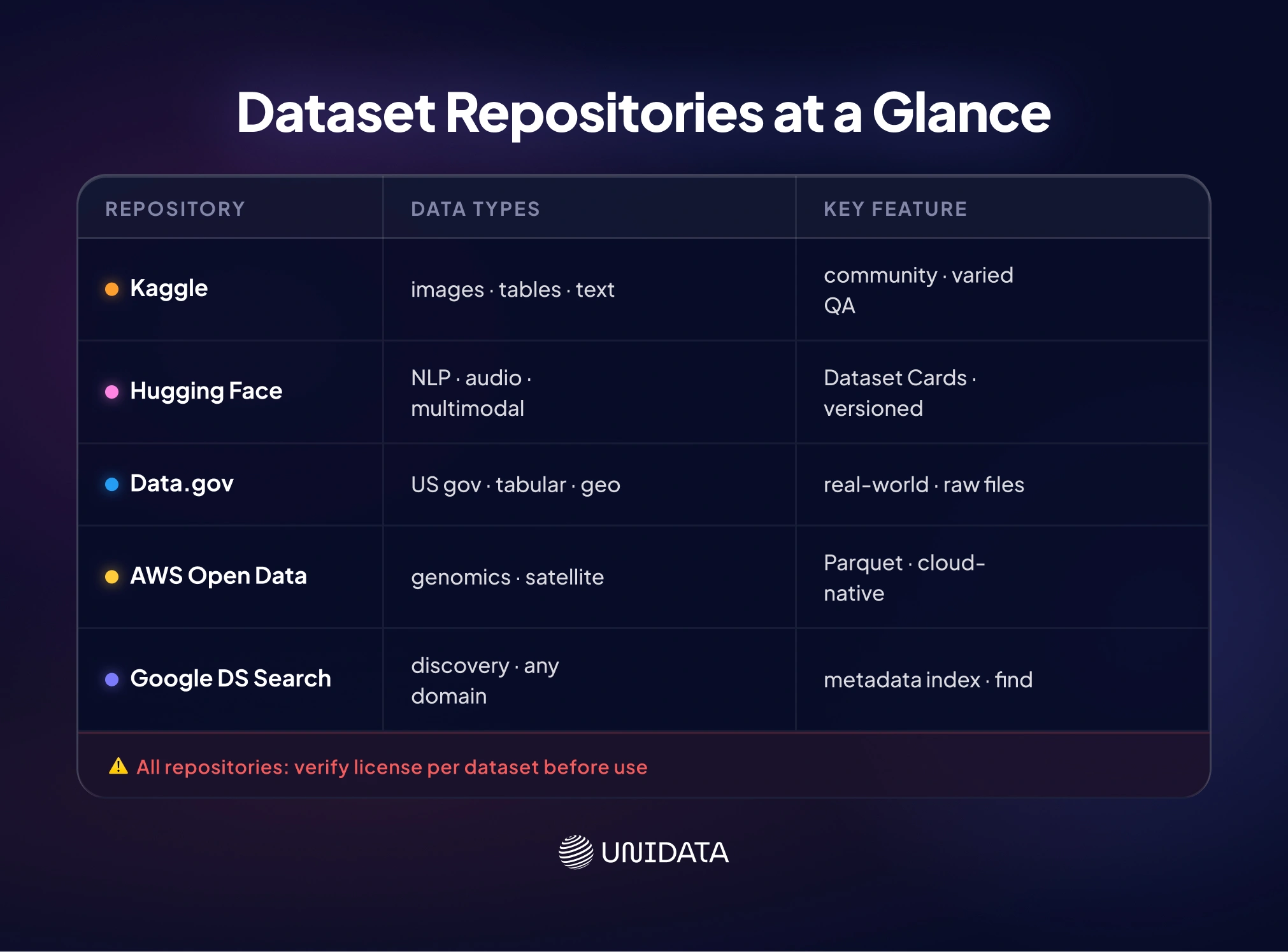
Most teams begin with open dataset portals. Kaggle, Hugging Face Datasets, Data.gov, AWS Open Data, and Google Dataset Search are common starting points. They differ in scope, content type, and licensing. Some are better for fast experiments. Others are better for long runs and cloud-scale work.
A comparison of these repositories is below.
Other common sources include the UCI Machine Learning Repository (classic, multi-domain datasets) and OpenML (community-shared ML datasets). Paid and private data can also come from marketplaces and APIs, such as social media feeds or financial data providers. That route can be the right move when public data cannot match your needs. It also adds work. You need to check rights, pricing, refresh terms, and what you can do with derived outputs.
For many starter projects and public benchmarks, open repositories are a fast way to get moving. They let you test ideas, validate task fit, and learn what “good data” looks like in your domain before you invest in collection.
Specialized Image Datasets: Facial Recognition
Facial recognition needs labeled image sets of human faces. Several well-known public datasets are used in research and prototyping. Each dataset makes tradeoffs. Some focus on identity labels. Others focus on attributes, landmarks, or detection in crowded scenes.
Common options include these.
- Labeled Faces in the Wild (LFW): A classic benchmark of face images collected from the web and labeled by identity. It is often used to test recognition under unconstrained conditions.
- CelebA (CelebFaces): Celebrity face images with attribute labels such as smiling or glasses. It is used for both recognition and attribute prediction.
- UMDFaces: Face crops with identity labels. It also includes facial landmark info, which helps with alignment and downstream modeling.
- VGGFace2: A large face ID dataset used to train and test face embedding models. It is often used when you need a strong face embedding baseline.
- PubFig, YouTube Faces, WiderFace, and others: Extra datasets for detection and recognition under varied conditions, including group scenes and video frames. Some also include labels tied to age and gender presentation.
All these datasets come with labels, such as identity, landmarks, or expressions. Many are free to download, but licensing varies. Some datasets limit use to research. Others limit re-sharing. Treat the license as part of the dataset, not a footnote.
Face data also raises privacy and ethics issues. If faces are identifiable, the data is sensitive. You should confirm how images were collected, what consent or permission exists, and whether the dataset was built in ways that match your intended use. Bias is another risk. If a dataset overrepresents some groups and underrepresents others, the system can end up with uneven error rates. To reduce this, prefer datasets with diverse coverage, and record what “diverse” means in your context.
A simple habit helps: keep a short datasheet for each dataset you use. Write down where it came from, what labels exist, what caveats you found, and what the license allows. That way, you are not trying to recreate provenance from memory months later.
Public face datasets can be useful for learning and benchmarking. You still need to cross-check licensing and coverage. You also need to confirm that images were not collected in ways that break terms of use. Responsible use, paired with clear notes, helps you build systems that are easier to defend and safer to deploy.
Specialized NLP Datasets: Sentiment Analysis
Sentiment analysis needs text labeled with emotion or polarity, such as positive, negative, or neutral. Public NLP datasets are easy to find. Picking the right one is the harder step. Domain, style, and label rules can change model behavior more than many teams expect.
Common dataset families include the following.
Movie and product reviews: Review datasets are classic training material for sentiment. They often contain longer, complete sentences. Many benchmarks focus on binary sentiment. Others include fine-grained labels at the phrase level. Similar corpora exist for product and restaurant reviews. They are useful when your target task is customer feedback.
Social media text: Tweet datasets and shared academic tasks are common when you need short, noisy language. They include slang, abbreviations, hashtags, and sarcasm. Teams also collect data from platforms like Twitter, Reddit, or Facebook. When you do that, check platform rules and usage permissions.
Other domains: Some datasets target finance, support, surveys, and travel. These often work better when you deploy into the same domain, because tone and vocab shift across industries. Hugging Face also hosts many sentiment datasets across languages and topics. That makes it easier to find something close to your use case.
A common question is, “What are the best datasets for sentiment analysis?” It depends on context. For English sentiment, a classic review dataset can be a strong baseline. For domain-specific sentiment, choose a dataset that matches the domain, like hotel reviews for travel or product reviews for retail. Many datasets also ship with standard train and test splits, which helps benchmarking. You can often find these resources through Kaggle, Hugging Face, government portals, and dataset search tools. If a dataset is hosted in multiple places, pick the host that provides the clearest docs and the simplest access path.
Whatever you choose, treat privacy as part of dataset selection. User-generated text can contain personal details, even when the dataset looks harmless at first glance. Follow text usage policies, and remove sensitive content when you do not need it for the task.
Best Practices for Dataset Evaluation
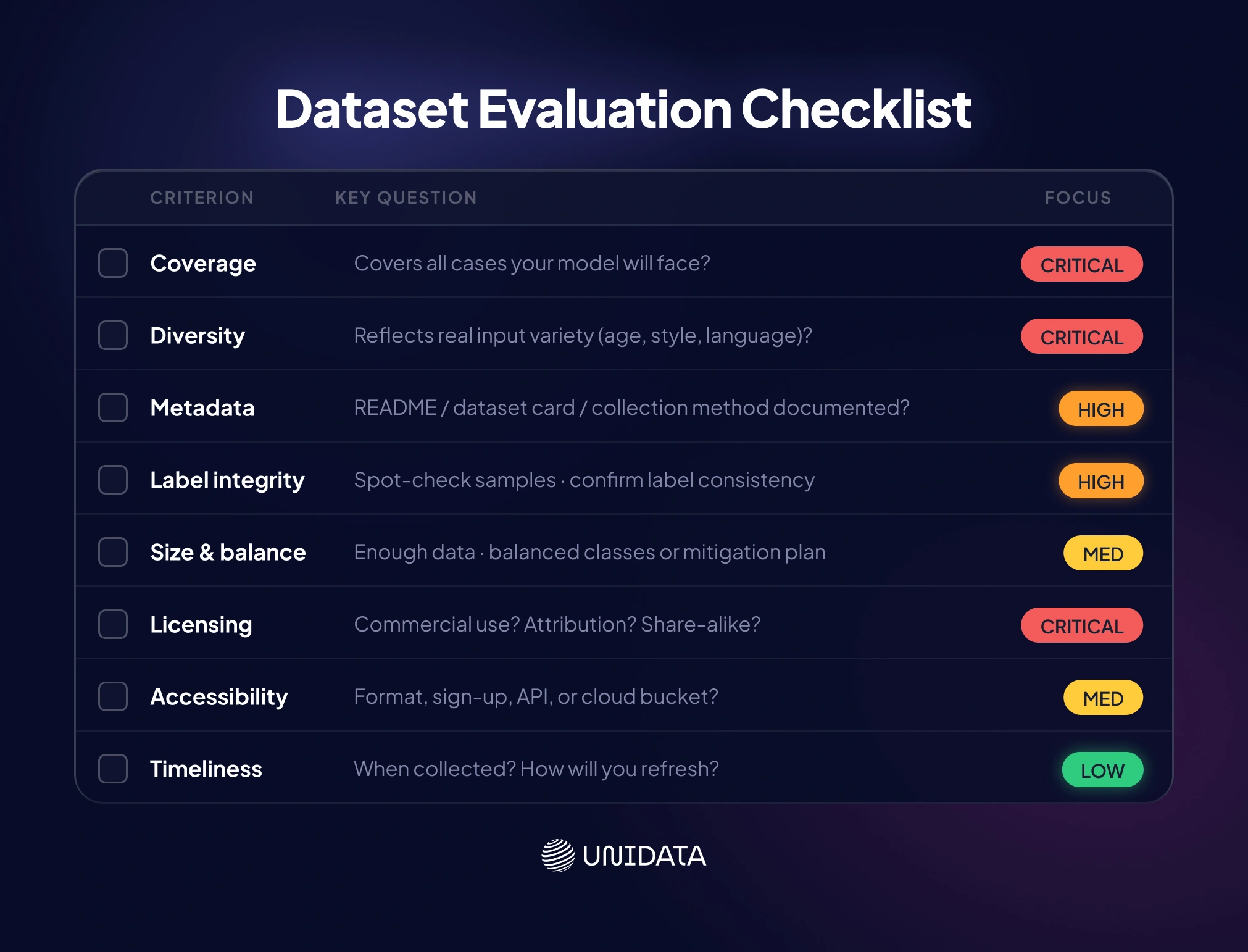
Choosing a dataset is not just about finding something that downloads. Quality matters. Before you train or evaluate a model, run a quick review of the dataset against a few core checks. These checks save time later. They surface problems while the fix is still cheap.
- Coverage (completeness): Does the dataset cover the range of cases your model will face? A sentiment dataset should include examples for each label you plan to predict. If neutral or irrelevant text shows up in production, include it here too. A face recognition dataset should cover the identities or face types you care about. Check for missing values, empty categories, and obvious blind spots. If key cases are missing, the model will fail when it meets those cases in the real world.
- Diversity (real-world match): The data should reflect the variety of real inputs. For images, that means variation in age, lighting, backgrounds, camera angles, and groups of people. For text, it means variation in speakers, topics, dialects, and writing styles. Bias can enter when certain groups or styles show up too rarely. Inspect class balance. If you can measure group coverage, do it. If you see strong skew, consider combining datasets or adjusting sampling so the model does not learn a narrow view of the world.
- Metadata quality (docs): Good datasets come with docs that explain what the dataset is and how it was built. Look for purpose, collection method, labeling rules, and schema details such as column meanings and units. When docs are missing, you end up guessing. In practice, prefer datasets with a README, a dataset card, or a paper that explains collection and labeling. Note the source and collection period. Strong metadata makes it easier to judge fit for your use case.
- Label integrity: For labeled data, label quality is everything. Errors and inconsistency will show up in model mistakes. Spot-check samples and confirm labels make sense. For sentiment, watch for polarity flips and inconsistent labels. For images, check for misaligned boxes, missing labels, or duplicate identities. If the dataset includes any quality signals, read them. If not, assume you need your own audit.
- Size and balance: Check whether the dataset is large enough and balanced for the model you plan to train. Very small datasets can overfit. Highly imbalanced datasets can push the model toward the dominant class. When you add data, aim for balanced classes when possible. If balance is not realistic, plan mitigation such as resampling, loss weighting, or careful thresholding. For niche tasks, even a small curated dataset can help. If so, document that limit and treat results as directional.
- Licensing and terms: Always read the legal terms. Some data is public domain. Some uses Creative Commons licenses that require attribution or restrict commercial use. Some datasets forbid re-sharing or require you to keep notices intact. Public web data can also be bound by terms of use. Read the dataset license, not just a repo summary. If you plan commercial use, choose permissive licenses or obtain explicit rights.
- Accessibility (technical): Make sure format and access fit your pipeline. CSV, JSON, and standard image formats are easy. Odd formats can waste days. Check whether you need to sign up, use an API, or work through a cloud bucket. For large assets, cloud-hosted copies can save time and storage.
- Update frequency and timeliness: Data can go stale. Time-sensitive domains often need recent data or regular updates. Note when the data was collected. If you are building a long-lived product, decide how you will refresh training data over time.
These checks map to everyday ML risk. If you can explain why a dataset is complete enough, varied enough, and legally safe enough, you are already ahead of many teams.
Legal, Ethical, and Compliance Considerations
When you source data, you inherit duties. Legal and ethical issues shape what you can ship and what users will trust. Treat dataset choice with the same care you give model choice.
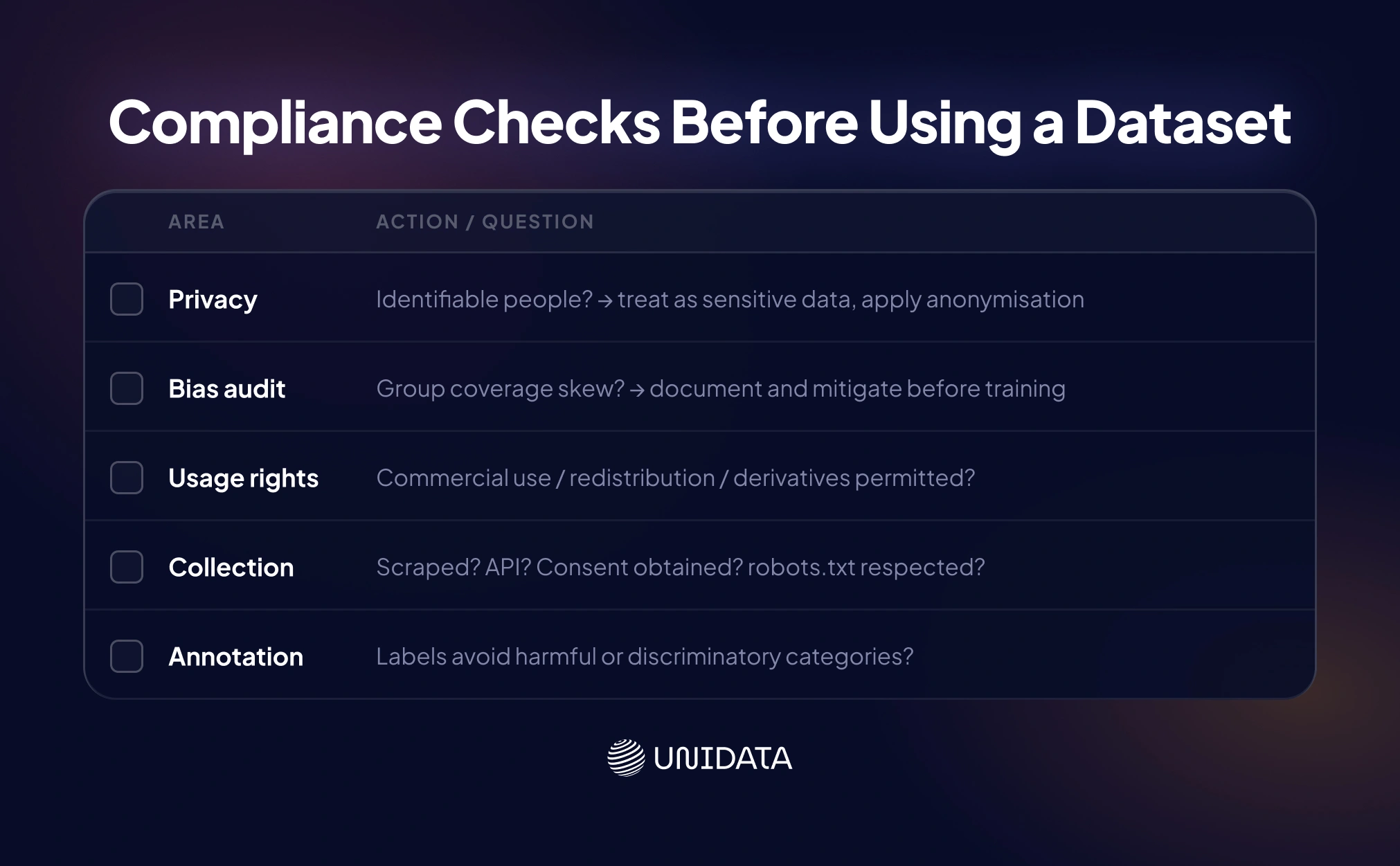
- Privacy and regulation: Personal or sensitive data must follow the laws and rules that apply to your product. If your dataset includes identifiable people, treat it as sensitive by default. If you use user-generated content, confirm it is allowed for analysis and handle personal details with care. If a public dataset contains names or identifiers, remove or protect them unless you truly need them.
- Bias and fairness: Biased training data yields biased models. If some groups show up less, models can work worse for them. That is not just a technical issue. It can become a user harm issue. Audit your dataset for skew, disclose known limits, and collect or source more data when coverage is weak. Keep it clear. Write down expected failure modes in plain language.
- Usage rights and IP: Even public data can carry copyright or contract limits. News text, images, and platform exports often have rules. Check whether the dataset allows reuse, re-sharing, and derived work. If you collect data through APIs, follow the developer terms. When you license paid data, negotiate scope. Clarify allowed uses, ownership of derived outputs, and any place or time limits.
- Terms of use compliance: If you extract data from websites, respect the site’s rules. Robots.txt and terms of service matter. “It was public” is not a safety check. If you cannot validate collection compliance, treat the dataset as risky and look for a cleaner source.
- Ethical annotation: Sensitive labels need care. If you label faces, groups, or personal posts, make sure guidelines avoid harmful categories and reduce the chance of offensive labeling. Train labelers, and keep labels limited to what the task needs. Sloppy labeling can add bias even when the raw data is broad.
In general, treat data work as part of governance. If your data process is documented and auditable, you can answer hard questions with evidence. If it is not, you end up with guesswork.
Summary
Sourcing data is a strategic task in AI and ML development. Start with well-known repositories to discover what exists. For tasks like face recognition or sentiment analysis, switch to domain-specific datasets that match your target conditions. Evaluate datasets carefully. Check coverage, diversity, label quality, licensing, and usability. Do not ignore compliance. Privacy, bias, and terms of use can break a project even when the model is strong.
Well-sourced, well-documented data sets your project up for more reliable training, cleaner evaluation, and safer deployment.
Frequently Asked Questions (FAQ)
Kaggle and Hugging Face Datasets are usually the fastest starting points for free machine learning datasets, especially for common ML tasks like classification, text classification, and computer vision. For public sector and large-scale data, check Data.gov and the AWS Open Data Registry. If you do not know where a dataset is hosted, use Google Dataset Search to discover relevant datasets across the web, then follow the original source page for documentation, licensing, and updates.
A dataset is “good enough” when it has reliable labels, clear documentation, and enough coverage of the data points your machine learning model will see in production. Start by sampling raw data, checking missing values, label consistency, and class balance. Confirm the dataset matches your input data format and your feature engineering plan. If you are using supervised learning, label quality matters more than dataset size. If you are training deep learning models, you usually need more training data and more diverse feature values to reduce overfitting.
Sometimes yes, sometimes no. Kaggle datasets come under different licenses, so commercial use depends on the specific dataset’s terms. Before you apply a dataset to training data for a production system, confirm whether commercial use is allowed, whether redistribution is restricted, and whether you must provide attribution. Also check if the dataset includes personal data or sensitive text data, because that can add compliance and privacy requirements even when the dataset is “public.”
Look for explicit permission for commercial use, derivative works, and redistribution. Confirm whether the license requires attribution, enforces share-alike rules, or limits usage to research only. For machine learning pipelines, licensing affects how you store, version, share, and retrain on the dataset over time. If terms are unclear, treat the dataset as risky for production machine learning, and prefer a dataset with clear licensing and documented usage rights.