
You're trying to pick a robot — or explain to a stakeholder why one type fits and another doesn't — and the word "robot" keeps covering everything from a caged welding arm to a bipedal machine learning to fold laundry. Those share almost no engineering, cost, or data requirements. The confusion isn't yours: "robot" is really three different classification questions wearing one name.
This guide untangles them. It covers the three lenses engineers and buyers actually use — mechanical structure, autonomy, and application — so you can place any robot, compare options on the axis that matters for your decision, and figure out which type your problem really needs.
What Is a Robot? Foundations of Classification
The fastest way to misjudge a robot project is to argue about whether something "counts" as a robot. A thermostat senses and acts but decides nothing; a CNC machine is programmable but blind. A working definition draws the line at three abilities held together: a robot senses its environment, decides what to do, and acts on the physical world with some degree of independence. ISO 8373:2021, the international robotics vocabulary, formalizes this for industrial machines as an automatically controlled, reprogrammable, multipurpose manipulator programmable in three or more axes. [2]
Three building blocks separate one robot from the next. Sensors feed perception — cameras, LiDAR, force sensors. Actuators turn decisions into motion — motors, hydraulics. And degrees of freedom, the number of independent ways the robot can move, set which tasks are even reachable. Hold those three in mind, because every classification lens below is a different question about them: how the body moves (structure), how the decisions get made (autonomy), and what job it does (application).
Industrial Robot Types by Mechanical Structure
When an automation engineer specs a cell, the first decision is kinematic: what shape of motion does the task need? That question defines the industrial robot — a fixed-base or platform-mounted, programmable manipulator built to repeat physical tasks at production scale. The category is large and still growing: more than 4.6 million industrial robots were in operation worldwide in 2024, the highest stock on record. [1]
Engineers classify these arms by mechanical structure — the arrangement of joints and axes that sets reach, speed, payload, and precision. Six configurations cover almost everything on a factory floor: articulated, SCARA, Cartesian (gantry), cylindrical, polar/spherical, and delta. The articulated arm is the most recognizable and most deployed, because its rotary axes — typically six — let it reach almost any position and orientation in its envelope. [4] The two subsections below group the six by how they trade flexibility against speed and precision.
Articulated, SCARA, and Cartesian Robots
These three cover the workhorse end of manufacturing, and they sort cleanly by motion type. The articulated robot uses rotary joints — typically six — which is why it dominates welding, painting, and machine tending, tasks that need the tool to approach from many angles. [3] Flexibility is its strength and its cost: more axes mean more to program and calibrate.
The SCARA robot (Selective Compliance Assembly Robot Arm) trades axes for speed. With four axes it is rigid vertically but compliant in the horizontal plane, which makes it fast and accurate for flat-plane assembly and pick-and-place. [4] The Cartesian robot — the gantry is one of its configurations — moves along three linear axes like a 3D printer's head, giving simple, highly repeatable motion across a large rectangular envelope — a fit for 3D printing, palletizing, and gantry assembly. [3]
The trade-off runs one direction: articulated arms buy reach and dexterity with complexity, while SCARA and Cartesian designs buy speed and repeatability by giving up degrees of freedom.
| Type | Axes | Best-fit task | Trade-off |
|---|---|---|---|
| Articulated | 6 (rotary) | Welding, machine tending | Most flexible, most complex |
| SCARA | 4 | Planar assembly, pick-and-place | Fast, limited vertical reach |
| Cartesian / gantry | 3 (linear) | 3D printing, palletizing | Very repeatable, large footprint |
Delta, Cylindrical, and Polar Robots
The remaining configurations are specialists. The delta robot looks nothing like an arm: three lightweight arms hang from an overhead base and meet at a single platform, a parallel structure that moves a small end-effector extremely fast — well over 100 picks per minute on a moving belt.That speed comes with low payload and short reach, which is exactly why delta robots own high-speed sorting and packaging in food and pharmaceutical lines.
The cylindrical robot pairs a rotating base with a linear arm, sweeping out a cylindrical work envelope. Its compact footprint suits assembly and machine tending in tight spaces. The closely related polar (spherical) robot adds a second rotary axis for a spherical reach — an older configuration now less common than the articulated arm.
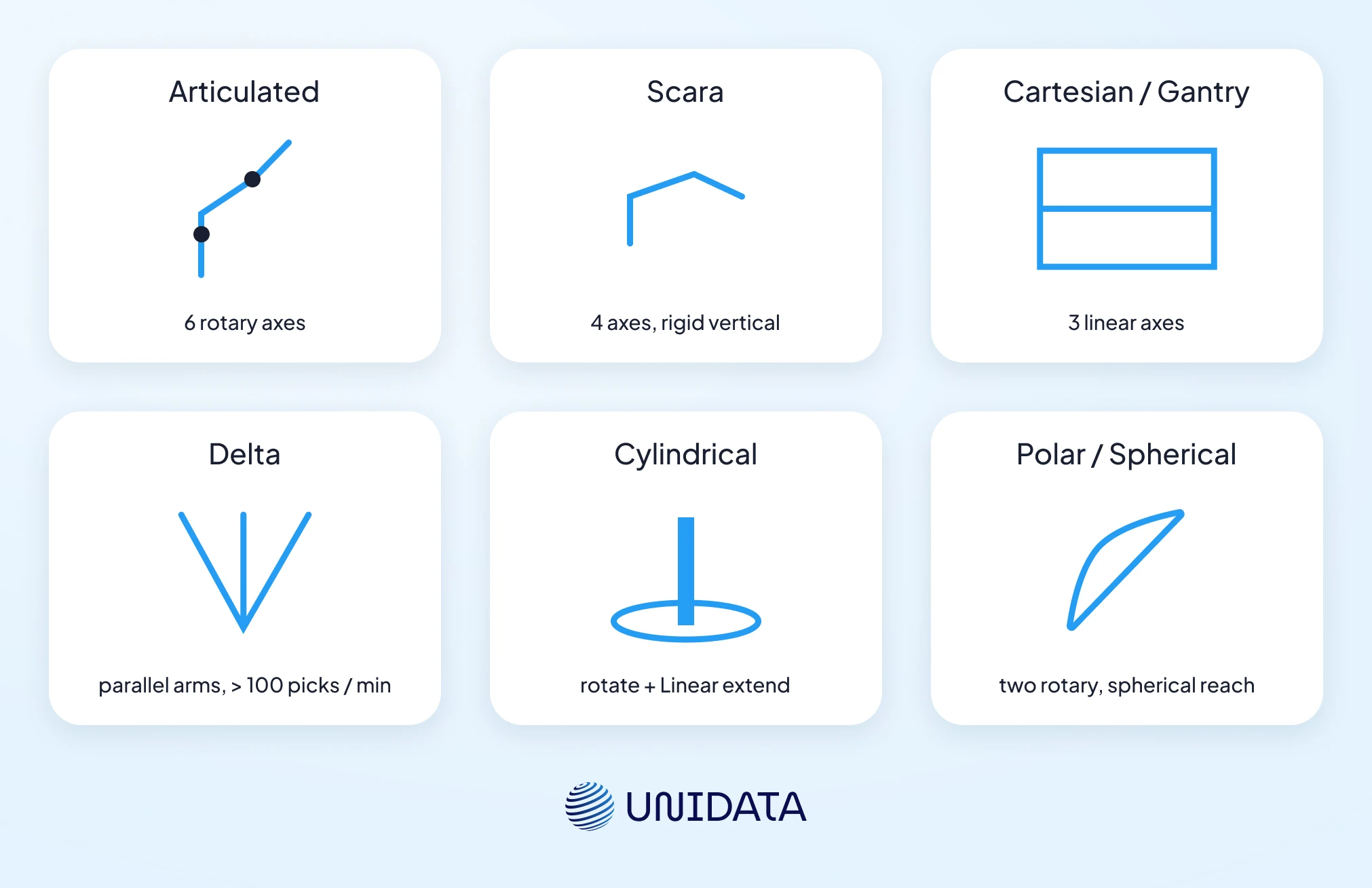
These designs trade generality for a single strength: speed, footprint, or reach. The articulated arm stays the default; the specialists earn their place only when one dimension of the task dominates everything else.
Robot Classification by Autonomy and Intelligence
Mechanical structure tells you nothing about how smart a robot is — and for ML and data teams, intelligence is the axis that drives cost and scope. A six-axis arm can be a simple position-repeater or an adaptive system that re-grasps an unfamiliar object. Same hardware, a completely different software and data problem.
Autonomy reads best as a spectrum, not a yes/no label. At one end, a robot runs fixed, pre-programmed motions. At the other, it perceives a changing environment and chooses its own actions. NIST's Autonomy Levels for Unmanned Systems (ALFUS) framework captures this with a graded scale, rating a system by how much human interacнtion it needs, how complex its missions are, and how difficult its environment is. [5] Artificial intelligence and machine learning are a primary driver — though not the only one — of moving a robot up that scale — from repeating a path to handling situations its programmers never explicitly coded. The subsections cover the levels themselves, then the AI stack that enables them.
Levels of Autonomy: From Remote-Controlled to Fully Autonomous
It helps to anchor the spectrum with real machines. At the manual end sits the teleoperated robot: a human drives every motion remotely, and the machine supplies reach, strength, or access a person lacks. A bomb-disposal robot is the classic case — all judgment stays with the operator. One step up, supervised and semi-autonomous robots handle routine action on their own but escalate to a human for decisions outside their training.
At the far end, a fully autonomous robot perceives, plans, and acts without per-task human input — a warehouse robot that maps its own route and reroutes around a spill needs no joystick. NIST's ALFUS model grades these positions by mission complexity, environmental difficulty, and required operator interaction rather than by a single number. [5]
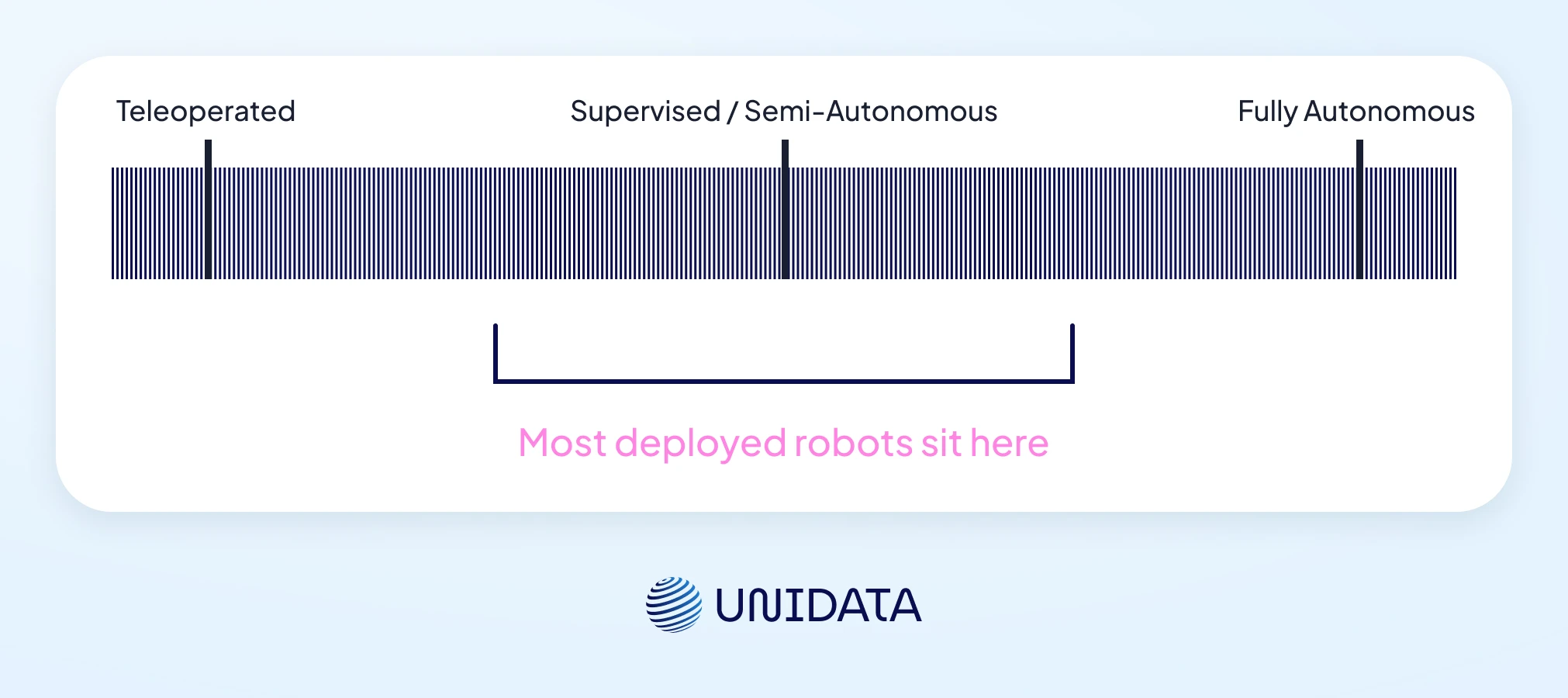
Most deployed robots today sit in the middle of the scale, not at the autonomous end. The honest framing for any project is not "is it autonomous?" but "how much human supervision does it still need, and in which situations?" That answer drives both staffing and data requirements.
AI, Machine Learning, and Computer Vision in Robots
This is the section where data quality decides whether the robot works. Autonomy is implemented as a perceive-decide-act loop, and each stage relies on a different part of the technology stack. Perception comes from sensors and computer vision: cameras, LiDAR, and IMUs feed models that detect objects, estimate pose, and build a map. Decision-making is where machine learning earns its place — a learned policy maps what the robot sees to what it should do next, generalizing to situations a rule-based controller would miss. Broader artificial intelligence adds planning and, in newer service and humanoid robots, natural-language interaction.
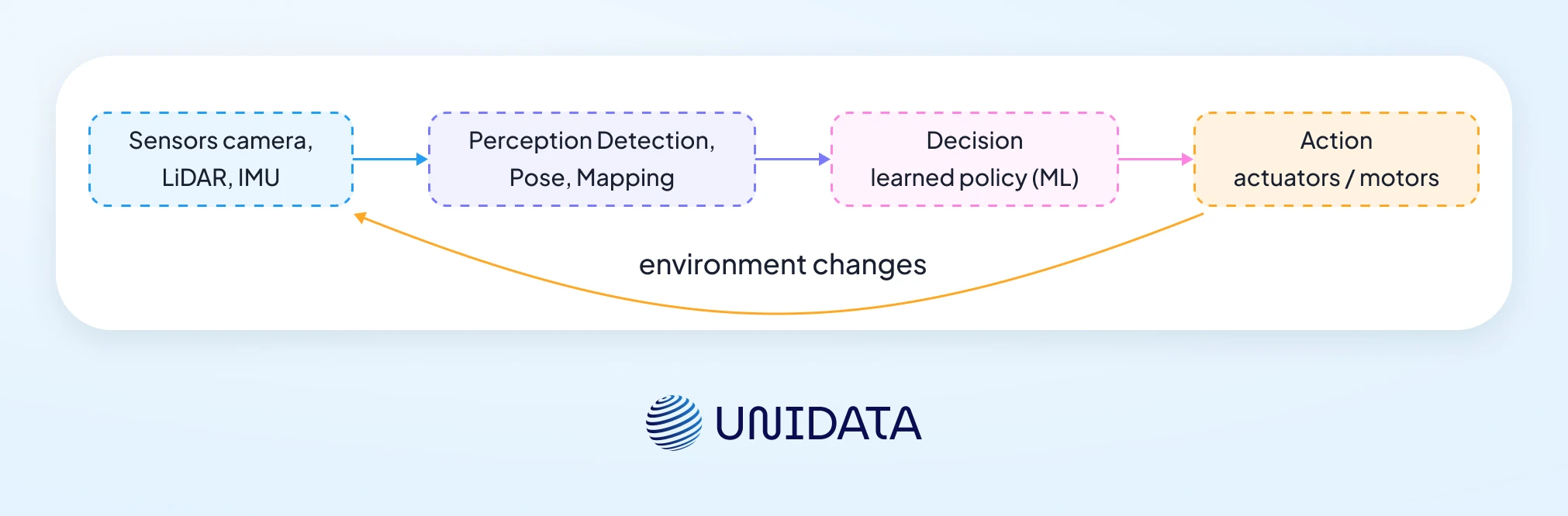
The dependency every team underestimates is data. A perception model is only as good as the labeled examples behind it, and the volume you need scales with the diversity of situations the robot will face. Policies trained on diverse, well-labeled real-world data generalize; policies trained on thin or noisy data fail at exactly the edge cases deployment exposes. For vision-guided robots, computer vision and learned control are not optional add-ons — they are the line between an automated machine and an intelligent one. Not every robot depends on vision, though: some navigate with LiDAR-based SLAM or act on force-and torque-sensing instead.
Mobile and Collaborative Robot Types
The robots growing fastest in commercial use aren't bolted to a factory floor — they move through warehouses, hospitals, and offices, or work directly alongside people. That shift breaks the old assumption that robots need cages and fixed positions. Sales of professional service robots reached roughly 200,000 units in 2024, led by transport and logistics machines. [7]
Two axes organize this category. The mobility axis runs from fixed to freely navigating, and splits into automated guided vehicles (AGVs) and autonomous mobile robots (AMRs). The human-proximity axis runs from isolated to shared-space, covering collaborative robots (cobots) built to work next to people and humanoid robots aiming at general-purpose tasks. The subsections below take the most-confused pair on each axis: AMR versus AGV, then cobot versus humanoid.
AMRs vs. AGVs: Key Differences
This is the single most-confused distinction in mobile robotics, and it comes down to one thing: how the robot knows where to go. An automated guided vehicle (AGV) follows a fixed, pre-installed path — magnetic tape, embedded wire, or floor markers. It is reliable and cheap to run, but it cannot adapt: put a pallet in its lane and it stops and waits for a human.
An autonomous mobile robot (AMR) carries its own map. Using LiDAR and cameras with simultaneous localization and mapping (SLAM), it builds and updates a model of the space, then plans and replans its route around obstacles in real time. Change the warehouse layout and an AMR adjusts on its own; an AGV needs its guide-path re-laid.
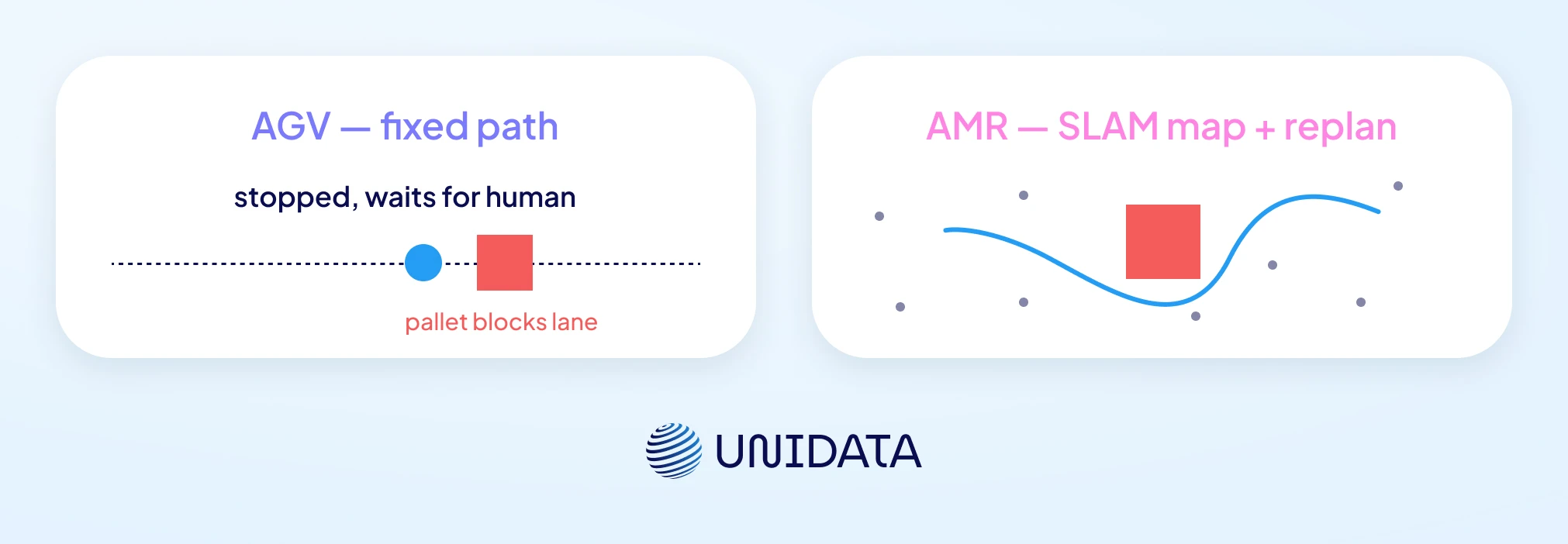
The catch for AMR teams is data: dynamic navigation only works if the robot has trained on realistic spatial layouts. Real-world spatial capture matters here — actual room shapes, furniture placement, and obstacle patterns rather than idealized maps, which is why we digitize real indoor environments instead of generating them.
Cobots and Humanoid Robots
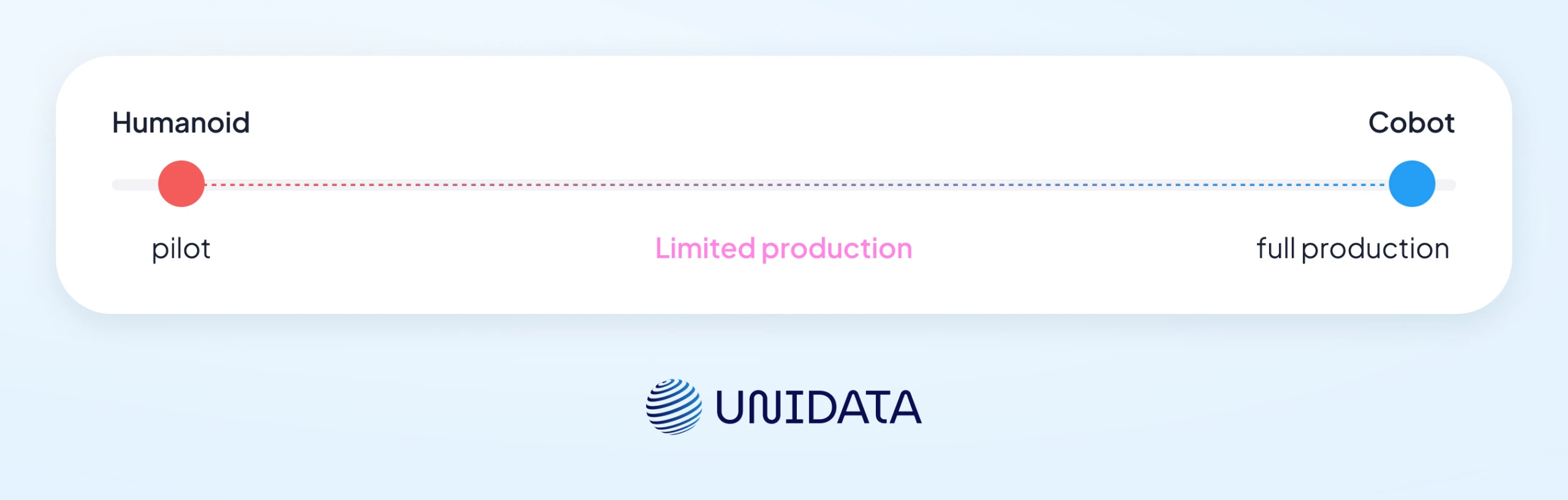
Both share workspace with people, but they sit at very different maturity levels. A collaborative robot (cobot) is a production-proven, safety-rated arm built to operate without a cage after the shared workspace passes a safety risk assessment. It works because of power and force limiting: under ISO/TS 15066, contact forces stay below defined biomechanical injury limits, and most implementations add joint-torque sensing that halts the arm on unexpected contact. [6] Cobots are common in assembly, machine tending, and quality inspection where a robot and a person share a bench.
The humanoid robot is the opposite case — enormous attention, early maturity. Bipedal, human-form machines aim at general-purpose work: the flexibility to do many tasks in spaces already built for people. Most models remain in pilot or limited early production despite heavy investment, because general-purpose behavior demands far more from artificial intelligence than a cobot's repeatable task does. A cobot needs to do one job safely; a humanoid needs to handle open-ended environments, which is a much harder data and learning problem.
Robot Types by Application and Industry
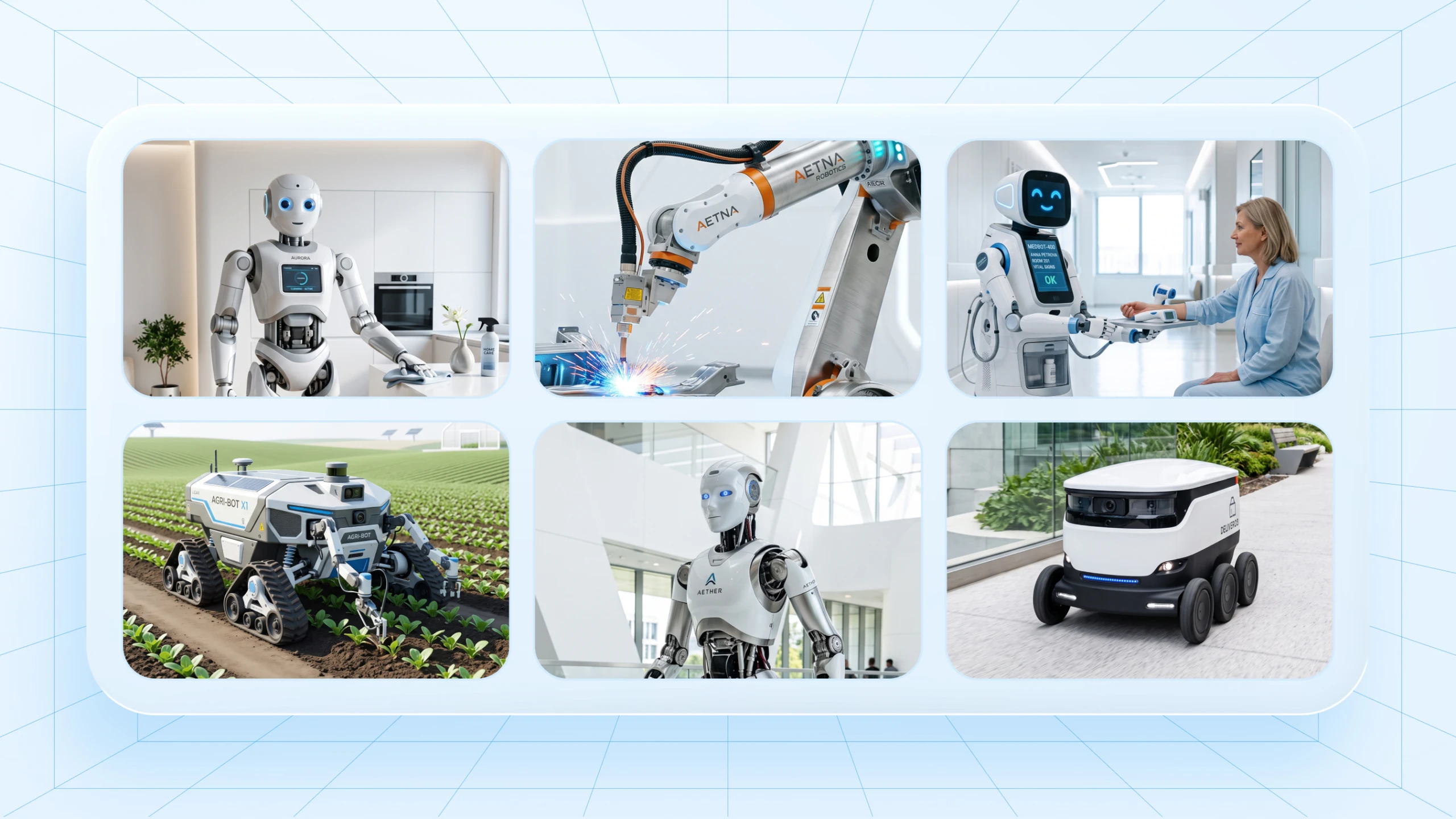
Buyers rarely shop for "an articulated robot at autonomy level three." They start from a problem — harvest this crop, deliver these meals, inspect this pipe — which is why the third classification lens is application domain: what the robot is for, regardless of how it's built or how autonomous it is. ISO 8373 draws the key line here. A service robot performs useful tasks for humans or equipment,excluding industrial automation — the delivery robot in a hotel lobby and the welding arm in a plant can share the same articulated-arm structure and actuators, yet fall in different categories by use: one serves people directly, the other runs a production process behind a fence. [2]
Robot Arm Training: A Complete Guide
Learn more
Application is the broadest lens because it has the most categories: service, medical, agricultural, space, military, rescue, aquatic, plus boundary cases like exoskeletons and nanorobots. The two subsections split them into the human-facing service and medical robots most readers encounter, then the field and frontier robots that work where people can't.
Service, Social, and Medical Robots
Service robots are the ones most people meet directly. In offices, airports, hotels, and homes they deliver items, clean floors, and guide visitors; transport and logistics machines alone made up the largest share of professional service robot sales in 2024. [7] The economics are simple — they take on repetitive, low-judgment work in spaces built for humans.
Medical robots are the higher-stakes branch, and the one most relevant to data-driven healthcare. Teleoperated surgical systems are the clearest example. The da Vinci platform translates a surgeon's hand motions into instrument movements, with newer systems reaching sub-millimeter average accuracy [8] — the precision that makes the smaller incisions of minimally invasive surgery possible. Sales of medical robots jumped sharply in 2024 as hospitals adopted surgical and assistive systems. [7] Robotic prosthetics and rehabilitation systems extend the same idea — precision and repeatability applied to the body.
Social robots are a newer, still-small branch: AI-driven companions used in eldercare, therapy, and education, designed for interaction rather than physical work. They sit under the service-robot umbrella but lean almost entirely on conversational AI, which keeps most of them experimental rather than essential.
Field Robots: Agricultural, Space, Aquatic, Rescue, and Military
Field robots earn their keep where the environment is too costly, remote, or dangerous for people — and breadth matters more than depth here. Agricultural robots automate harvesting, weeding, and crop monitoring, increasingly with computer vision that tells a ripe fruit from an unripe one. Space robots — planetary rovers, orbital servicers, and station manipulators — operate where no human can intervene in real time, so they blend teleoperation with on-board autonomy to absorb communication delays.
Aquatic robots, including remotely operated and autonomous underwater vehicles, inspect pipelines, hulls, and offshore structures. Rescue robots enter collapsed buildings and disaster zones to search for survivors, and military robots handle reconnaissance and explosive disposal at a safe distance from operators.
Two boundary cases stretch the definition. An exoskeleton is wearable augmentation — it has actuators and sensors but no autonomy of its own, amplifying a human rather than replacing one. A nanorobot operates at sub-millimeter scale, mostly in research toward targeted drug delivery; today it is more a direction than a deployed product. Both are worth knowing precisely because they sit at the edges of what "robot" means.
Choosing a Robot Type and What's Next
The practical takeaway is that "what type of robot" is the wrong first question. The right one is "which lens does my decision turn on?" If you are an engineer selecting hardware, mechanical structure decides reach, speed, and payload. If you are a team scoping an AI or ML investment, autonomy level decides how much perception, learning, and supervision you are signing up for. If you are a buyer solving an operational problem, application domain narrows the field fastest. Most real decisions use all three, in that order.
| Your role / goal | Lens that decides | Question to answer |
|---|---|---|
| Engineer selecting hardware | Mechanical structure | What motion, reach, payload, speed? |
| ML / AI team scoping investment | Autonomy and intelligence | How much perception, learning, supervision? |
| Buyer solving an operational problem | Application domain | What job, in what environment? |
Two trends are reshaping the taxonomy. Rising autonomy is blurring old categories — AGVs gain AMR-like navigation, cobots gain vision-driven adaptation — as AI moves more robots up the scale. And humanoid robots, still early, are the bet that one general-purpose body can replace many specialized ones. Whether that bet pays off depends less on mechanics than on training data: Apple's EgoDex released 829 hours of egocentric manipulation video with paired 3D hand tracking across 194 tabletop tasks, [9] and NVIDIA's EgoScale trained on more than 20,000 hours of action-labeled egocentric human video and found a log-linear scaling law between data volume and model performance, lifting manipulation success 54% over a no-pretraining baseline. [10] Real-world data is the lever.
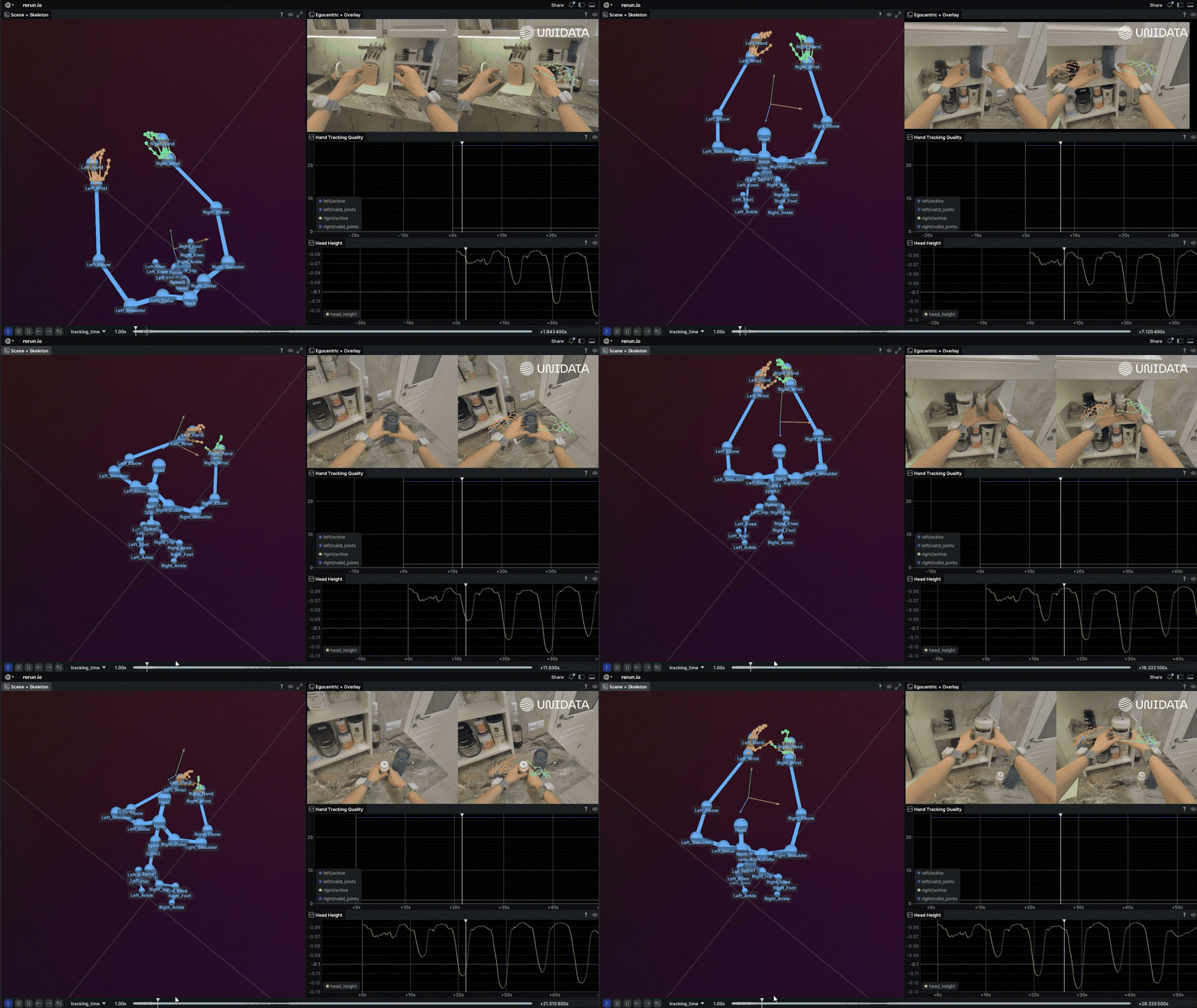
The work behind egocentric video and 3D environment capture is what closes that gap — scripted scenarios that now run into the thousands (12,000 in one current pipeline), captured with a Pico 4 Ultra headset and motion tracker across kitchens, offices, and warehouses, instead of idealized footage.
Conclusion
Structure, autonomy, and application answer three different questions: what a machine can physically do, how much supervision it still needs, and whether it fits the job and the environment you have. Those boundaries keep softening as autonomy rises, which makes the lens you choose more useful than the label you land on.
If you are training perception or manipulation models and need egocentric video or 3D environment capture built for robot learning — start here.
- Data Collection
- AI Data Collection
- Crowdsourcing
- Biometric Data
- Synthetic Data

Frequently Asked Questions (FAQ)
By installed base, the articulated industrial robot is the most common — its six rotary axes handle welding, assembly, and material handling across manufacturing, and more than 4.6 million industrial robots are in operation worldwide. In service settings, transport and logistics robots lead by sales, but factory arms still dominate the global robot population.
The four mechanical configurations most used in manufacturing are articulated (six-axis) arms, SCARA robots, Cartesian (gantry) robots, and delta robots. Articulated arms offer the most flexibility, SCARA and delta robots prioritize speed for assembly and high-speed picking, and Cartesian robots give precise, repeatable motion over large rectangular work areas.
An AGV (automated guided vehicle) follows a fixed path — wire, tape, or markers — and stops when something blocks it. An AMR (autonomous mobile robot) uses LiDAR, cameras, and SLAM to build its own map and reroute around obstacles in real time. AMRs adapt to layout changes; AGVs need their guide-paths re-laid.
A cobot (collaborative robot) is a safety-rated arm built to work next to people without a cage, using power and force limiting to keep contact below injury thresholds. A regular industrial robot is faster and stronger but usually fenced off for safety. The defining difference is shared workspace, not just the hardware itself.
Mechanical-structure classification groups robots by their joints and axes of motion. The main types are articulated (rotary joints), SCARA (selective compliance), Cartesian (linear axes), cylindrical, polar/spherical, and delta (parallel). Each arrangement sets the robot’s reach, speed, payload, and precision, so engineers pick the structure that matches the task’s motion requirements.
A robot acts on the physical world through sensors and actuators; an AI system processes information and makes decisions, often with no body at all. Modern robots use AI as their decision-making layer, but AI can run purely in software. The robot is the embodiment; AI is one possible brain inside it.
Machine learning lets a robot handle situations its programmers never explicitly coded. Instead of fixed rules, a learned policy maps sensor input to actions and generalizes to new objects and environments. This is what moves a robot up the autonomy scale — from repeating a fixed path to adapting its behavior in real time.
A few are, but most remain in pilot or limited early production. Several makers run factory and warehouse trials, yet shipped volumes are still small compared with industrial arms or mobile robots. General-purpose humanoid behavior demands far more training data and AI maturity than today’s deployments have reached.
Service robots include hotel and hospital delivery robots, floor-cleaning robots, airport guide robots, and warehouse logistics machines. Medical examples are teleoperated surgical systems and rehabilitation robots, and social robots used in eldercare and education also count. By ISO’s definition, a service robot does useful work for people outside industrial manufacturing.
“Most advanced” depends on the measure. For autonomy and AI integration, humanoid and advanced mobile robots push hardest, combining vision, learned control, and planning. For precision, teleoperated surgical systems reach millimeter-scale accuracy. There is no single “most advanced” robot — different types lead on different dimensions of capability.
Nanorobots are sub-millimeter machines studied mainly for medicine — targeted drug delivery, microsurgery, and diagnostics inside the body. Most work remains experimental rather than clinical. The term stretches the usual definition of a robot, since these devices rarely sense and decide independently the way larger robots do.
Further Reading & References:
- [1] International Federation of Robotics — "World Robotics 2025: Global Robot Demand in Factories Doubles Over 10 Years" — IFR — 2025
- [2] International Organization for Standardization — "ISO 8373:2021 Robotics — Vocabulary" — ISO — 2021
- [3] KUKA — "From Delta to Scara: Overview of Industrial Robot Types" — KUKA AG — 2022
- [4] Control Design — "A Look at Articulated, SCARA, Cartesian and Delta Robots" — Control Design / Endeavor Business Media
- [5] National Institute of Standards and Technology (Huang, H.-M.) — "Autonomy Levels for Unmanned Systems (ALFUS) Framework" — NIST
- [6] International Organization for Standardization — "ISO/TS 15066:2016 Robots and Robotic Devices — Collaborative Robots" — ISO — 2016
- [7] International Federation of Robotics — "World Robotics 2025: Service Robots See Global Growth Boom" — IFR — 2025
- [8] "Comparing the Accuracy of the da Vinci Xi and da Vinci Si for Image Guidance and Automation" — Int. J. Med. Robotics Comput. Assist. Surg. (PMC9540612) — 2022
- [9] "EgoDex: Learning Dexterous Manipulation from Large-Scale Egocentric Video" — Apple Machine Learning Research / arXiv 2505.11709 — 2025
- [10] NVIDIA Research — "EgoScale: Scaling Dexterous Manipulation with Diverse Egocentric Human Data" — arXiv 2602.16710 — 2026