Free computer vision datasets differ less in size than in license: MS COCO and Open Images annotations are CC BY 4.0, while ImageNet, Cityscapes, CelebA, DOTA and Virtual KITTI 2 are free only for non-commercial research. Check that line before anything else if the model may ship.
Below are 13 datasets with volumes and access terms checked against official pages and papers in September 2026, grouped by task.
Foundation datasets for classification and detection
1. ImageNet
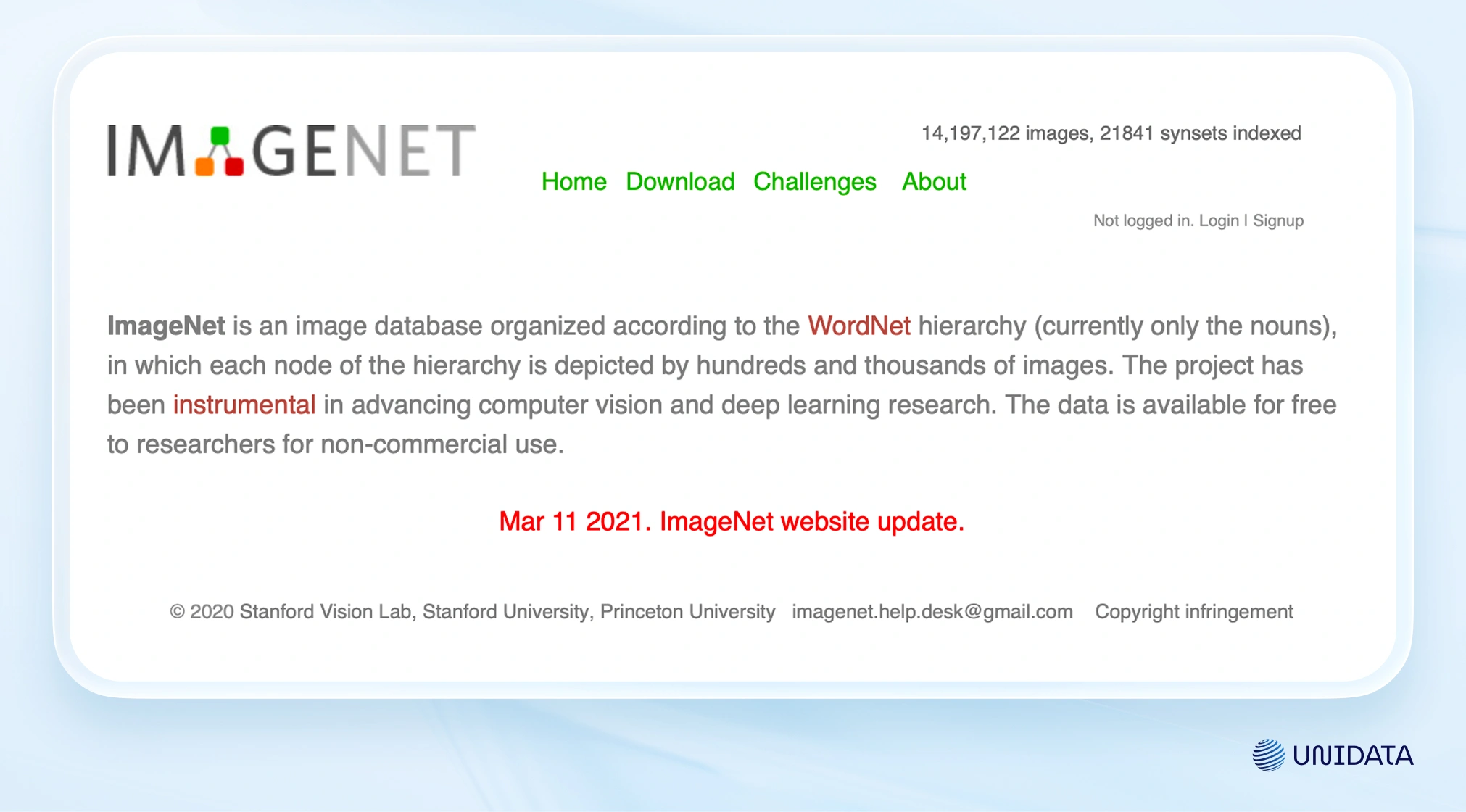
Volume: 14.2 million images across 21,841 WordNet synsets; the ILSVRC-2012 subset has 1,281,167 training images in 1,000 classes1
Access: Free with login and agreement to terms; non-commercial research and education only
Format: JPEG images organized by WordNet hierarchy
Task fit: Image classification, localization, transfer learning, backbone pretraining
The benchmark every new backbone is compared against, and the source of most pretrained weights in TorchVision and Hugging Face. Almost all practical work uses the 1,000-class ILSVRC subset rather than the full set.
2. Open Images Dataset V7
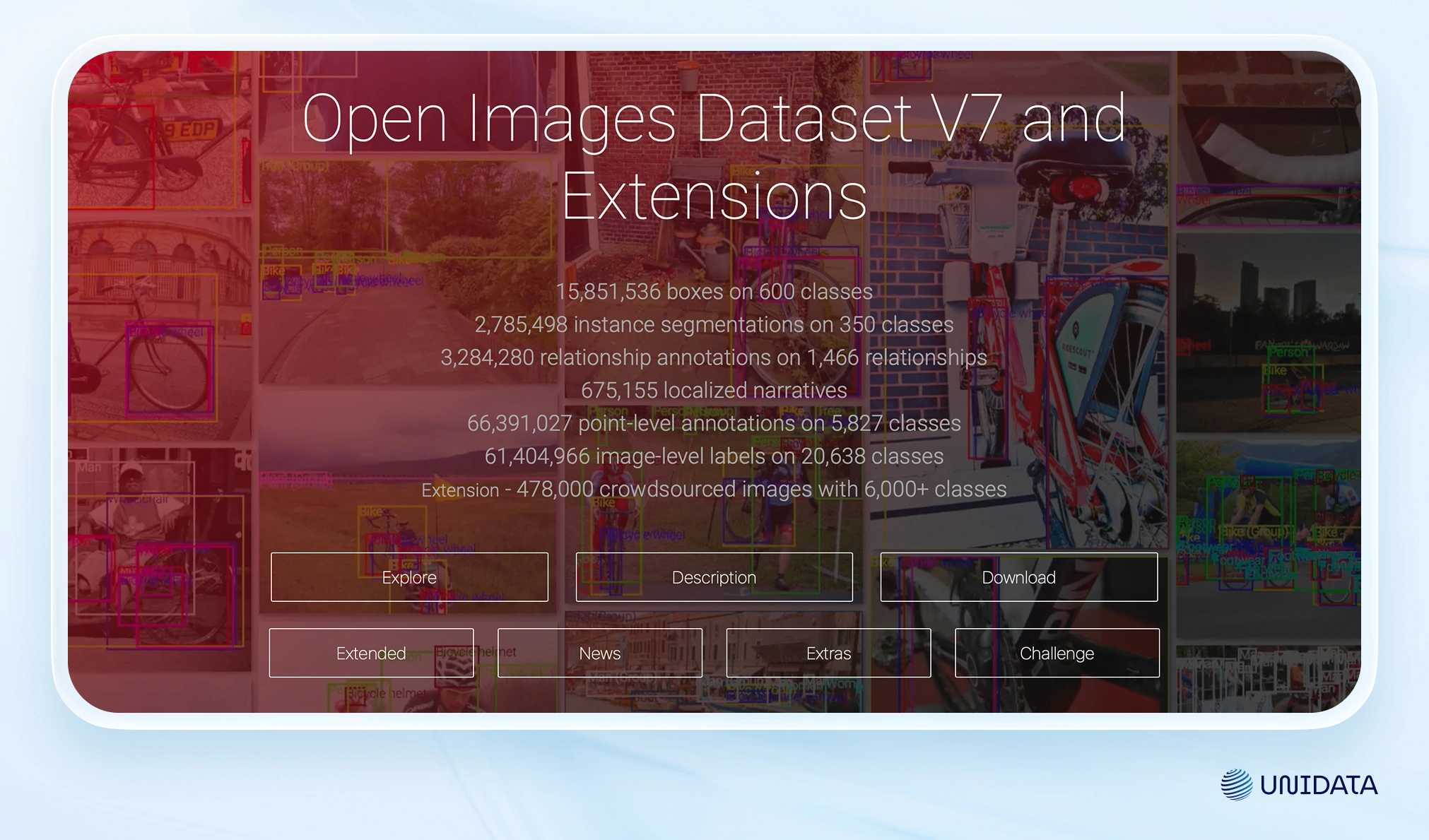
Volume: 9.18 million images; 15,851,536 boxes across 600 classes; 2,785,498 instance masks across 350 classes; 66.4 million point labels2
Access: Free, no signup; annotations CC BY 4.0, images listed as CC BY 2.0 (check each image's license before commercial use)
Format: Images + CSV annotations (boxes, masks, points, relationships)
Task fit: Object detection, instance segmentation, visual relationship detection
Flickr-sourced images give a real-world long tail, which makes it a good generalization check once a model scores well on COCO. Use FiftyOne or the official downloader to pull a class subset instead of the full set.
3. MS COCO
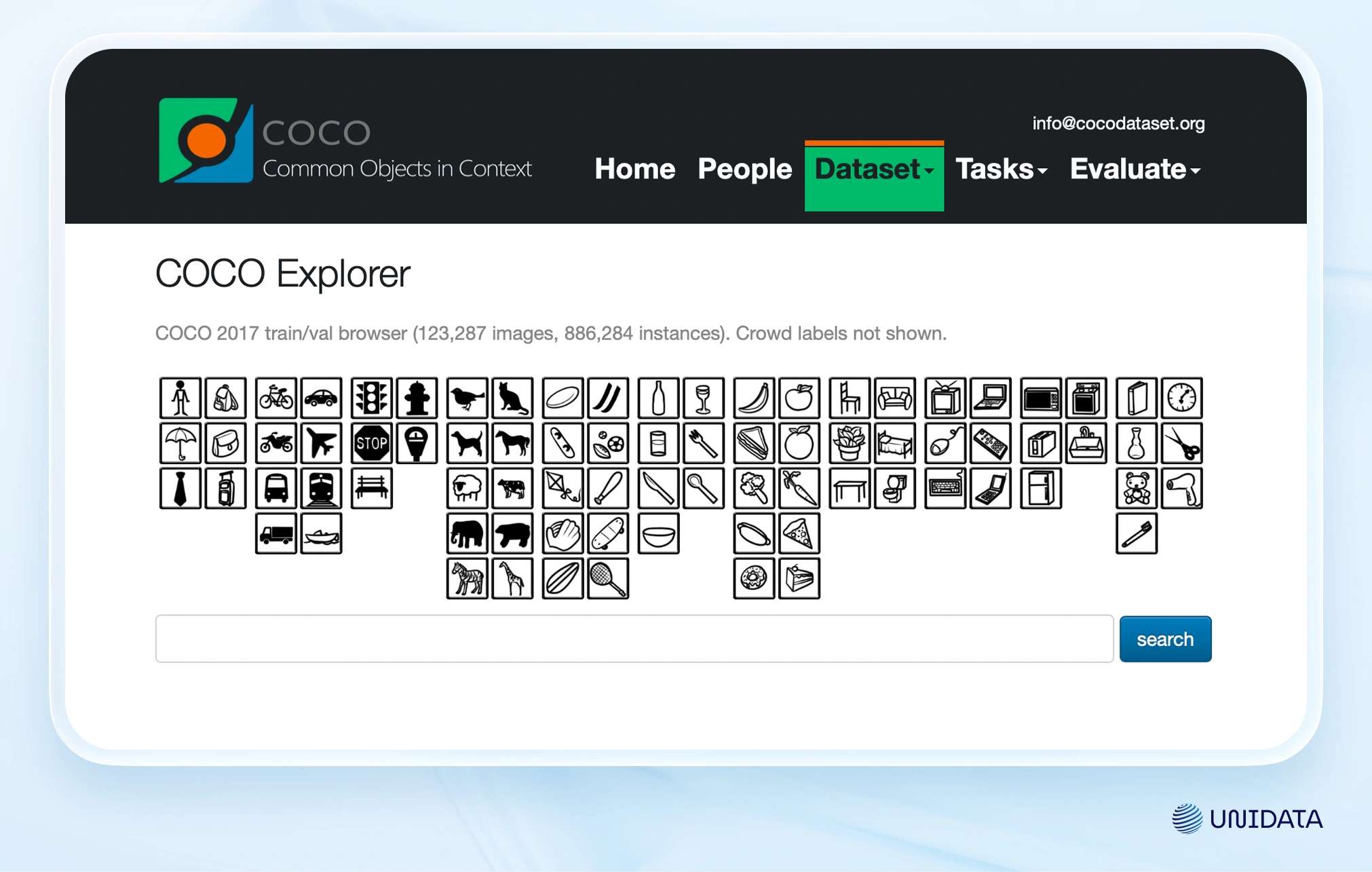
Volume: 328,000 images with 2.5 million labeled instances, 80 object categories, keypoints and five captions per image3; the 91-class "stuff" layer comes from COCO-Stuff4
Access: Free, open download; annotations CC BY 4.0, images under Flickr terms
Format: Images + JSON annotations (COCO format)
Task fit: Object detection, instance and panoptic segmentation, keypoints, captioning
The default comparison point for objects in context: papers report its mAP, and nearly every toolkit reads its annotation format. Fewer classes than Open Images, but more consistent labels.
4. PASCAL VOC 2012

Volume: 11,530 train/val images, 20 classes, 27,450 annotated objects, 6,929 segmentations; test set evaluated on a submission server5
Access: Free download of train/val; no explicit dataset license, images under Flickr terms
Format: Images + XML annotations
Task fit: Object detection, semantic segmentation, action classification
Small enough for a same-day training run and still in the baseline tables of current papers. Treat it as a development set, not a primary training source.
Segmentation and scene understanding
5. Cityscapes
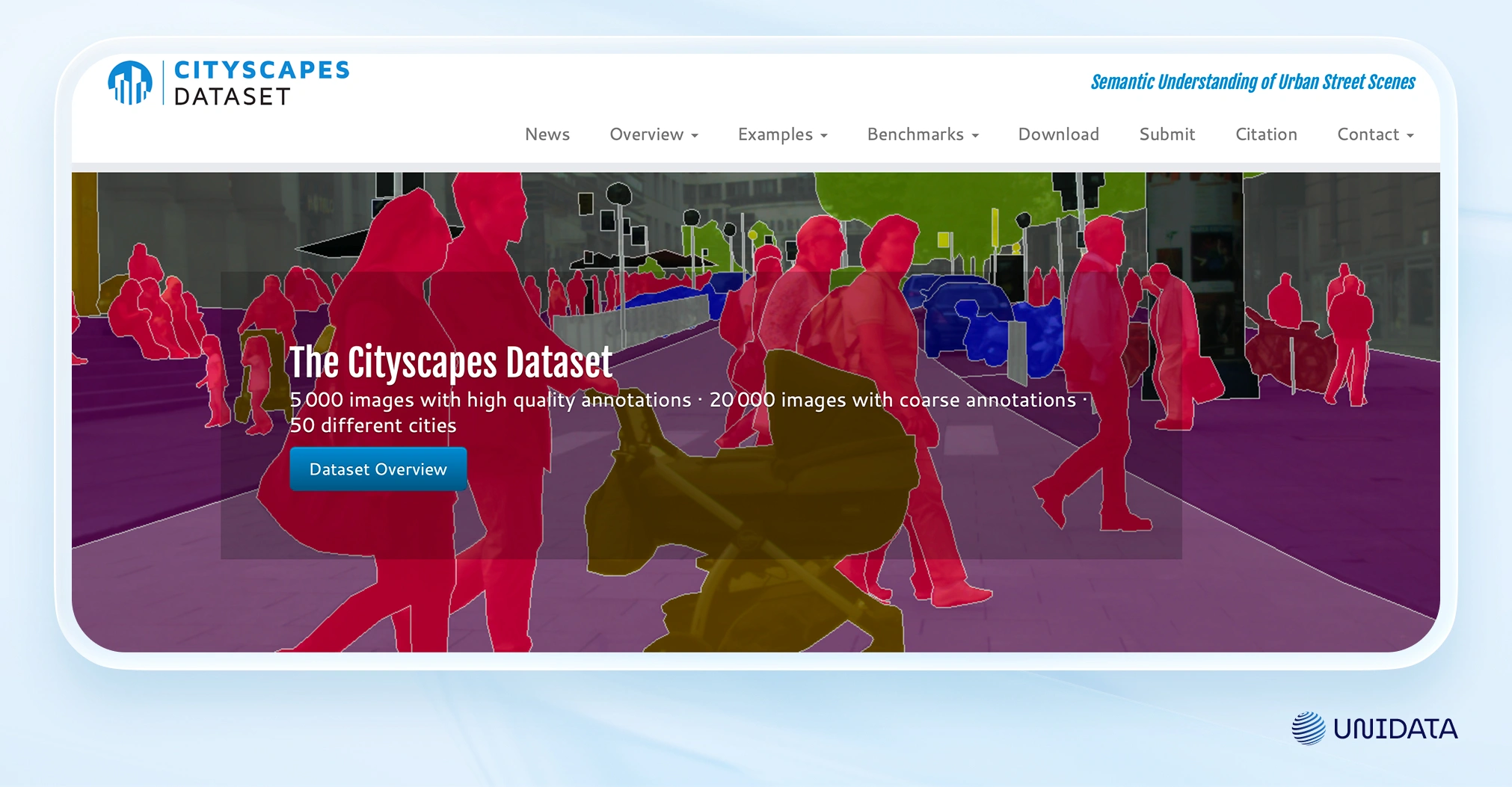
Volume: 5,000 finely annotated and 20,000 coarsely annotated images, 30 classes, street scenes from 50 cities6
Access: Free registration for people affiliated with a research body; non-commercial license, no redistribution
Format: Images + pixel-level label PNGs
Task fit: Semantic, instance and panoptic segmentation
The standard for urban semantic segmentation. The coarse subset trades precision for volume, so pick the split your loss actually needs.
6. ADE20K
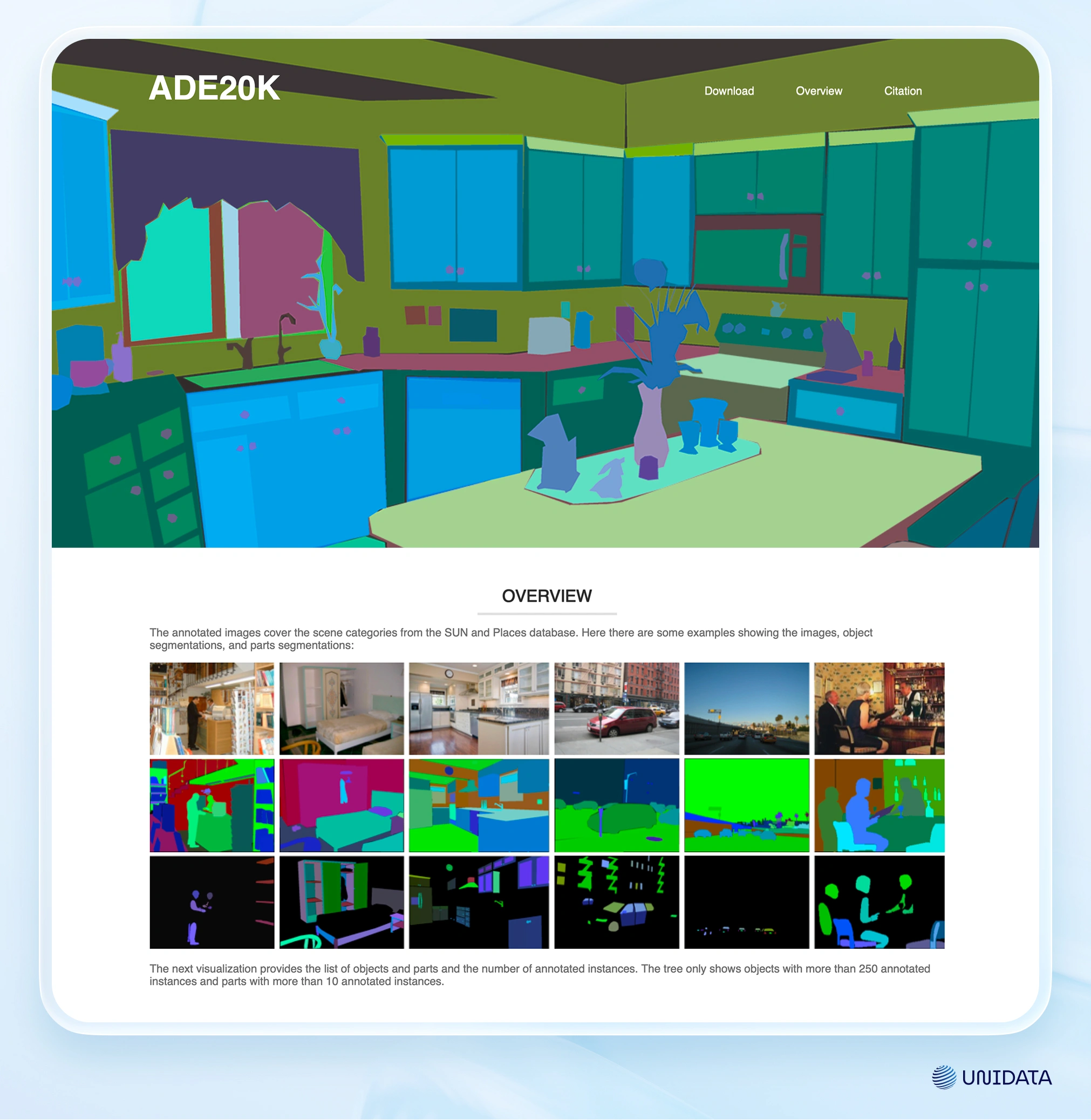
Volume: Full set of 25,574 training and 2,000 validation images; the common "20K images, 150 classes" figure is the SceneParse150 benchmark subset (20,210 training images)7
Access: Full set after registration, images for non-commercial research and education only; SceneParse150 is a direct download; annotations BSD-3
Format: Images + pixel labels
Task fit: Semantic segmentation, scene parsing, open-vocabulary segmentation
Covers indoor and outdoor scenes, which Cityscapes does not. Check whether a paper reports on the full set or SceneParse150 before comparing numbers.
7. SA-1B (Segment Anything 1 Billion)
Volume: 11 million images, 1.1 billion masks, about 100 masks per image8
Access: Free for research use under the SA-1B Dataset Research License
Format: Images + RLE-encoded masks (COCO-style)
Task fit: Promptable and zero-shot segmentation, foundation-model training
The data behind the Segment Anything Model. The full release runs to several terabytes, so most teams use a subset or pretrained SAM weights.
Video and face datasets
8. Kinetics-700
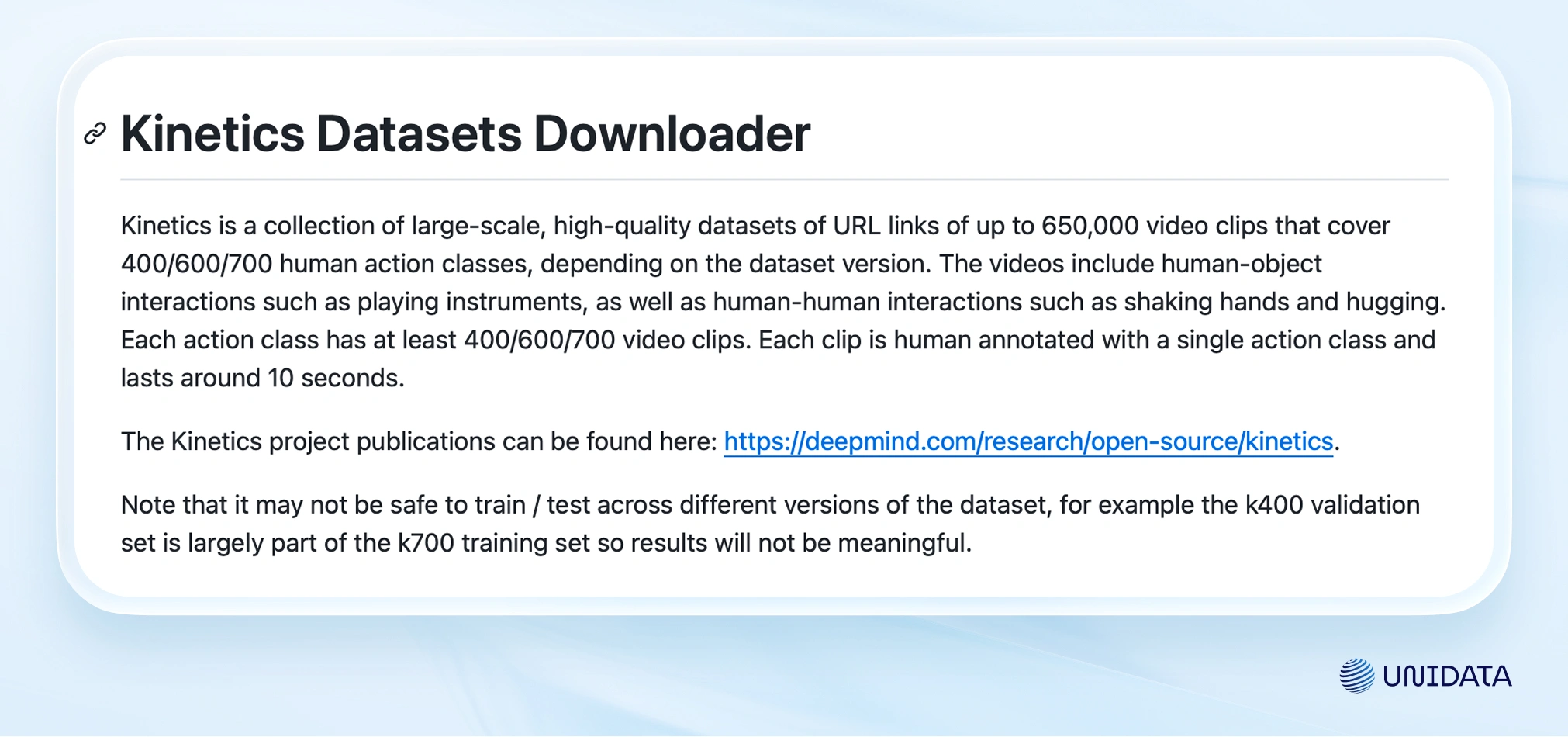
Volume: 700 action classes with at least 600 clips each in the 2019 release, about 650,000 clips10; Kinetics-700-2020 raises the floor to 700 clips per class
Access: Free, no signup, via the CVDF mirror; no license statement found, clips come from YouTube
Format: Short video clips, one action label each
Task fit: Action recognition, video classification, temporal modeling
The default action-recognition benchmark9. Clips disappear from YouTube over time, so the usable set shrinks.
9. CelebA
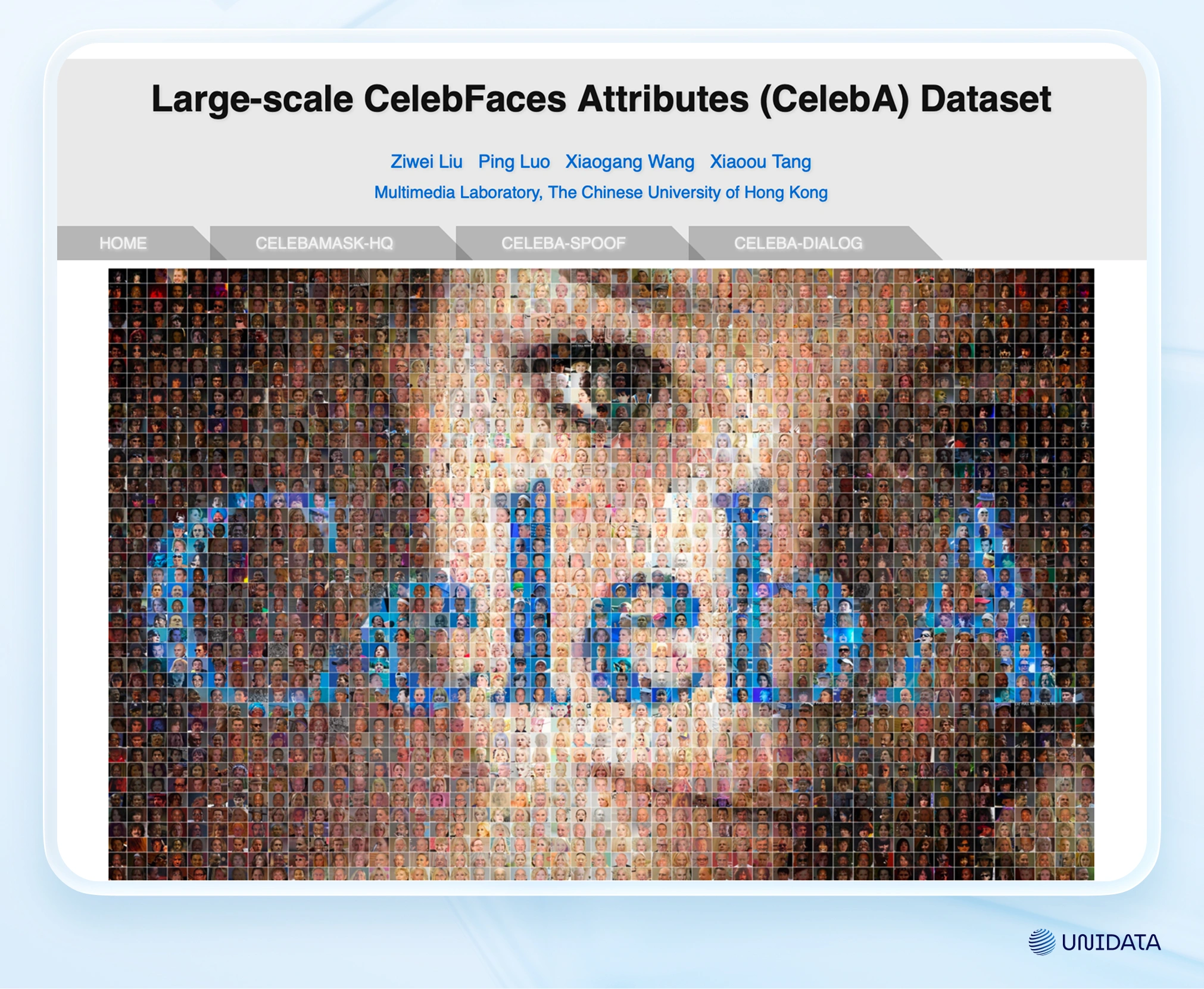
Volume: 202,599 face images of 10,177 identities, 40 binary attributes and 5 landmarks per image11
Access: Free for non-commercial research only; no redistribution
Format: Images + attribute and landmark annotations
Task fit: Face attribute recognition, landmark detection, generative modeling
Still common in GAN and attribute-learning papers. Celebrity photography skews demographics and pose, so audit for bias across groups before building on it.
10. LFW (Labeled Faces in the Wild)
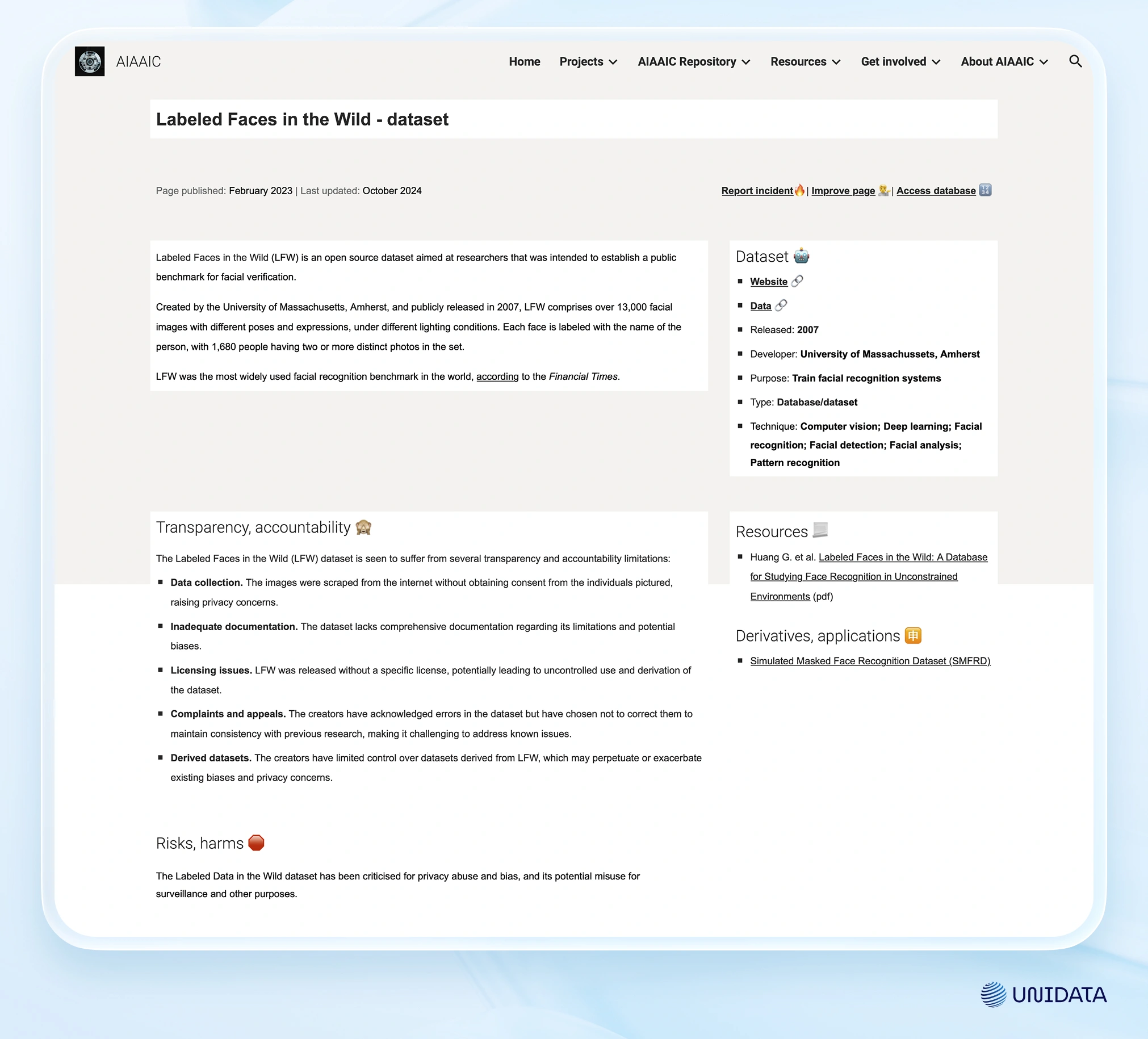
Volume: 13,233 images of 5,749 people, 1,680 of them with two or more images12
Access: Free download; the authors caution that LFW scores do not show an algorithm is suitable for commercial use
Format: Images + match/mismatch pair labels
Task fit: Face verification in unconstrained conditions
A quick sanity check for a verification pipeline. Current models saturate it, so a strong score is a floor, not a result.
Domain-specific and synthetic datasets
11. DOTA-v2.0
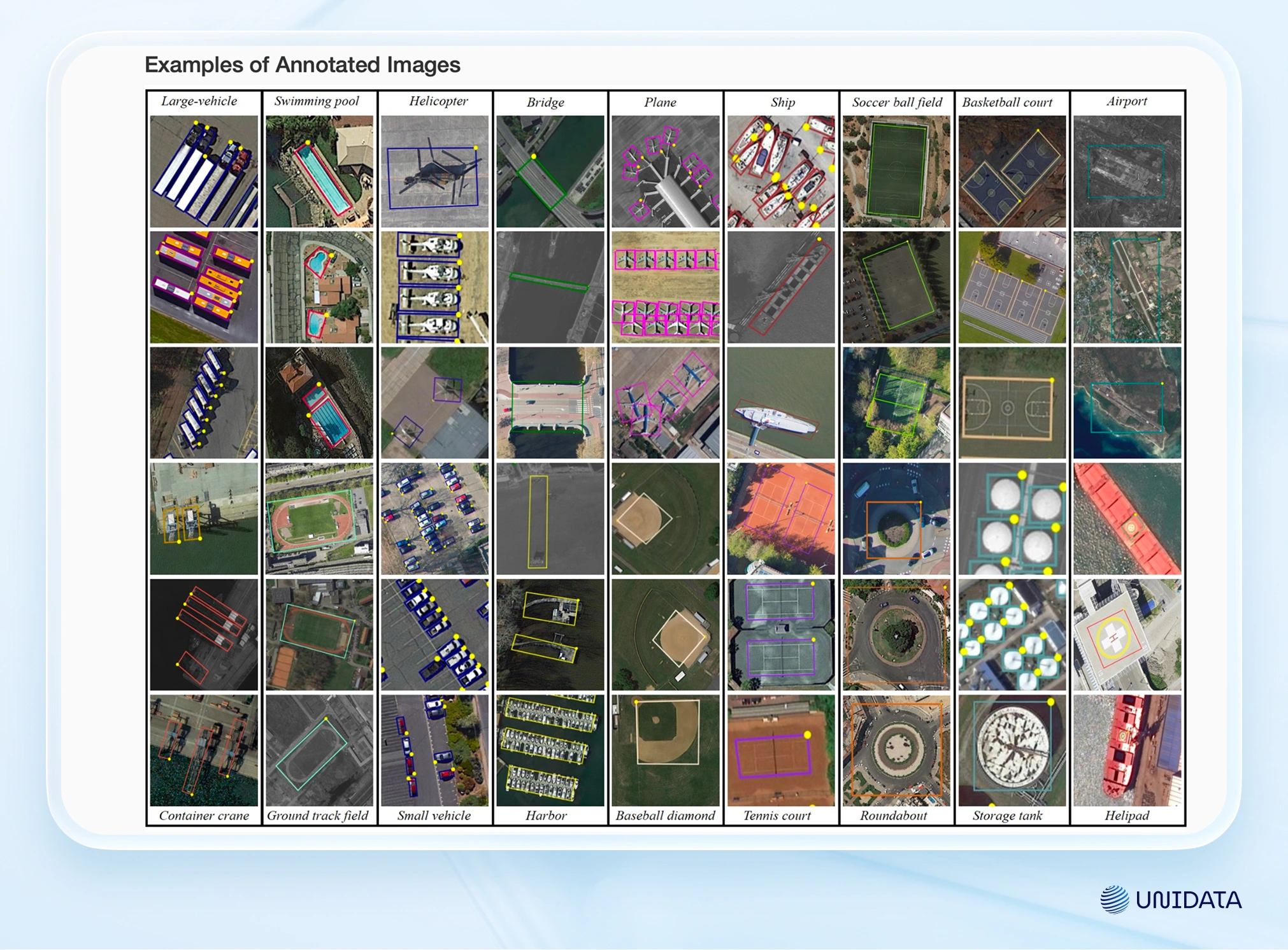
Volume: 11,268 aerial images, 1,793,658 instances, 18 categories, oriented bounding boxes13
Access: Free for academic use; commercial use prohibited
Format: Images + oriented bounding-box annotations
Task fit: Oriented object detection, aerial and remote-sensing imagery
The reference set for drone and satellite detection, where objects appear at any rotation. Geography and sensors are fixed, so test on your own region before trusting results.
12. Mapillary Vistas
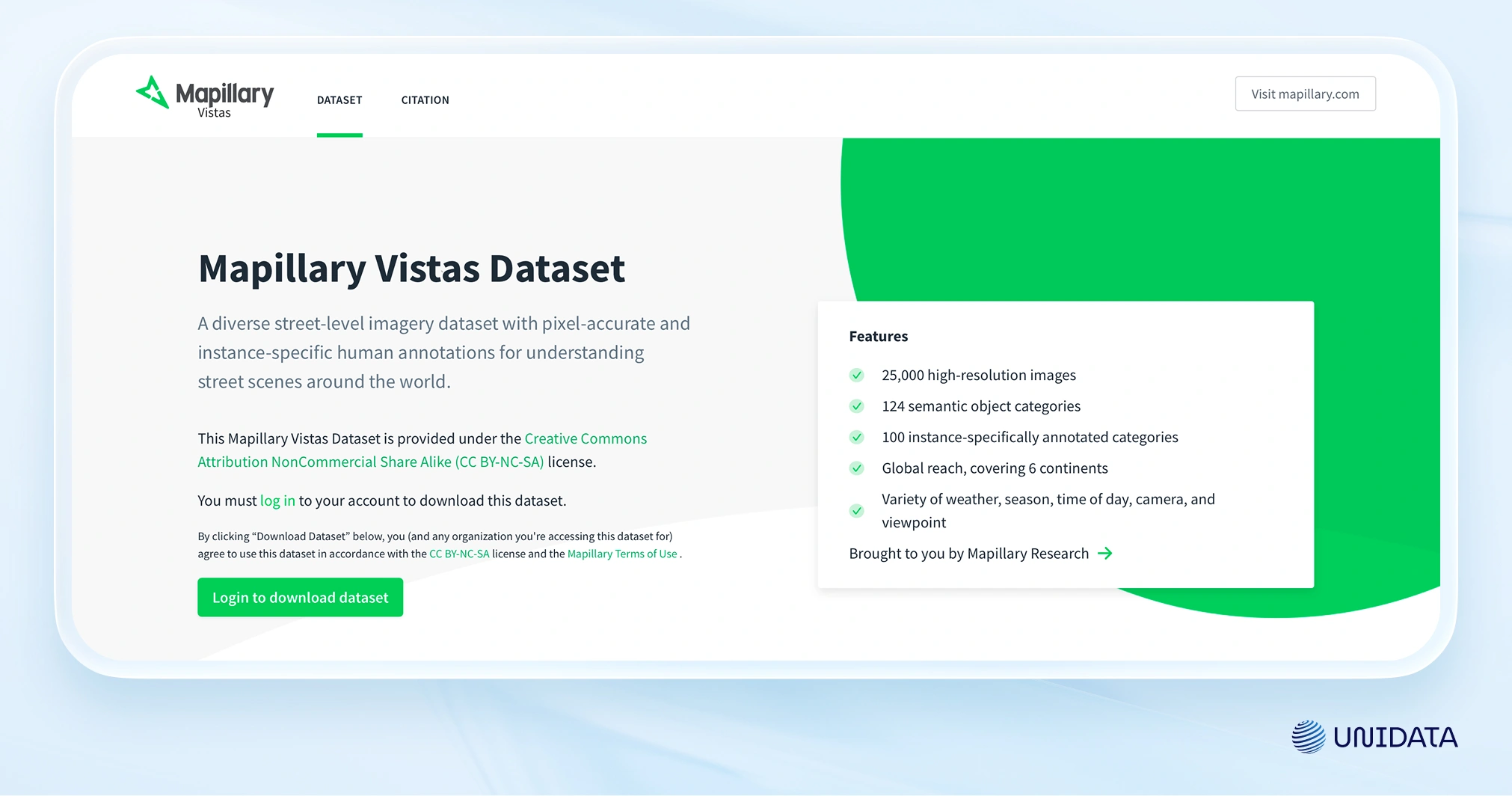
Volume: 25,000 images (18,000 train, 2,000 validation, 5,000 test), 66 categories, 37 with instance labels14
Access: Free with signup for the research edition; a separate commercial edition exists
Format: Images + segmentation labels
Task fit: Street-scene segmentation, cross-dataset generalization
Crowdsourced images from many cities and cameras. Pair it with Cityscapes: Cityscapes for label density, Mapillary for how a model holds up elsewhere.
13. Virtual KITTI 2
Volume: Five KITTI tracking sequences re-rendered as clone, fog, morning, overcast, rain and sunset, plus 15° and 30° left and right camera rotations15
Access: Free, non-commercial only (CC BY-NC-SA 3.0)
Format: RGB + depth + segmentation + optical flow + camera pose
Task fit: Domain adaptation, synthetic-to-real transfer, multi-task learning
Isolates domain shift on fixed scene geometry rather than generating new content. See our synthetic data guide for when that is enough.
Quick comparison table
| Dataset | Category | Access | Format | Task fit |
|---|---|---|---|---|
| ImageNet | Classification | Non-commercial, login | JPEG + WordNet labels | Classification, pretraining |
| Open Images V7 | Detection / segmentation | CC BY 4.0 annotations | CSV boxes + masks | Detection, relationships |
| MS COCO | Detection / segmentation | CC BY 4.0 annotations | COCO JSON | Detection, captioning, keypoints |
| PASCAL VOC 2012 | Detection / segmentation | Free, no explicit license | XML | Baselines |
| Cityscapes | Segmentation | Non-commercial, registration | Pixel-level labels | Urban segmentation |
| ADE20K | Segmentation | Non-commercial images | Pixel labels | Scene parsing |
| SA-1B | Segmentation | Research, Meta license | RLE masks | Promptable segmentation |
| Kinetics-700 | Video / action | Free, no license stated | Video clips + labels | Action recognition |
| CelebA | Face | Non-commercial | Images + attributes | Attributes, GANs |
| LFW | Face | Free | Images + pair labels | Face verification |
| DOTA-v2.0 | Aerial | Academic only | Oriented boxes | Aerial detection |
| Mapillary Vistas | Street scenes | Research edition, signup | Segmentation labels | Generalization |
| Virtual KITTI 2 | Synthetic | Non-commercial | RGB + depth + flow | Domain adaptation |
How to choose a computer vision dataset
Check three things, in this order:
- Task: classification, detection, segmentation, video or faces. This picks the section above.
- Format: COCO JSON is read by Detectron2, MMDetection, Ultralytics and FiftyOne; VOC XML and YOLO text labels are also common. Decide your target format before downloading.
- License: only Open Images and COCO annotations are CC BY 4.0; most others above are non-commercial. Resolve this before a model reaches a product decision.
When the free datasets run out
Public datasets are for prototyping and benchmarking. Production models usually need data from the client's own objects, environments and edge cases. Dense aerial scenes show the gap first: on an aerial imagery annotation project, frames with thousands of objects slowed the tool, and assigning annotators by object class kept the work moving. On a license-plate annotation project, the annotated real data outperformed datasets built with synthetic plates. For the decision itself, see build or buy an ML dataset.
If your project has outgrown the free datasets and needs annotation built around your own images — start here.
Frequently Asked Questions (FAQ)
MS COCO and Open Images V7 cover the most ground, with large scale, rich annotations and near-universal tooling. PASCAL VOC is fastest for baselines, and DOTA-v2.0 is the choice for oriented or aerial boxes.
Open Images and MS COCO annotations are released under CC BY 4.0, but their images carry Flickr licenses that must be checked individually. ImageNet, Cityscapes, CelebA, DOTA-v2.0, Virtual KITTI 2 and ADE20K images are non-commercial, and SA-1B is research-only. For a commercial product, plan on licensed or custom-collected data.
Cityscapes for urban scenes, ADE20K or its SceneParse150 subset for general scene parsing, SA-1B for promptable segmentation at scale, and Mapillary Vistas for geographic diversity. Combining two is standard for generalization testing.
Most are hosted on their official project pages, linked in each heading above. Hugging Face Datasets and FiftyOne load many of them in one call. Always confirm the license before commercial use.
Yes, for testing domain adaptation and generating conditions such as fog or unusual camera angles that are expensive to capture. They do not replace real data once a task depends on real-world noise, so pair them with a real validation set.
Further Reading & References:
- [1] Deng, J., Dong, W., Socher, R., Li, L.-J., Li, K., Fei-Fei, L. "ImageNet: A Large-Scale Hierarchical Image Database" — CVPR — 2009 ↩︎
- [2] Kuznetsova, A., Rom, H., Alldrin, N., et al. "The Open Images Dataset V4: Unified Image Classification, Object Detection, and Visual Relationship Detection at Scale" — IJCV — 2020 ↩︎
- [3] Lin, T.-Y., Maire, M., Belongie, S., et al. "Microsoft COCO: Common Objects in Context" — ECCV — 2014 ↩︎
- [4] Caesar, H., Uijlings, J., Ferrari, V. "COCO-Stuff: Thing and Stuff Classes in Context" — CVPR — 2018 ↩︎
- [5] Everingham, M., Van Gool, L., Williams, C.K.I., Winn, J., Zisserman, A. "The PASCAL Visual Object Classes Challenge: A Retrospective" — IJCV — 2015 ↩︎
- [6] Cordts, M., Omran, M., Ramos, S., et al. "The Cityscapes Dataset for Semantic Urban Scene Understanding" — CVPR — 2016 ↩︎
- [7] Zhou, B., Zhao, H., Puig, X., Fidler, S., Barriuso, A., Torralba, A. "Scene Parsing through ADE20K Dataset" — CVPR — 2017 ↩︎
- [8] Kirillov, A., Mintun, E., Ravi, N., et al. "Segment Anything" — ICCV — 2023 ↩︎
- [9] Kay, W., Carreira, J., Simonyan, K., et al. "The Kinetics Human Action Video Dataset" — arXiv preprint — 2017 ↩︎
- [10] Carreira, J., Noland, E., Hillier, C., Zisserman, A. "A Short Note on the Kinetics-700 Human Action Dataset" — arXiv preprint — 2019 ↩︎
- [11] Liu, Z., Luo, P., Wang, X., Tang, X. "Deep Learning Face Attributes in the Wild" — ICCV — 2015 ↩︎
- [12] Huang, G.B., Ramesh, M., Berg, T., Learned-Miller, E. "Labeled Faces in the Wild: A Database for Studying Face Recognition in Unconstrained Environments" — University of Massachusetts, Amherst, Technical Report 07-49 — 2007 ↩︎
- [13] Ding, J., Xue, N., Xia, G.-S., et al. "Object Detection in Aerial Images: A Large-Scale Benchmark and Challenges" — IEEE TPAMI — 2021 ↩︎
- [14] Neuhold, G., Ollmann, T., Rota Bulò, S., Kontschieder, P. "The Mapillary Vistas Dataset for Semantic Understanding of Street Scenes" — ICCV — 2017 ↩︎
- [15] Cabon, Y., Murray, N., Humenberger, M. "Virtual KITTI 2" — arXiv preprint — 2020 ↩︎