A model trained only on text misses what a flat tone of voice or a mismatched image gives away immediately. Most real-world signals split across more than one channel at once — a product review carries words, a face, and a voice that don't always agree, and a model reading just one of them stays blind to the rest.
A multimodal dataset pairs two or more of these channels — typically text, images, and audio — around the same underlying event, so a model can learn from all of them together. This guide covers what that takes in practice: how the data gets collected and aligned, how it's annotated, how fusion architectures combine it, and which datasets are worth knowing before building or buying one.
Defining multimodal datasets and their core modalities
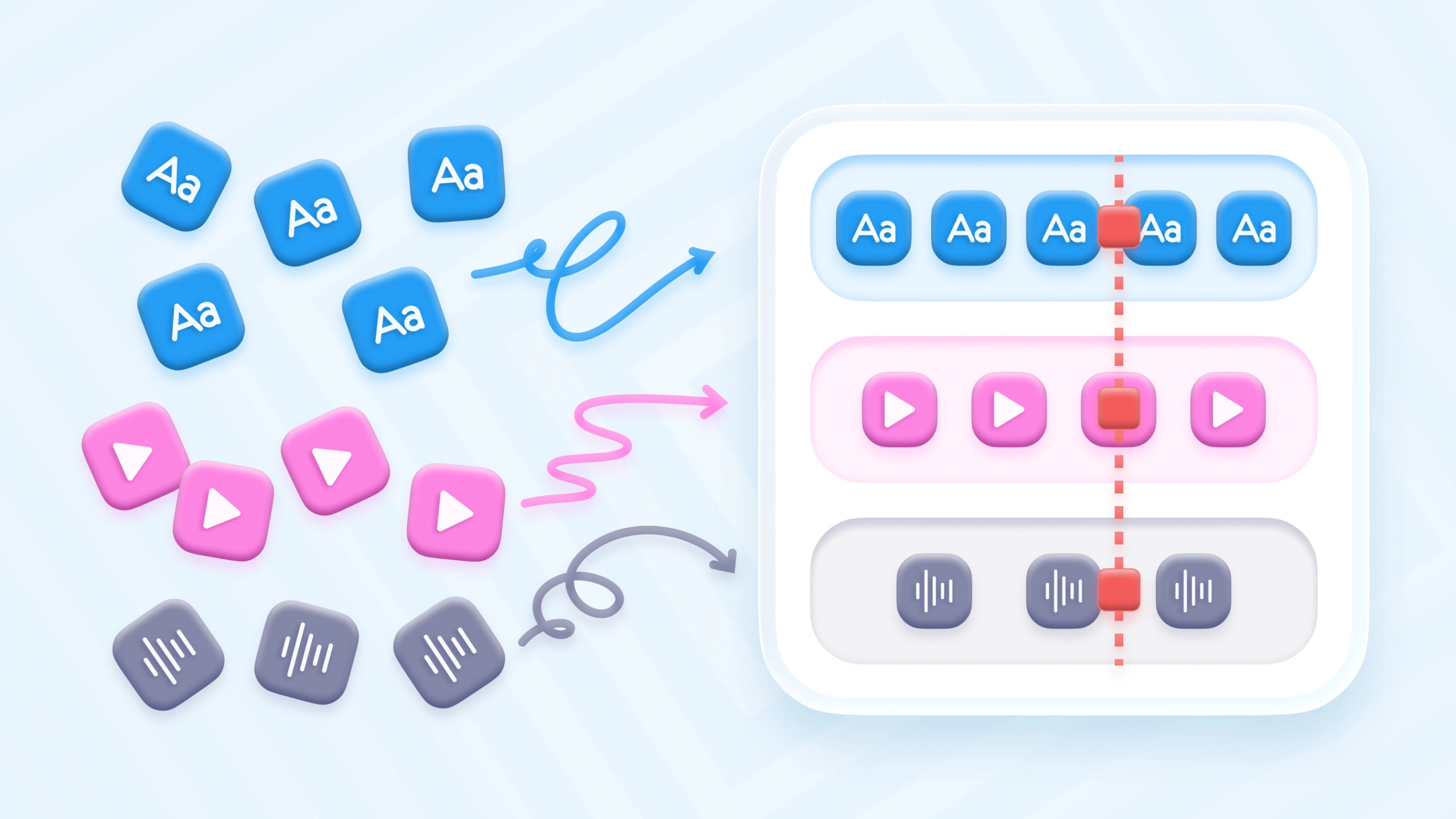
A multimodal dataset is training data that pairs two or more data modalities — usually text, images, and audio — around a shared subject or event. A product review video is a clean example: the same clip yields a transcript (text), video frames (image), and a voice track (audio), and each one carries information the others don't.
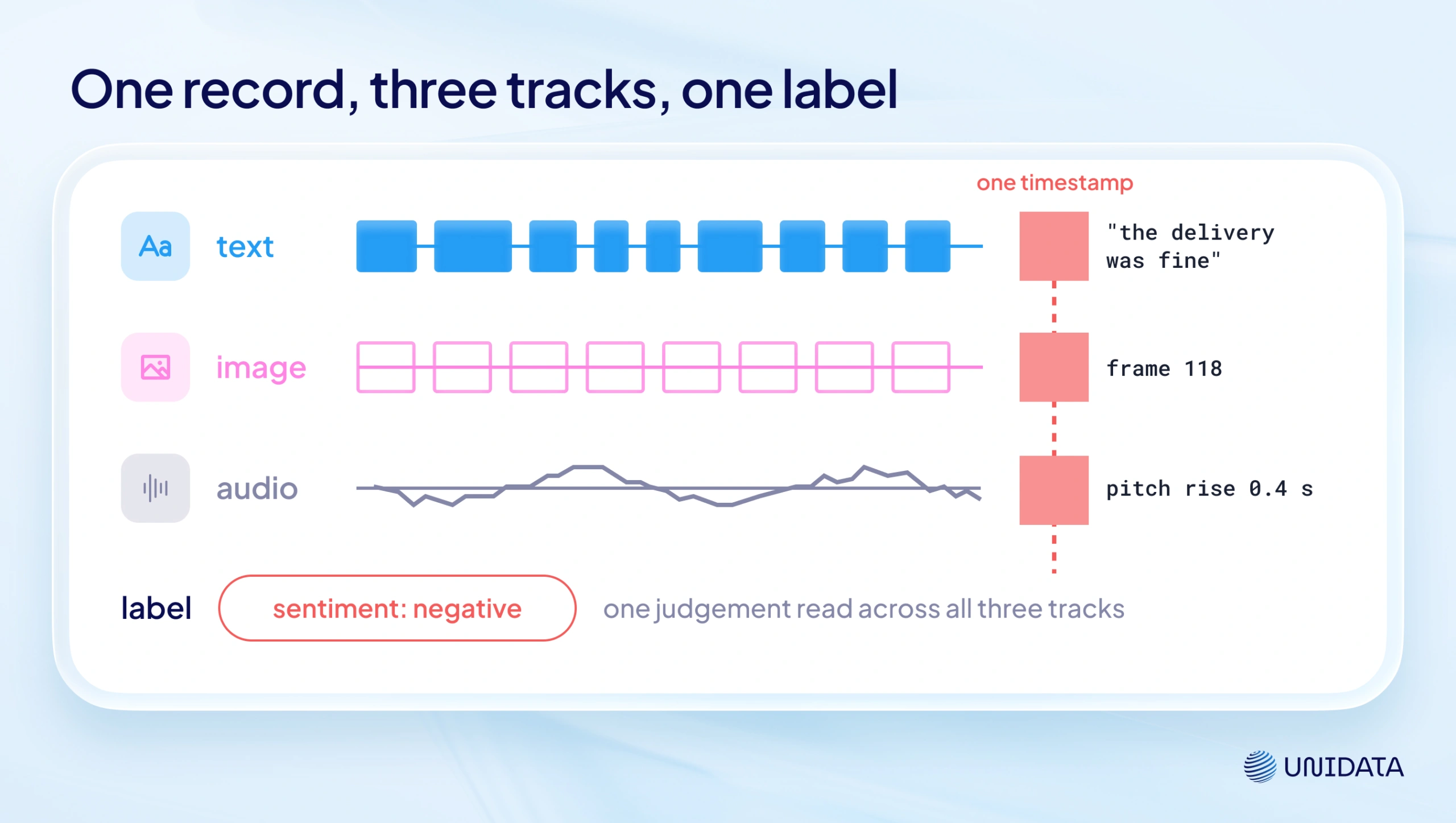
"Modality" here just means a distinct format or channel of data — it separates "what kind of signal" (text vs. image vs. audio vs. sensor readings) from the content itself. A multimodal dataset bundles several of these channels into one labeled record instead of training a separate model on each signal type in isolation.
Training data of any kind only teaches a model what's actually present in the dataset, multimodal or not, which is why the modality mix has to match the task before annotation even starts.
Contrast that with a unimodal dataset, which holds only one modality — a folder of product photos, or a transcript corpus with no audio or images attached. Unimodal data is cheaper to collect and easier to annotate, but it forces a model to infer everything from a single channel. When a customer's tone of voice contradicts their words, or an image contradicts its caption, a unimodal model has no second channel to catch the mismatch — it learns whatever pattern that one input offers, including patterns that don't actually hold up.
Multimodal learning is the discipline built on top of this kind of data: models that take in two or more modalities at once and learn to combine them into a single decision, rather than averaging separate single-modality outputs after the fact.
None of that works without a properly built multimodal dataset first — the modalities have to exist, paired and labeled around the same event, before any model can learn the relationship between them. That construction step, not the model architecture, is usually where multimodal projects actually stall.
Why multimodal data improves AI model performance
Each data modality carries information the others miss. A blurry video frame might make a facial expression ambiguous, but the audio track — tone, pace, pauses — often resolves exactly that ambiguity. A multimodal dataset lets a model cross-check signals against each other instead of betting everything on one input, which is the main reason multimodal models tend to stay accurate when one modality is noisy, occluded, or just hard to read.
That complementarity also helps with generalization (machine learning) — a model's ability to perform well on data it hasn't seen before. A model relying on a single modality can latch onto spurious correlations specific to that channel, such as lighting conditions in images or background noise in audio; requiring agreement across two or more independent modalities filters out some of that noise, because a spurious pattern in one channel rarely repeats identically in another [1].
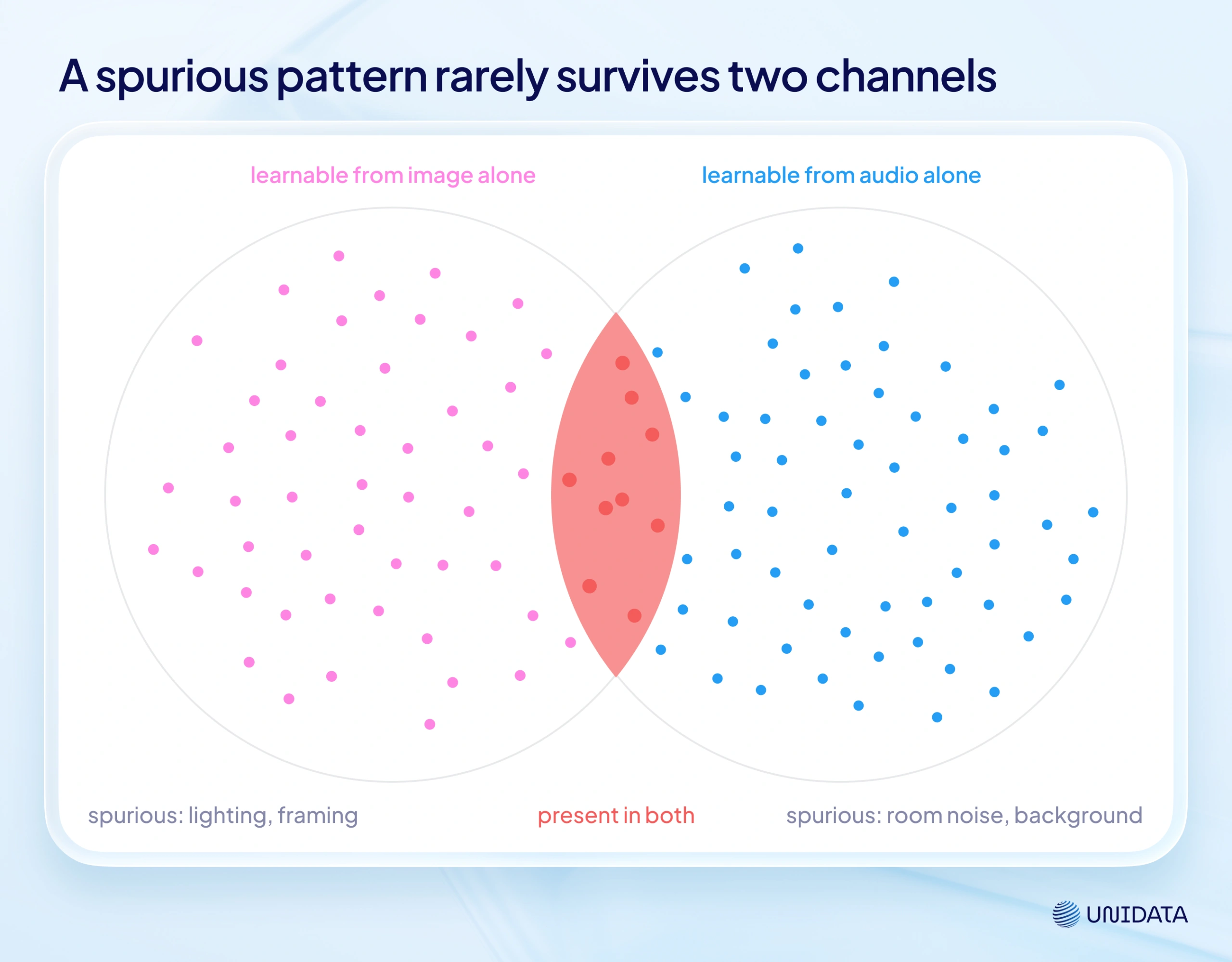
This is the mechanism behind most reported multimodal accuracy gains — not a bigger model, but a harder-to-fool one.
Key applications across industries
Visual Question Answering puts this to a direct test: given an image and a question in plain language ("what color is the umbrella?"), the model has to read both the pixels and the text together to produce an answer — a task that's effectively impossible from either modality alone. The original VQA benchmark paired roughly 250,000 images with about 760,000 questions and 10 million answers to train and evaluate exactly this kind of joint reasoning [2].
Image captioning runs the same pairing in the opposite direction: given an image, generate a text description. MS COCO's captioning benchmark — over 330,000 images, each with five independent human-written captions — is the dataset most captioning models are still trained or evaluated against [3].
Autonomous driving extends the pattern past vision-language into raw sensor fusion: camera frames give dense texture and color, while LiDAR contributes accurate 3D geometry that a camera alone can't recover, and modern perception stacks fuse the two — along with radar and other sensors — at multiple stages of the pipeline rather than picking one [4].
In each case, the failure mode of going unimodal is specific: a vision-only VQA model can't answer questions that depend on text-stated context, a caption model with no language signal degenerates into object lists, and a camera-only driving stack misjudges distance in exactly the conditions, like fog, glare, or dusk, where LiDAR is most useful.
How multimodal datasets are collected and annotated
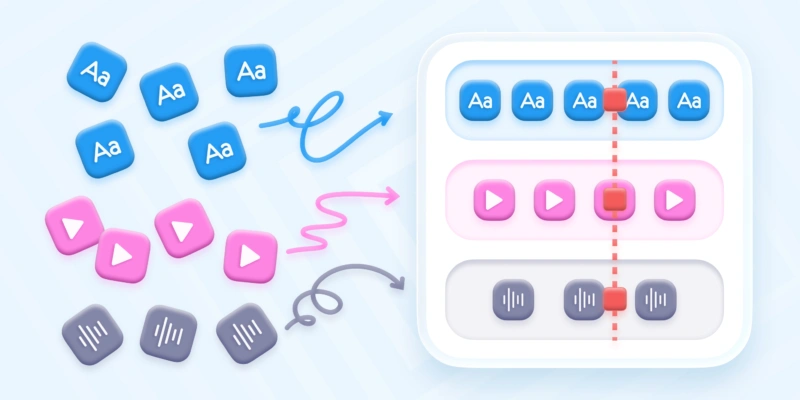
Building a multimodal dataset starts with a logistics problem before it's a modeling problem: text, images, and audio usually come from different pipelines — scraped web pages, captured photos or video, recorded speech — and nothing guarantees they describe the same moment unless someone makes them. Teams sourcing this kind of data end up solving two separate problems in sequence: data alignment, proving that a given text span, image region, and audio segment refer to the same underlying event, and data annotation, attaching usable labels once that correspondence is established.
Skip either step and the dataset looks complete but trains a model on mismatched pairs — text describing one frame, labeled as if it described another. The two sections below cover each problem in turn.
Data collection and synchronization methods
Data alignment is usually solved with one of two techniques, depending on what's being matched. Dynamic Time Warping handles temporal sequences that move at different speeds — stretching or compressing one sequence's timeline so it lines up with another, which is exactly the problem in syncing a voice track to lip movement in video when the two were captured or compressed at slightly different rates [5].
Canonical Correlation Analysis solves a different version of the problem: finding statistical correspondence between modality pairs that aren't sequential at all, such as matching an image region to the text span that describes it, by learning a shared space where related pairs from each modality end up close together [1].
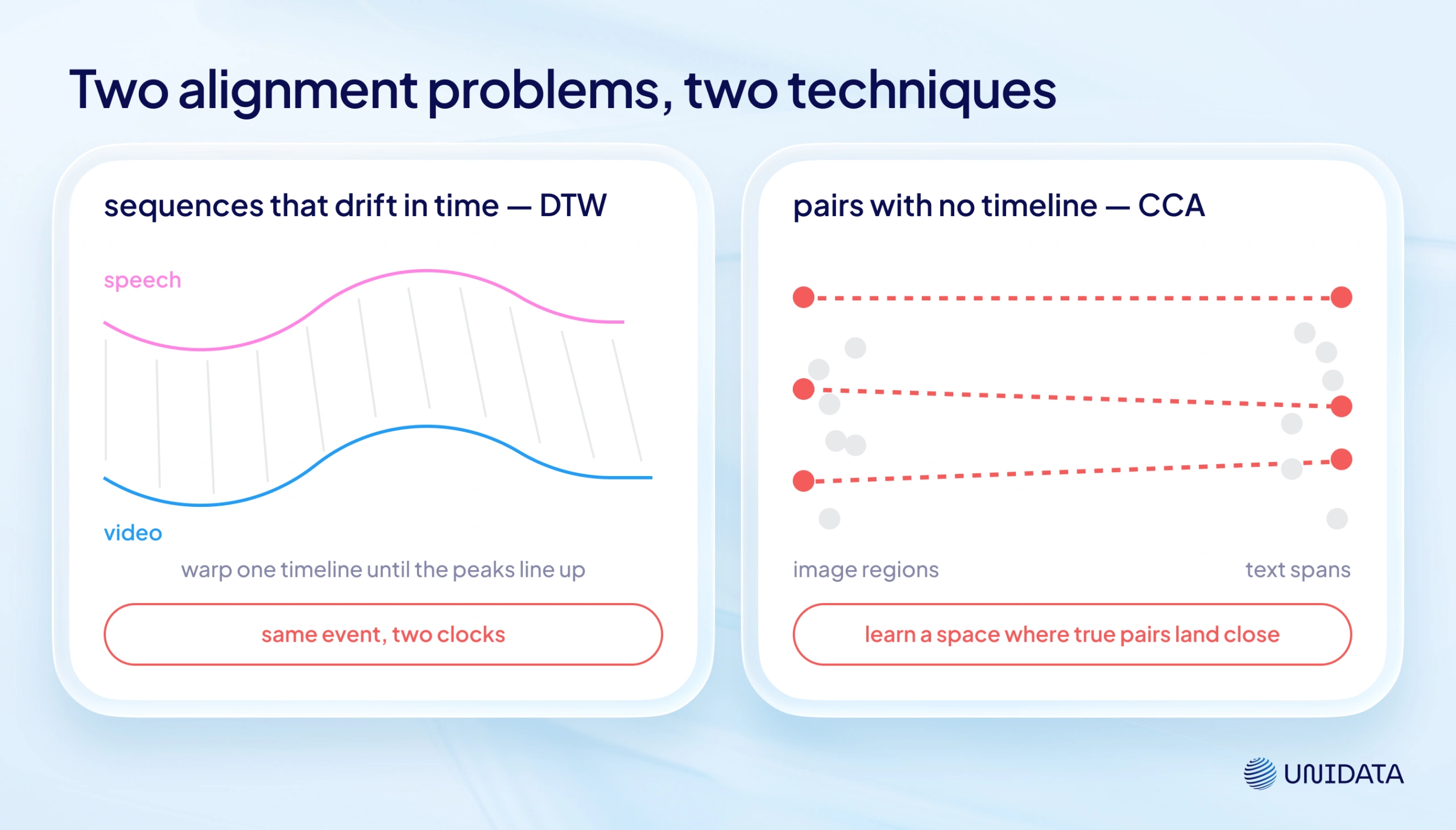
Misalignment, not a shortage of raw data, is the most common reason a multimodal dataset underperforms once a model trains on it. A few frames of audio-video drift or an image-caption pair sourced from the wrong timestamp doesn't crash training — it just quietly teaches the model the wrong association, which is far harder to catch than a missing label.
Annotation challenges across modalities
Annotating a multimodal dataset costs more than labeling a single modality, mainly because the labels have to hold meaning across channels at once, not just within one. Labeling sentiment from a video clip means reading text tone, hearing vocal pitch, and watching facial expression together — three separate judgments that all have to anchor to the same timestamp, or the label stops meaning anything once a model tries to learn from it.
Annotators working this kind of data need familiarity with more than one modality's conventions, not just one — which is consistent with the broader pattern that annotation is a skilled task rather than commodity labor, regardless of how many modalities are involved.
Scale makes the problem sharper, not smaller. A project annotating 363,000 banking call recordings for categorization still needs every label tied correctly to its audio segment, just at higher volume — and that's audio alone, before adding a second or third channel. Reading text tone, hearing pitch, and watching expression for the same five-second clip takes a trained annotator meaningfully longer per record than labeling any one of those channels on its own, which is the real cost driver behind multimodal annotation: not the modality count itself, but the synchronized judgment each additional channel demands.
Fusion architectures for combining modalities
Multimodal fusion is the step where a dataset's separate modality streams turn into one joint representation a model can reason over — text, image, and audio embeddings don't combine by simply being concatenated and hoped into coherence. Before fusion happens, each modality typically passes through its own modality-specific encoder: a dedicated network trained to turn that modality's raw input into a fixed-length vector, with the specific encoder choice — a convolutional network for images, a transformer for text — depending entirely on what kind of data it's processing [1].
Fusion architecture and encoder choice are usually decided together, because the format each encoder outputs constrains how the fusion step downstream can combine them.
Modality-specific encoders
Encoder choice tracks the modality. Images are typically encoded with a convolutional neural network — ResNet remains a common baseline, using residual connections to train networks deep enough to extract useful visual features without accuracy degrading as depth increases [6] — producing a fixed-length feature vector per image, commonly 512 or 2048 dimensions depending on the variant.
Text is typically encoded with a transformer (machine learning model) such as BERT, which reads a sequence bidirectionally and produces a semantic embedding, commonly 768 dimensions, that captures meaning rather than just word identity [7].
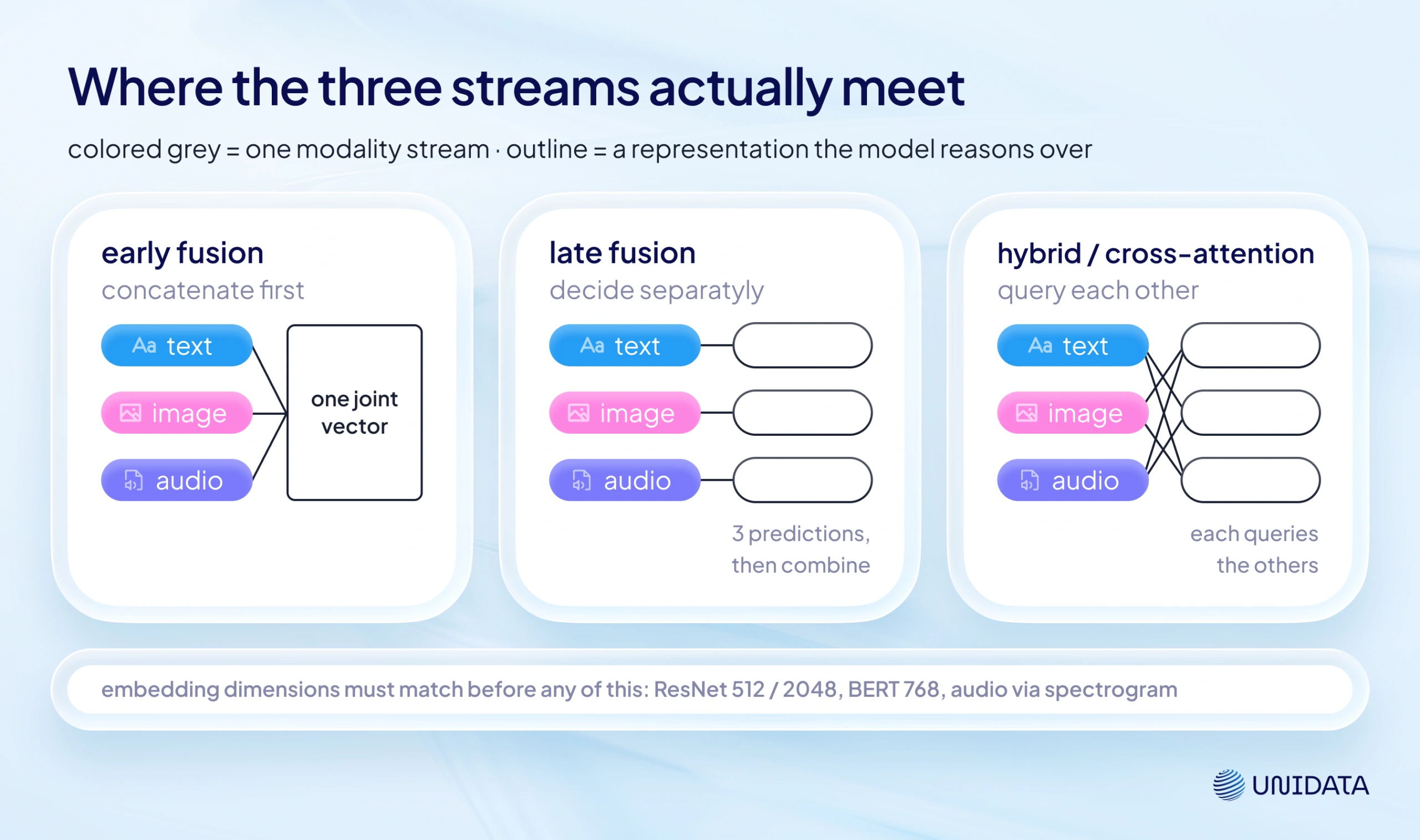
Audio sits between the two approaches in practice: it's commonly converted to a spectrogram — a 2D image-like representation of frequency over time — and then run through a CNN, or alternatively encoded directly with an audio-specific transformer. Either way, the goal stays the same regardless of modality: produce an embedding in a comparable numeric format, so the fusion step downstream isn't combining incompatible representations. A mismatched embedding dimension or scale between modalities is a common, avoidable source of fusion failures before any genuinely hard modeling problem comes into play.
Early, late, and hybrid fusion strategies
Three fusion strategies cover most multimodal architectures. Early fusion concatenates raw or lightly processed embeddings from each modality before any joint processing — information-rich, because nothing is discarded before the model sees it, but rigid, since it assumes the modalities are reliably present and aligned at training time [1].
Late fusion goes the other way: each modality is processed independently through to a prediction, and only the final outputs are combined — more resilient when a modality might be missing or noisy, at the cost of missing interactions that only show up when modalities are considered jointly.
Hybrid fusion tries to get both. Cross-modal attention — the mechanism behind models like ViLBERT — lets one modality's representation query another's directly inside the network, so visual attention can be conditioned on the text and vice versa, rather than only meeting at a final concatenation step [8].
Contrastive learning, as used in CLIP, takes a different route entirely: instead of fusing modalities into one architecture, it trains separate encoders to produce embeddings that land close together in a shared space when they describe the same thing, and far apart when they don't [9]. That shared-space approach has become the dominant way to align modalities for retrieval and zero-shot tasks, even when the downstream model never fuses them in the traditional sense.
Notable multimodal datasets to know
The datasets ML teams actually train against split roughly into two camps. Image-text datasets — LAION-5B and MS COCO chief among them — pair pictures with captions or alt text at scales ranging from hundreds of thousands to billions of pairs. Audio-visual and tri-modal datasets, such as CMU-MOSEI, go further and combine video, audio, and text in the same record, usually for sentiment or emotion tasks where all three channels carry signal.
The two sections below break down what each is actually good for, since "biggest" and "best for the task at hand" are rarely the same dataset.
Image-text datasets
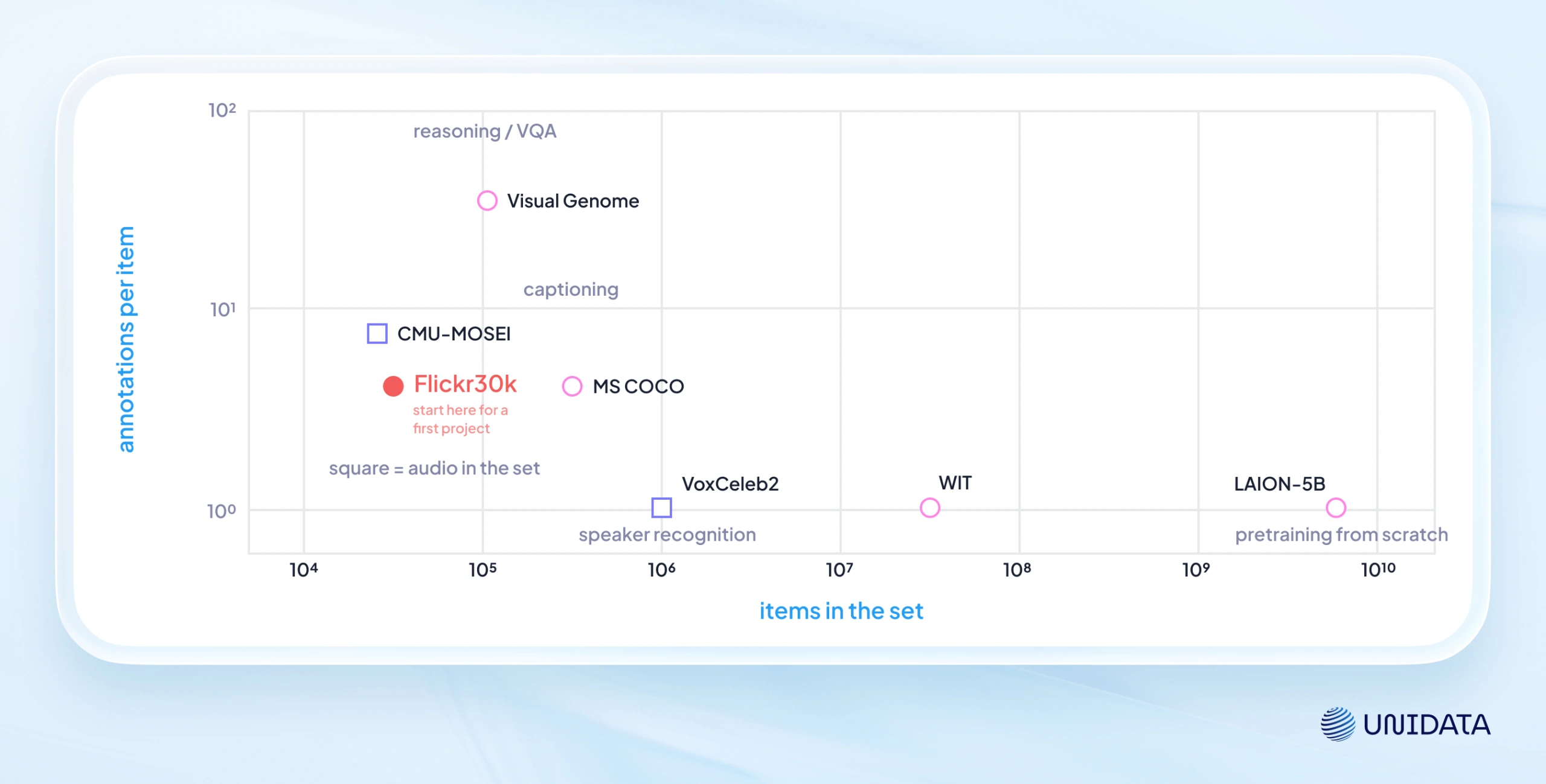
LAION-5B is the scale option: 5.85 billion image-text pairs scraped from the web and filtered using CLIP similarity scores to remove mismatched pairs, making it the largest freely available image-text dataset and the default choice for pretraining large multimodal models from scratch [10]. MS COCO trades scale for annotation quality — about 330,000 images, each with five independently written captions, making it the standard benchmark for image captioning specifically rather than open-ended pretraining [3].
WIT (Wikipedia-based Image Text) sits in between: 37.6 million image-text pairs pulled from Wikipedia articles across 108 languages, which makes it the strongest option when multilingual retrieval matters more than raw scale [11]. Visual Genome takes a different approach entirely — about 108,000 images, but with dense region-level descriptions, an average of 42 per image, plus object, attribute, and relationship annotations, which is what suits it to visual reasoning and Visual Question Answering rather than captioning or pretraining [12].
Picking among these is less about which dataset is "best" and more about which task — pretraining, captioning, multilingual retrieval, or reasoning — the model actually needs to learn.
Audio-visual and tri-modal datasets
CMU-MOSEI is the largest tri-modal sentiment dataset available: roughly 23,000 annotated segments drawn from over 3,000 YouTube videos, with synchronized text, audio, and visual data covering sentiment intensity and six emotion categories [13]. VoxCeleb2 stays audio-visual rather than tri-modal but goes wider on scale — over a million utterances from more than 6,000 speakers across 145+ nationalities, built for speaker recognition rather than sentiment [14].
Both illustrate the annotation-cost point from the collection section. Tri-modal data like CMU-MOSEI needs every segment's text, audio, and visual track verified against the same timestamp before the sentiment label means anything, and VoxCeleb2's scale still requires each utterance correctly tied to its speaker identity across sessions recorded at different times and audio quality.
That synchronized-judgment cost is exactly why this category of dataset is the most expensive to build from scratch, and the main reason most teams start from one of these existing sets rather than collecting tri-modal data themselves for a first project.
Common challenges and best practices
Four problems account for most of the trouble teams hit after the dataset itself is built. Modality imbalance happens when one modality dominates the training signal, often because it's simply easier to learn from, and the model quietly stops using the others even though they're present in every record. Computational cost climbs fast with multimodal data, particularly with attention-based fusion: self-attention's cost scales quadratically with sequence length, and joining modalities into one long sequence multiplies that cost rather than dividing it [15].
Data alignment issues, covered earlier, resurface here as a training-time symptom rather than a collection-time one — a model that underperforms for no clear reason is worth checking for silent misalignment before anything else. The fix for each problem differs, which is why treating "multimodal is harder" as one issue instead of four tends to waste debugging time.
Addressing modality imbalance and missing data
Modality dropout is the standard fix for modality imbalance: during training, one modality is randomly omitted for a given batch, which forces the model to learn useful representations from the remaining modalities instead of always leaning on whichever one is easiest [16]. It's a training-time technique, not a data-collection one — the dataset stays the same; what changes is how often each modality is allowed to participate during a given step.
Missing modality at inference is a related but separate problem: a deployed model might lose its audio feed, or a camera might fail, and the system still needs to produce an output. This is where fusion strategy choice from earlier stops being architectural trivia and starts determining production behavior directly.
Late-fusion architectures, where each modality branch produces an independent prediction before combination, degrade gracefully because the remaining branches can still output something usable, while early and tightly-coupled hybrid fusion architectures tend to fail harder when a modality drops out entirely, since the joint representation was never trained to function without it [17]. Knowing which failure mode is acceptable for the deployment environment should inform the fusion choice well before training starts, not after a modality fails in production.
Conclusion and next steps
A multimodal dataset that's properly aligned, annotated, and balanced across modalities is the precondition for a working multimodal learning system, not a detail to fix after the architecture is chosen. Get the data wrong and no fusion strategy, however sophisticated, recovers from it.
For a first project, start smaller than LAION-5B or CMU-MOSEI: a public dataset like Flickr30k — about 31,000 images with five captions each and phrase-level grounding annotations — is large enough to learn fusion and alignment mechanics without the infrastructure a billion-pair dataset demands [18]. Ready-made datasets are a reasonable place to prototype a multimodal pipeline end to end; production systems usually need custom collection and annotation matched to the actual deployment domain, since no public dataset was built around a specific product's edge cases. Review fusion strategy trade-offs against the deployment environment's failure tolerance before committing to an architecture — that choice, covered earlier, is harder to undo than swapping out an encoder later. For teams with raw multimodal recordings and no annotation pipeline yet, data annotation across image, video, audio, and text is the practical next step before any fusion decision matters.
Frequently Asked Questions (FAQ)
A multimodal dataset pairs two or more data modalities — typically text, images, and audio — around the same subject or event. This lets a model learn from several signal types at once, instead of one, which matters when no single channel captures the full picture, like a video where words and tone disagree.
Text, images, and audio are the three most common modalities, though video and sensor data, like LiDAR, count too. Each carries a different kind of signal: text gives explicit meaning, images give visual context, audio gives tone and timing. A multimodal dataset combines two or more of these around the same event.
A unimodal dataset contains only one modality, such as a folder of images with no text or audio attached. A multimodal dataset pairs two or more modalities around a shared event, letting a model cross-check signals. Unimodal data is cheaper to collect, but a unimodal model can’t catch a contradiction between, say, an image and its caption.
LAION-5B, with 5.85 billion image-text pairs, and MS COCO, with 330,000-plus captioned images, lead the image-text category. For audio-visual or tri-modal data, CMU-MOSEI, with about 23,000 annotated video segments, and VoxCeleb2, with over a million speaker utterances, are standard. The right choice depends on the task: pretraining, captioning, sentiment, or speaker recognition.
Multimodal fusion combines separate modality streams into one joint representation a model can reason over. Early fusion concatenates embeddings before joint processing; late fusion combines independent per-modality predictions; hybrid fusion uses cross-modal attention so modalities query each other. Each modality is usually encoded separately first, with a CNN for images or a transformer for text.
Labels have to hold meaning across every modality at once, anchored to a shared reference like a timestamp. Labeling sentiment, for instance, means reading text tone, hearing vocal pitch, and watching facial expression together as one judgment. That synchronized judgment, not the modality count itself, is what drives up annotation time and cost.
Data alignment proves a given text span, image region, and audio segment describe the same event before any label is attached. Without it, a dataset can look complete while training a model on mismatched pairs, such as audio out of sync with video or a caption describing the wrong frame. Misalignment is a common reason multimodal models underperform.
Modality imbalance happens when one modality dominates the training signal because it’s easier to learn from, and the model quietly stops relying on the others. The standard fix is modality dropout: randomly omitting one modality during training so the model is forced to learn from the rest instead of defaulting to the easiest channel.
Vision-language tasks like Visual Question Answering and image captioning depend on multimodal datasets pairing images with text. VQA needs an image and a question answered together; captioning needs an image paired with written descriptions. Datasets like MS COCO and Visual Genome supply exactly this kind of paired, annotated data for both tasks.
Contrastive learning, as used in CLIP, trains separate encoders for each modality to produce embeddings that land close together in a shared space when they describe the same thing, and far apart when they don’t. Rather than fusing modalities inside one architecture, it aligns them in embedding space, now the dominant approach for retrieval and zero-shot tasks.
It varies by scale and modality mix: LAION-5B’s billions of pairs need far more storage than MS COCO’s 330,000 images, and audio or video adds more volume than text alone. Compute scales with sequence length too: attention-based fusion costs grow quadratically as combined sequences get longer, which often matters more than raw storage.
It depends on the fusion architecture used during training. Late-fusion models tend to degrade gracefully, since each modality branch can still produce an independent prediction. Early-fusion or tightly-coupled hybrid architectures tend to fail harder, because their joint representation was never trained to function without every modality present — a reason to plan for missing-modality risk upfront.
Further Reading & References:
- [1] Baltrušaitis, T., Ahuja, C., & Morency, L.-P. "Multimodal Machine Learning: A Survey and Taxonomy" — IEEE Transactions on Pattern Analysis and Machine Intelligence — 2018
- [2] Antol, S., Agrawal, A., Lu, J., Mitchell, M., Batra, D., Zitnick, C.L., & Parikh, D. "VQA: Visual Question Answering" — ICCV — 2015
- [3] Chen, X., Fang, H., Lin, T.-Y., et al. "Microsoft COCO Captions: Data Collection and Evaluation Server" — arXiv — 2015
- [4] Wang, K., et al. "Multi-modal Sensor Fusion for Auto Driving Perception: A Survey" — arXiv — 2022
- [5] "Improving the Robustness of DTW to Global Time Warping Conditions in Audio Synchronization" — Applied Sciences (MDPI) — 2024
- [6] He, K., Zhang, X., Ren, S., & Sun, J. "Deep Residual Learning for Image Recognition" — CVPR — 2016
- [7] Devlin, J., Chang, M.-W., Lee, K., & Toutanova, K. "BERT: Pre-training of Deep Bidirectional Transformers for Language Understanding" — NAACL — 2019
- [8] Lu, J., Batra, D., Parikh, D., & Lee, S. "ViLBERT: Pretraining Task-Agnostic Visiolinguistic Representations for Vision-and-Language Tasks" — NeurIPS — 2019
- [9] Radford, A., Kim, J.W., Hallacy, C., et al. "Learning Transferable Visual Models From Natural Language Supervision" (CLIP) — ICML — 2021
- [10] Schuhmann, C., et al. "LAION-5B: An Open Large-Scale Dataset for Training Next Generation Image-Text Models" — NeurIPS Datasets and Benchmarks — 2022
- [11] Srinivasan, K., Raman, K., Chen, J., Bendersky, M., & Najork, M. "WIT: Wikipedia-based Image Text Dataset for Multimodal Multilingual Machine Learning" — SIGIR — 2021
- [12] Krishna, R., et al. "Visual Genome: Connecting Language and Vision Using Crowdsourced Dense Image Annotations" — IJCV — 2017
- [13] Zadeh, A., Liang, P.P., Poria, S., Cambria, E., & Morency, L.-P. "Multimodal Language Analysis in the Wild: CMU-MOSEI Dataset and Interpretable Dynamic Fusion Graph" — ACL — 2018
- [14] Chung, J.S., Nagrani, A., & Zisserman, A. "VoxCeleb2: Deep Speaker Recognition" — Interspeech — 2018
- [15] Duman Keleş, F., Wijewardena, P.M., & Hegde, C. "On The Computational Complexity of Self-Attention" — ALT — 2023
- [16] Neverova, N., Wolf, C., Taylor, G., & Nebout, F. "ModDrop: Adaptive Multi-Modal Gesture Recognition" — IEEE Transactions on Pattern Analysis and Machine Intelligence — 2016
- [17] "Robust Multimodal Learning with Missing Modalities via Parameter-Efficient Adaptation" — arXiv — 2024
- [18] Plummer, B.A., Wang, L., Cervantes, C.M., Caicedo, J.C., Hockenmaier, J., & Lazebnik, S. "Flickr30k Entities: Collecting Region-to-Phrase Correspondences for Richer Image-to-Sentence Models" — ICCV / IJCV — 2015