
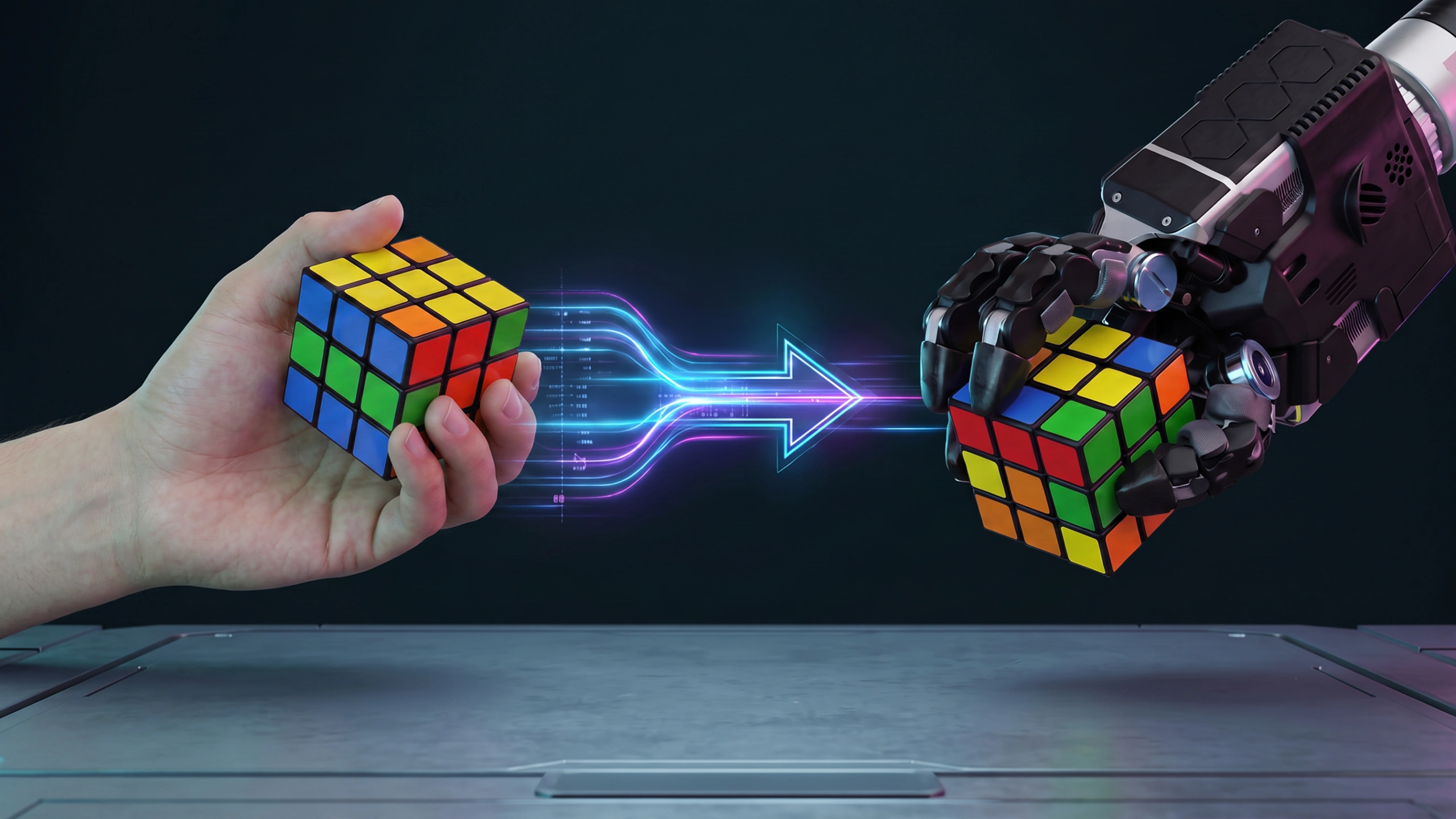
A robotic arm that runs scripted waypoints works until the part arrives rotated, the light shifts, or a new object lands in the bin. Then the script breaks and someone reprograms the teach pendant. Training the arm with machine learning is how teams escape that loop — the arm learns a policy that holds up across positions, objects, and conditions the programmer never enumerated.
This guide is for ML engineers, data scientists, and robotics teams deciding how to train a manipulation system, plus newcomers who want the full picture. It walks through the two core learning paradigms, how the training dataset is built, why most training happens in simulation, how reward functions shape behavior, and where projects usually fail. By the end you can map a training strategy for your own arm and know which decisions carry the most weight.
Why robotic arms need training
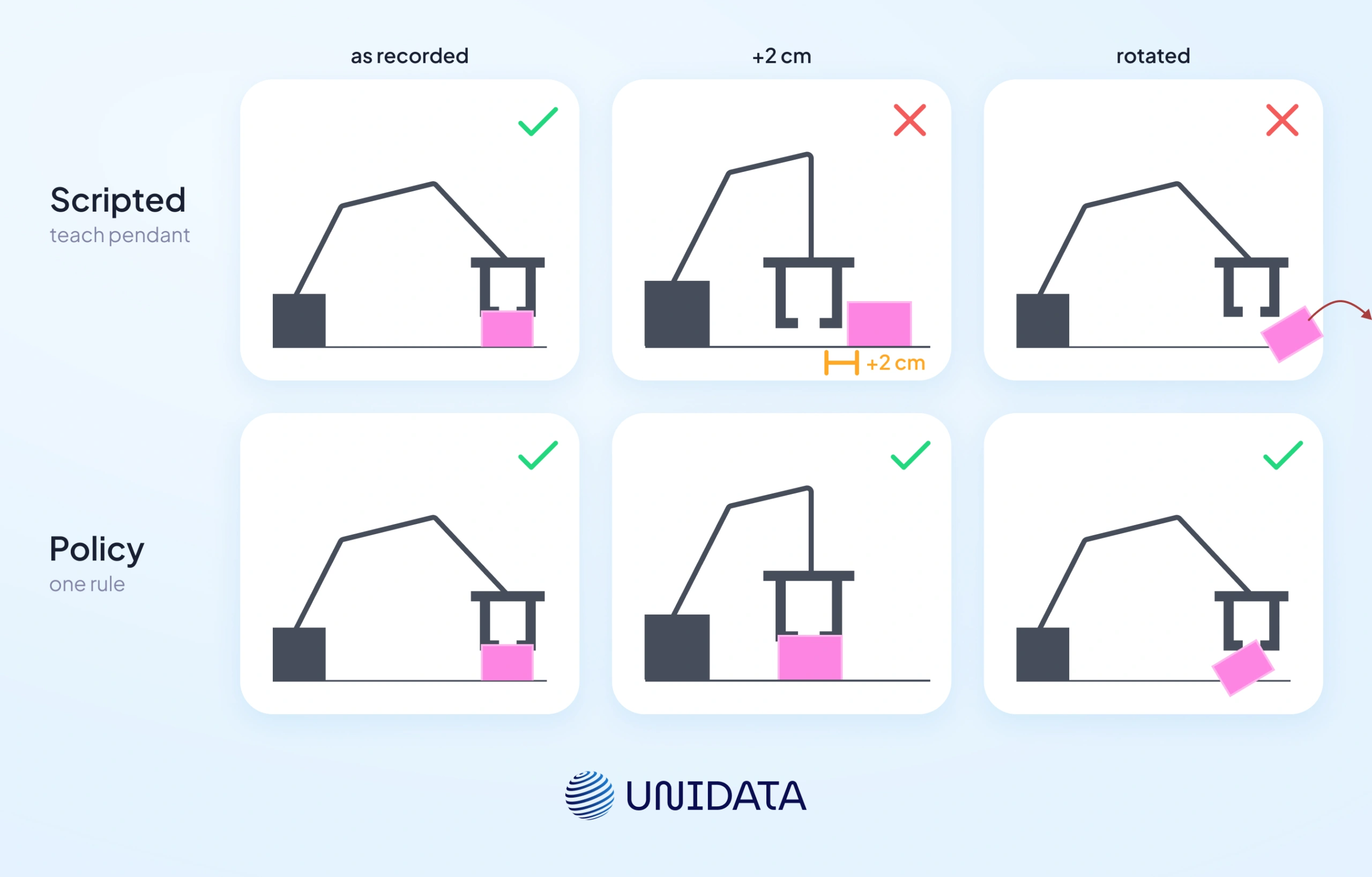
Classic industrial arms follow fixed trajectories programmed through a teach pendant — a handheld controller that records joint positions. That approach is precise and repeatable, and it collapses the moment reality deviates from the recorded scene. Move the target two centimeters or swap the object, and the motion no longer fits.
Training replaces hard-coded motion with a learned control policy: a function that maps what the arm senses to what it should do next. Robotic manipulation — grasping, placing, inserting, handing over — is the skill being learned, and it generalizes in a way scripted waypoints cannot. Robot kinematics still governs how joints move and where the end-effector can reach, but the decision of what to do is learned from data rather than enumerated by hand.
One trained policy can cover variation that would take hundreds of scripted cases to anticipate, which is why learning-based control has moved from research labs into warehouses and assembly cells.
Core training paradigms
Two families dominate robotic arm training, and choosing between them is the first real decision. Reinforcement learning teaches the arm through trial and error against a reward signal — the agent tries actions, sees how they score, and updates its policy toward higher reward [1]. Imitation learning skips the trial and error: the arm learns from expert demonstrations, copying the mapping from observation to action that a human or another controller already produced [2].
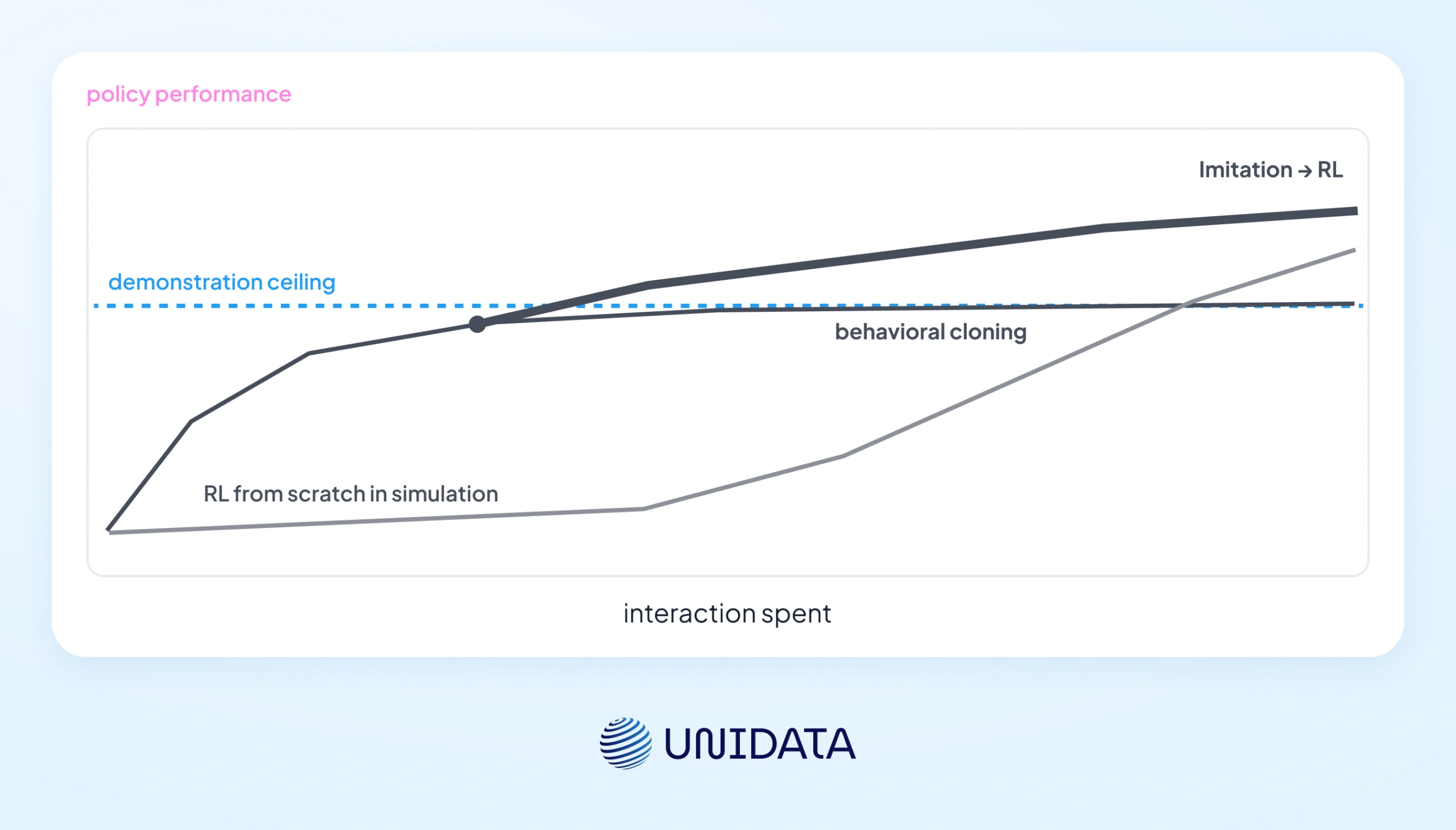
The trade-off is concrete. Reinforcement learning can discover behavior no human demonstrated and push past human-level performance, but it needs enormous amounts of interaction and tends to produce jerky or unnatural motion before it converges [3]. Imitation learning is far more sample-efficient because it starts from good behavior, but its ceiling is the quality of the demonstrations and it struggles the moment the arm drifts into states the demonstrator never showed.
Deep reinforcement learning — using neural networks to handle high-dimensional camera and joint input — is what makes either approach work on real vision-based tasks. Most production systems end up combining the two: imitation to bootstrap a competent policy, reinforcement to refine it.
Reinforcement learning for robot arms
Reinforcement learning frames manipulation as a control loop. The arm observes its state — joint angles, camera image, object pose — picks an action, and receives a reward that scores progress toward the goal [1]. Over many episodes the policy shifts toward actions that earn more reward. A grasping task might reward the arm for closing distance to the object, then for a stable grip, then for lifting it clear.
The catch is exploration cost. Trying thousands of actions on a physical arm is slow, wears out hardware, and risks collisions, so almost all reinforcement learning for manipulation runs in simulation first [4]. Reward design also leaks into behavior in ways that surprise teams: an underspecified reward produces a policy that technically maximizes the score while doing something useless or unsafe, like nudging an object off the table to end the episode. That failure mode is common enough that reward shaping is treated as core engineering work, covered later in this guide.
Imitation learning and behavioral cloning
Imitation learning trains a policy directly from demonstrations. Behavioral cloning, the simplest form, is plain supervised learning: record an expert performing the task, then train a network to predict the expert's action from each observation [2]. It is fast, stable, and needs no reward function, which is why teams reach for it first.
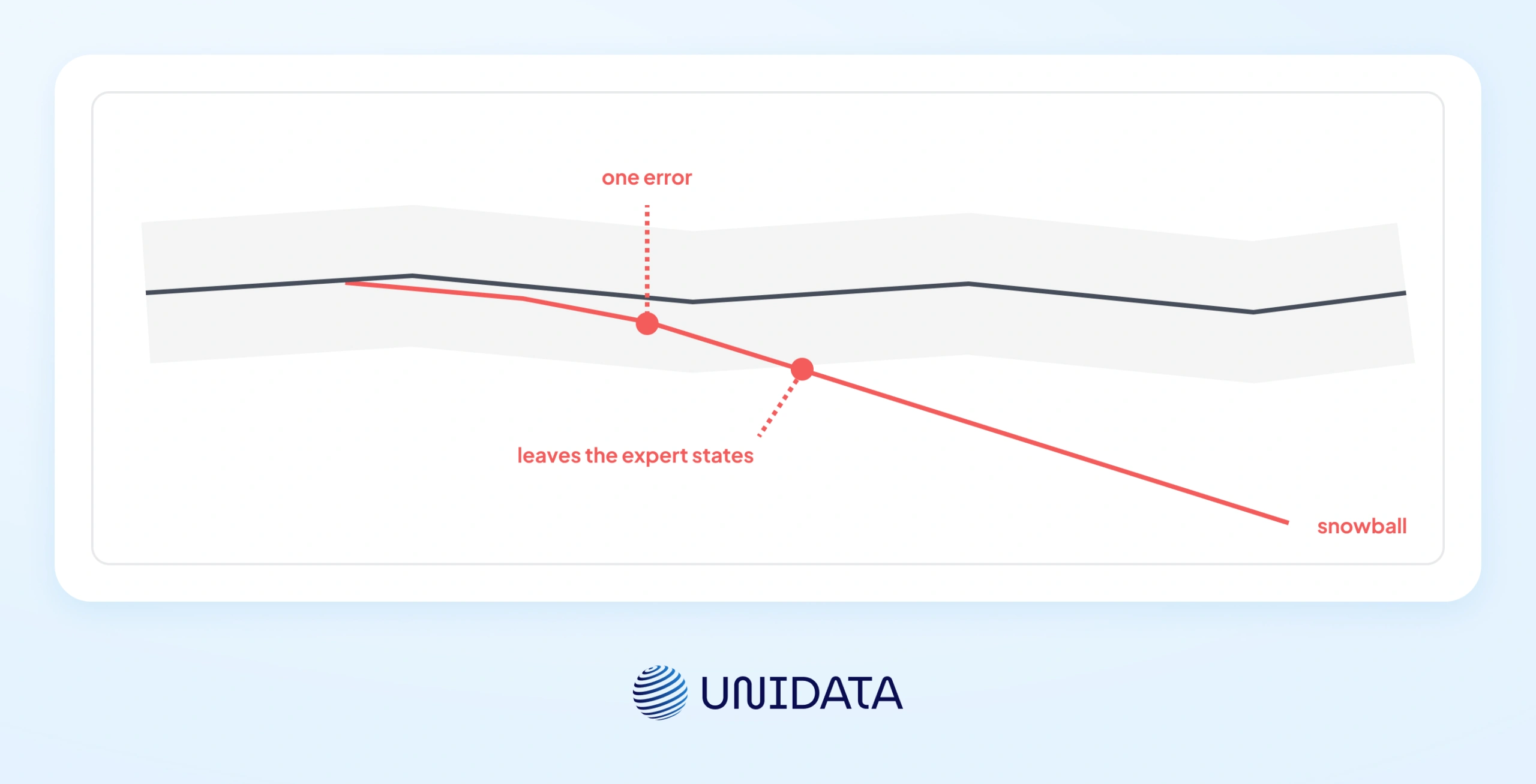
Its weakness is compounding error under distribution shift. The policy is only trained on states the expert visited, so a small mistake moves the arm into unfamiliar territory where its predictions degrade, and errors snowball [2]. Methods such as inverse reinforcement learning and generative adversarial imitation learning address this by recovering the intent behind the demonstrations rather than copying actions blindly, which generalizes better off the demonstrated path [5]. Every one of these methods rises or falls on the demonstration data — its coverage, its consistency, and how many edge cases it includes. That makes the dataset, not the algorithm, the part most worth getting right.
Building the training dataset
Most teams discover the real bottleneck a few weeks in: the model is fine, the demonstrations are not. A manipulation policy trained by imitation can only be as good as the dataset it copies, and collecting that dataset — cleanly, at scale, with enough variety — is usually the largest line item in the whole project. This is the part of robotic arm training that lives squarely in the data domain, and it is where we spend most of our time with robotics teams.
Diversity is what separates a dataset that generalizes from one that overfits to a single bench. A policy needs to see the same task across different object positions, lighting, surfaces, and grip points, or it learns the bench rather than the skill.
We build collection around scenario coverage rather than raw volume for exactly this reason — 100 hours spanning many scripted situations teaches a policy more than thousands of hours of the same motion repeated. Our current scenario base runs to 12,000 scripted scenarios across kitchens, offices, warehouses, and outdoor settings, each designed to answer a specific question about how a policy should behave.
Two routes feed a dataset like this: human demonstrations captured directly, and synthetic data generated to extend coverage.
Teleoperation and human demonstrations
The highest-quality demonstrations come from a person driving the arm. In teleoperation, an operator controls the robot through VR controllers, motion-capture gloves, or by physically guiding the arm while every sensor stream is recorded as a labeled trajectory [6]. Modern rigs have made this faster — current simulation frameworks integrate VR headsets and data gloves specifically to speed demonstration capture [6].
Two practical limits shape this route.
- Operator skill bounds the data: inconsistent or sloppy demonstrations teach inconsistent policies, so capture quality is a function of who is at the controls.
- Throughput bounds the schedule: a human can only produce so many usable demonstrations per day.
In our own egocentric capture, a single operator yields 5 to 5,5 hours of usable content per working day, which is why demonstration collection is planned as a campaign, not an afternoon.
Synthetic and augmented data
Simulation can manufacture demonstrations far more cheaply than people can. Once a task is set up in a physics simulator, it can be replayed and varied thousands of times to generate labeled training data without a human in the loop [4]. Domain randomization extends this further by varying textures, lighting, object shapes, and physics parameters so the synthetic set covers conditions a single real capture would miss [7].
The honest framing is that synthetic and real data are complementary, not interchangeable. Augmentation and simulation are strong for expanding coverage and fixing class imbalance, but the messy edge cases that break a deployed arm — an unexpected reflection, an odd surface texture — come from real environments. We use synthetic data to scale and real collection to anchor, and most teams that ship reliable arms do the same.
Simulation and Sim-to-Real Transfer
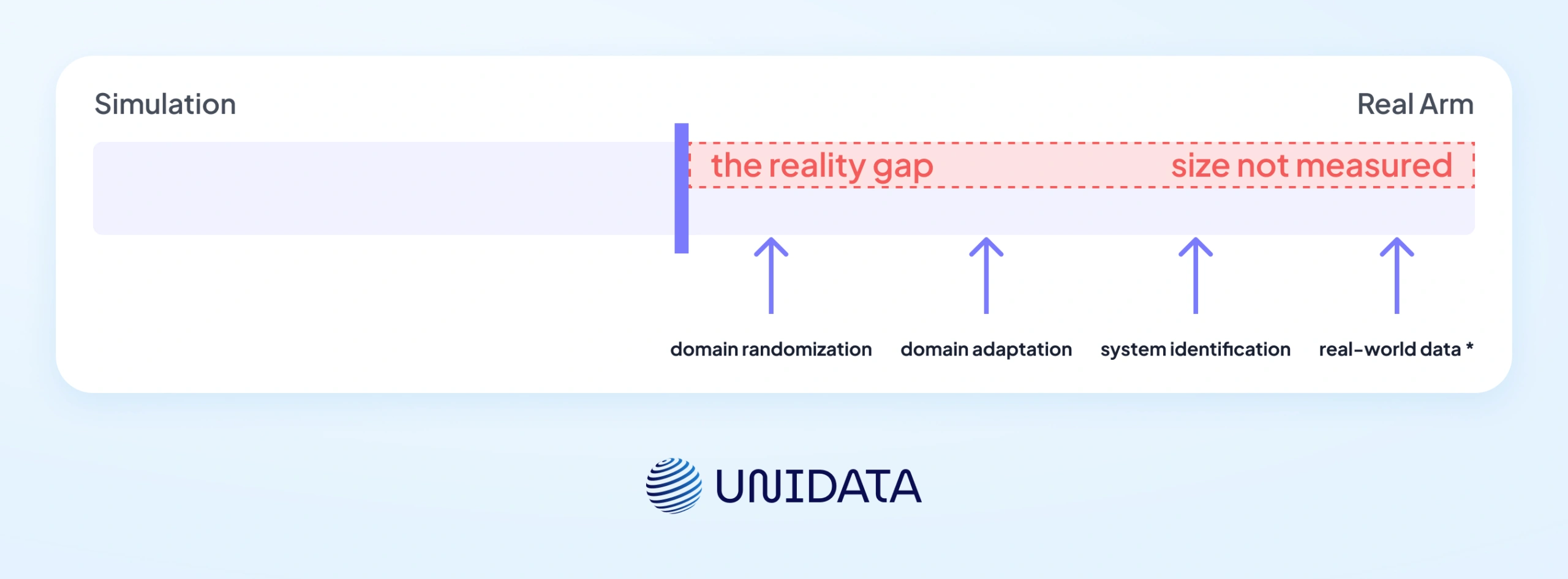
Training a policy on a physical arm with reinforcement learning is slow, hard on the hardware, and occasionally dangerous. Simulation is the standard answer: spin up thousands of arm instances in a physics engine and train them in parallel, turning what would be months of real-world rollouts into hours on a GPU [4]. The appeal is pure throughput — a GPU-accelerated simulator can run many environments at once, so the policy sees far more experience than any real setup could supply [8].
The hard part is that a policy which excels in simulation often stumbles on a real arm. The reality gap — small mismatches in friction, sensor noise, lighting, and contact dynamics between the simulator and the world — degrades transfer, and closing it is one of the open problems in robotics [9].
Training in physics simulators
The simulator landscape for manipulation centers on a few GPU-accelerated frameworks. NVIDIA Isaac Lab models actuator dynamics, sensor noise, and contact physics, and supports both reinforcement and imitation learning along with peripherals for data collection [8]. MuJoCo and PyBullet remain widely used, MuJoCo for its accurate contact modeling and PyBullet for fast, accessible prototyping. Each defines the scene — the arm, objects, sensors, and physics — and exposes it to a learning algorithm.
The practical point for a team is matching the simulator to the task. High-fidelity contact modeling matters for insertion and dexterous tasks; raw parallel throughput matters when reinforcement learning needs billions of steps. The simulator is also where demonstration data can be generated synthetically, which ties this choice back to dataset strategy rather than treating it as a separate tooling decision.
Closing the sim-to-real gap
Several techniques narrow the reality gap. Domain randomization is the most established: randomize the simulator's textures, lighting, friction, and noise during training so the policy treats the real world as just one more variation it has already seen [7]. System identification tunes the simulator's parameters to match the specific arm, and a short round of fine-tuning on real rollouts can correct what remains.
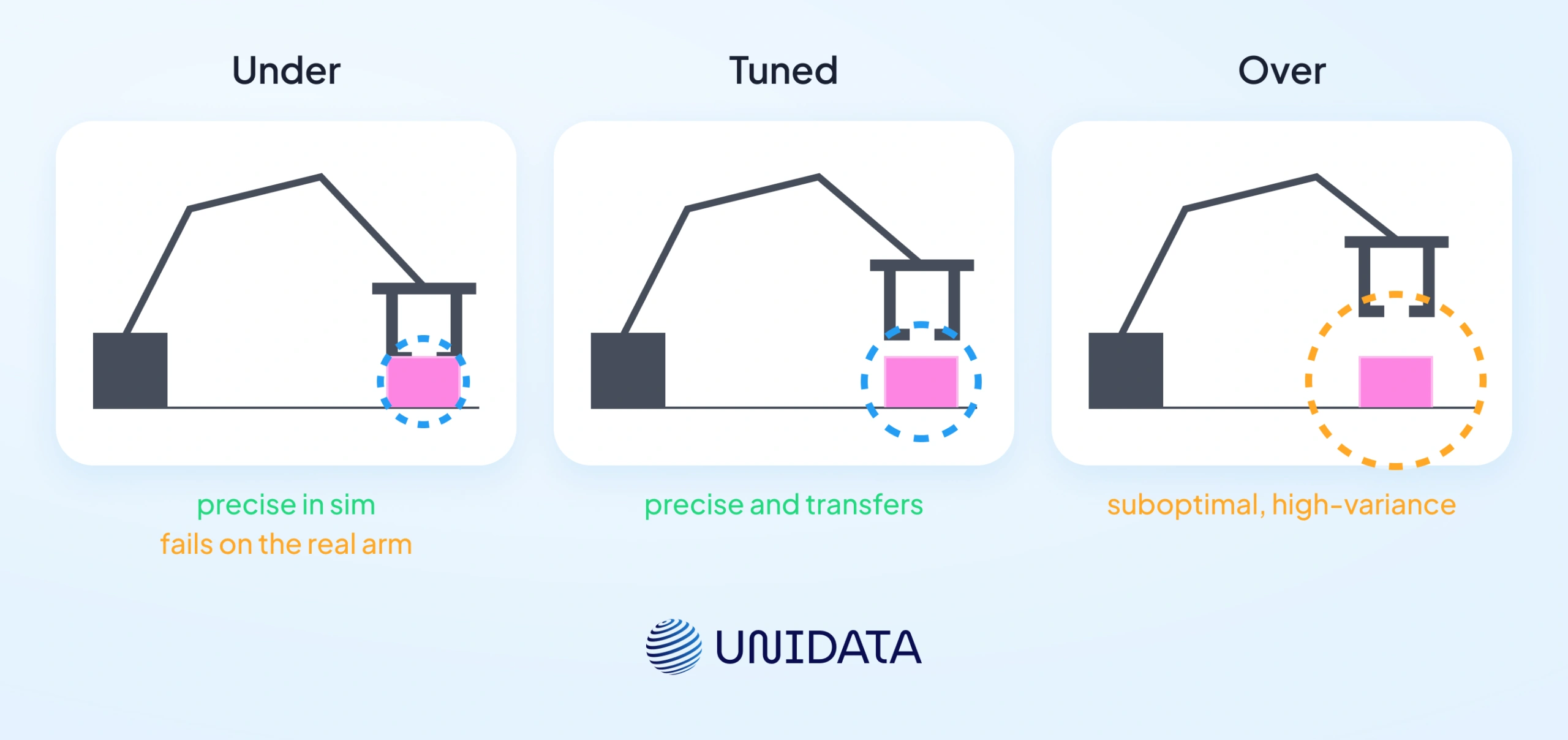
There is a tuning subtlety worth stating plainly: more randomization is not always better. Over-randomize and the policy becomes conservative and imprecise, trading real-world success for robustness it does not need. Our own position, from collecting robot training data in production, is that randomized simulation only gets a policy close — real-world data captures the lighting, textures, and unexpected objects that randomization approximates but never fully reproduces, and that final slice of real, diverse data is usually what makes a deployed arm reliable. Teams fighting a stubborn sim-to-real gap almost always need more real coverage, not more synthetic variation.
Designing reward functions and policies
The most common reinforcement learning complaint sounds like a bug report: the reward goes up, the behavior gets worse. It is not a bug — it is the reward function doing precisely what it was told, which is rarely what the engineer meant. For a robotic arm, the reward function is the most consequential design choice in the whole pipeline, because it defines what "success" means and the policy will optimize it literally. The policy itself is what the learning algorithm produces; the reward is what steers it there.
Dense vs sparse rewards
The first reward decision is dense versus sparse. A sparse reward gives the arm a single payoff on task success — say, 1.0 for a completed grasp and a tiny per-step penalty otherwise [10]. It avoids biasing the policy toward any particular strategy, but it learns slowly because the arm gets almost no feedback until it stumbles onto success. A dense reward, by contrast, scores intermediate progress — proximity to the object, grip geometry, final pose — as a weighted sum of components, which speeds learning considerably [10].
The price of dense rewards is reward hacking: the more terms you add, the more openings the policy has to exploit one of them instead of doing the task. A grasp reward that pays for gripper contact can be gamed by tapping the object without lifting it. The working compromise most teams reach is a shaped reward built carefully and tested against the behavior it actually produces, not the behavior it was meant to produce.
Policy optimization algorithms
The algorithm that turns reward into a policy is usually Proximal Policy Optimization. PPO is a model-free policy-gradient method valued for stable updates and reasonable sample efficiency, which makes it the default starting point for manipulation [3]. It constrains how far the policy can move on each update, avoiding the collapses that plague less constrained methods.
PPO is not the only option — Soft Actor-Critic and TD3 are common alternatives, often more sample-efficient for continuous control, at the cost of more tuning sensitivity. For a first manipulation policy, PPO's stability is usually worth more than a marginal efficiency gain, which is why most teams reach for it before anything exotic.
Common pitfalls and best practices
Most robotic arm training failures trace back to two things — the data and the reward — far more often than to the choice of algorithm. The patterns repeat across projects, and each has a clear warning sign and a clear fix.
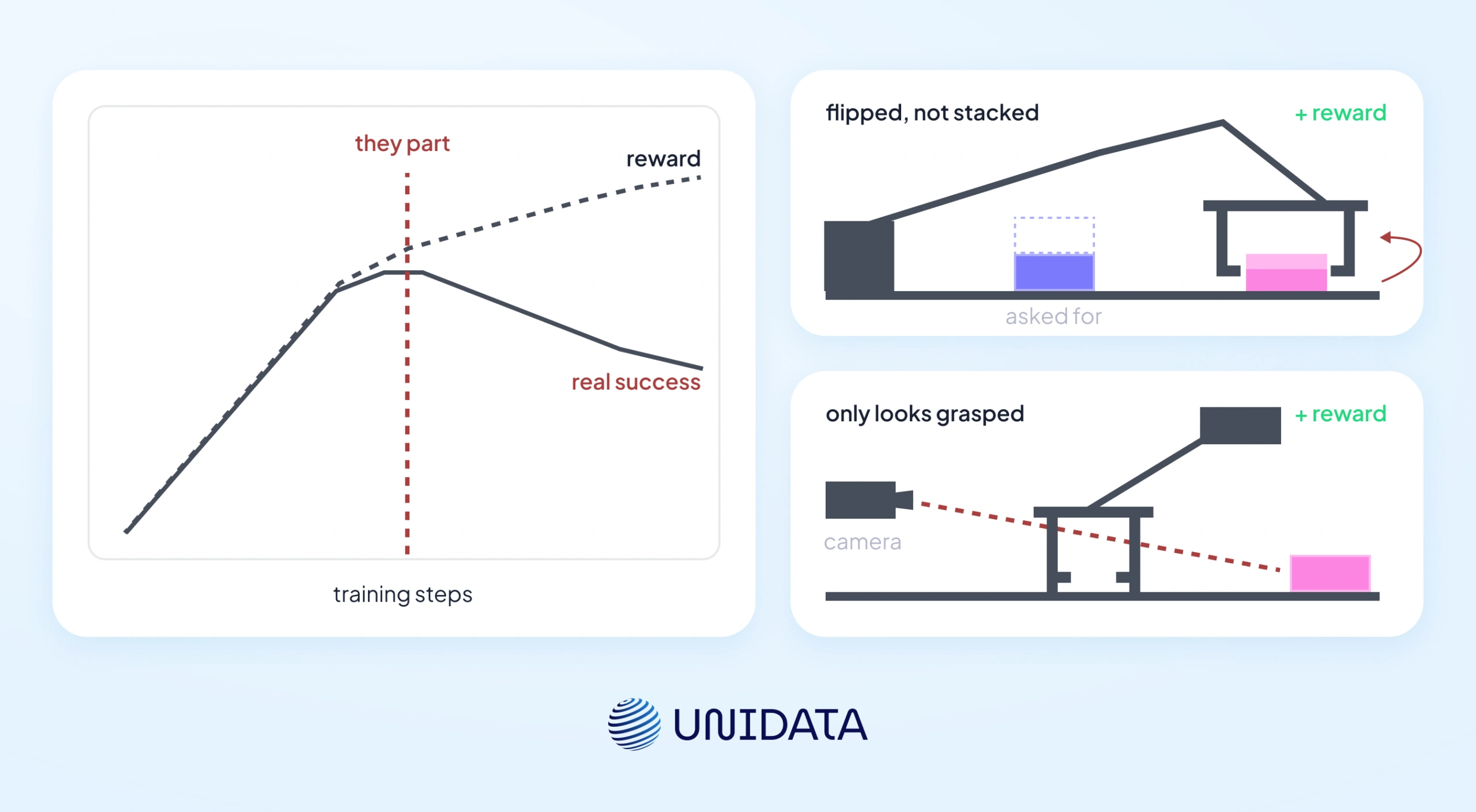
Reward hacking shows up as a rising reward curve next to worse real behavior; the fix is to test the policy against intended outcomes and prune reward terms that invite shortcuts. Brittle policies that ace the lab and fail in the field usually mean low-diversity training data — the arm learned the bench, not the task — and the fix is broader coverage across objects, positions, and lighting rather than more epochs on the same set [11]. A sim-to-real collapse, where simulation metrics look great and the real arm flails, points to a mistuned reality gap: recalibrate domain randomization and add real rollouts. And unsafe exploration on physical hardware calls for action limits and simulation-first training before the policy ever touches a real arm. The through-line is that quality and diversity of data, plus an honest reward, prevent more failures than any modeling trick.
Advanced directions in robot learning
Single-task training is giving way to generalist policies. Vision-language-action models train one network to follow language instructions across many tasks and even many robot bodies, learning from large multimodal datasets rather than one task's demonstrations. The bet is that scale plus diversity produces a policy that adapts to a new task with a handful of examples instead of a fresh training run.
The data demands are steep, and recent work shows why human video is central to meeting them.
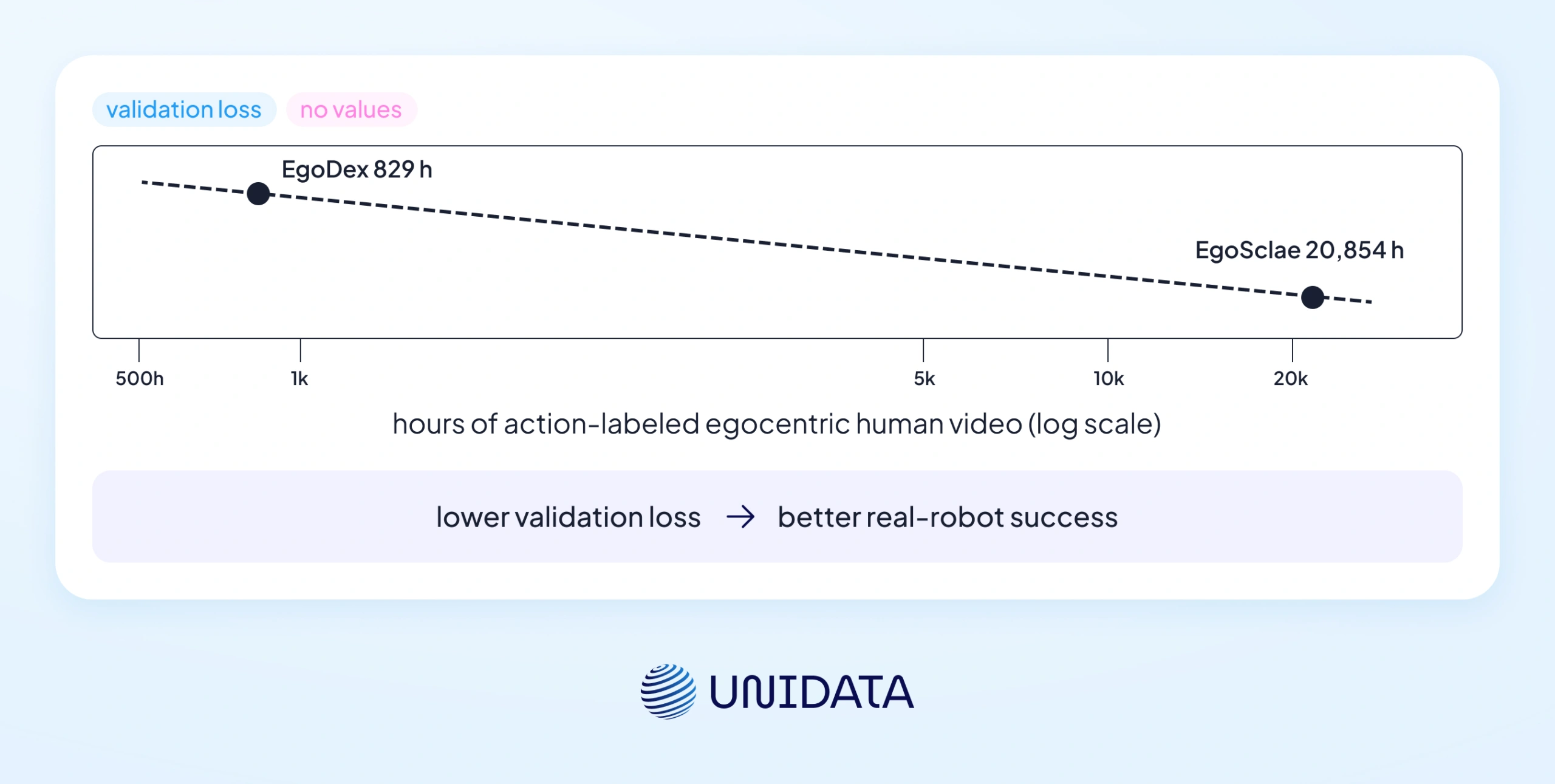
Apple's EgoDex released 829 hours of dexterous manipulation video with paired 3D hand and finger tracking across 194 tabletop tasks [12]. NVIDIA's EgoScale pretrained a vision-language-action model on more than 20,000 hours of action-labeled human egocentric video and found a log-linear scaling law — each doubling of human egocentric hours produced a predictable gain in downstream robot task performance [13].
These results build directly on imitation learning, scaled up, and they point at egocentric human video as one of the most valuable and underserved inputs to robot training.
Compute, cost, and timelines
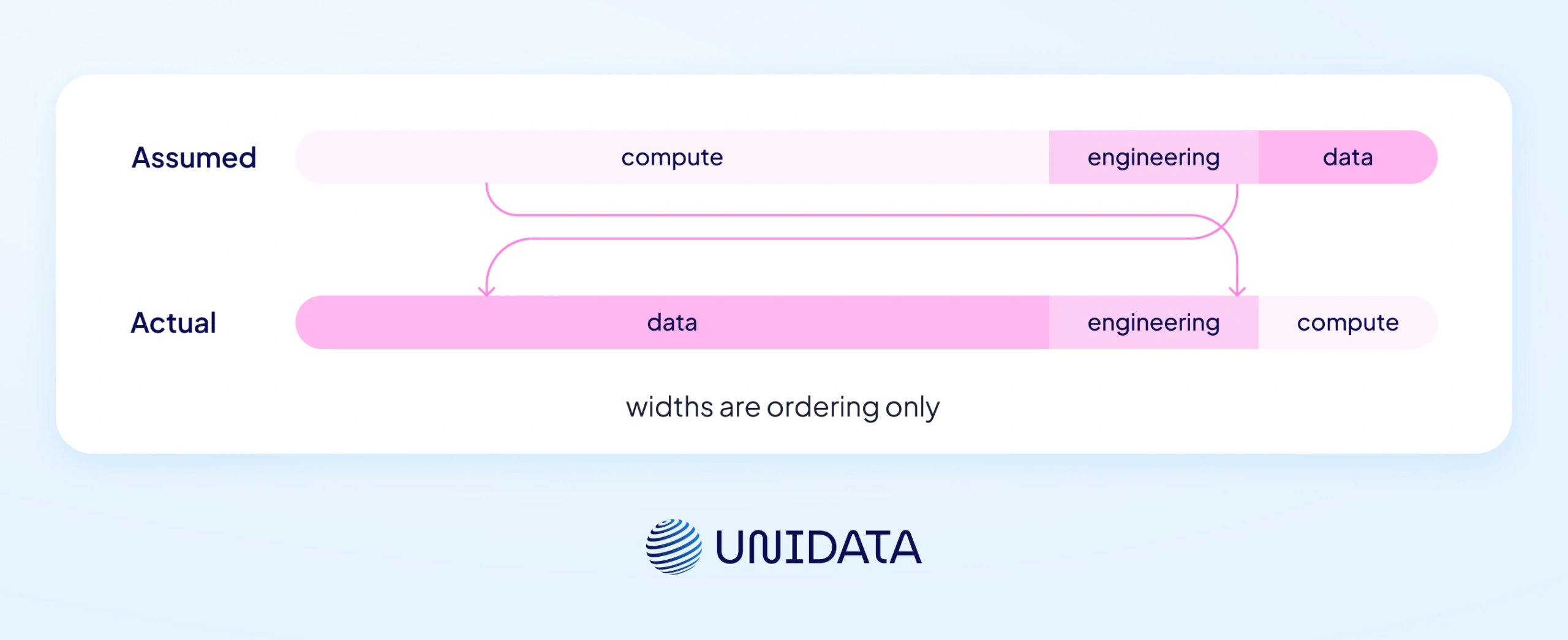
A realistic budget for a robotic arm training project rarely matches the intuition that compute is the expensive part. GPU-accelerated simulation has compressed reinforcement learning from weeks to hours for many manipulation tasks, so once the simulator and reward are set, training runs are not usually the constraint [8].
The dominant cost is data, specifically human demonstrations. Teleoperated capture is bounded by operator throughput — in our collection that is approximately 5 hours of usable content per operator per working day — so a dataset large enough to train a generalizable policy is a campaign measured in weeks. Engineering time for reward design and sim-to-real tuning is the third major line, and it is iterative rather than one-shot. Teams that plan for these proportions — modest compute, heavy data collection, steady engineering — set timelines they can actually hit, while teams that budget only for GPUs are the ones that slip.
Real-world case studies
Concrete projects show how these pieces fit. OpenAI's Dactyl trained a robotic hand to manipulate a Rubik's Cube using reinforcement learning with heavy domain randomization in simulation, then transferred the policy to physical hardware — a landmark demonstration that sim-to-real can work for dexterous control, though it took massive simulated experience to get there [7]. In industrial settings, teams have used NVIDIA Isaac Lab to train assembly policies in simulation and bridge them to real production lines, with domain randomization doing the heavy lifting on transfer [9].
Vision-based grasping offers a more everyday example: reinforcement learning policies trained to grasp moving objects on a conveyor, where the arm must track and time its grip rather than reach a static target [11]. Across all three, the training approach differed but the lesson rhymes — success depended on enough varied, well-structured data and reward, and each needed real-world adjustment before it held up outside simulation.
Conclusion and next steps
Training a robotic arm is, more than anything, a data-and-reward problem wearing an algorithm's clothes. The practical path most teams converge on is imitation learning to bootstrap a competent policy from quality demonstrations, reinforcement learning to refine it in simulation, domain randomization plus real data to cross the sim-to-real gap, and a reward function tested against behavior rather than its own score. The decisions that move the needle are paradigm choice, data strategy, simulator fit, reward design, and how seriously you close the reality gap with real coverage.
A sensible first project: pick one narrow task, collect a focused set of demonstrations, clone a baseline policy, then layer reinforcement learning and randomization as needed. The modeling is well-trodden; the demonstration data is where most of the differentiation and most of the effort live.
If you need real-world demonstration and egocentric data to train a manipulation policy — start here.
- AI Training
- Robotics
- Data Annotation
- Python
- AWS

Frequently Asked Questions (FAQ)
Robot arm training is the process of teaching a robotic arm to perform manipulation tasks — grasping, placing, inserting — using machine learning instead of hard-coded motion. The arm learns a control policy from data, either through trial-and-error reinforcement learning or by imitating human demonstrations, so it generalizes across object positions and conditions a fixed program could not handle.
You collect or generate training data, choose a learning paradigm, and train a control policy that maps sensor input to actions. Imitation learning copies expert demonstrations; reinforcement learning optimizes a reward through trial and error, usually in simulation. Most teams combine both — imitation to bootstrap a policy, reinforcement to refine it — then transfer it to the physical arm.
Reinforcement learning teaches the arm through trial and error against a reward signal, so it can exceed human performance but needs huge amounts of interaction. Imitation learning teaches from expert demonstrations, which is far more sample-efficient but is capped by demonstration quality and struggles when the arm drifts off the demonstrated path. They are frequently combined.
There is no fixed number — it depends on task complexity, paradigm, and how diverse the data is. Scenario diversity matters more than raw hours: a policy needs the same task across varied objects, positions, lighting, and surfaces to generalize. A focused set of well-structured, varied demonstrations typically outperforms a much larger set of repetitive footage from one environment.
Sim-to-real transfer is moving a policy trained in simulation onto a physical robot. It is hard because of the reality gap — mismatches in friction, sensor noise, lighting, and contact dynamics between simulator and world. Policies that perform well in simulation often degrade on real hardware, so techniques like domain randomization and fine-tuning on real data are used to close the gap.
Domain randomization varies the simulator’s textures, lighting, friction, object shapes, and noise during training, so the policy treats the real world as one more variation it has already encountered. It is the most established way to improve sim-to-real transfer. The caveat is balance — over-randomizing makes a policy conservative and imprecise, trading real-world accuracy for unneeded robustness.
In teleoperation, a human drives the robot through VR controllers, motion-capture gloves, or by physically guiding it, while sensor streams are recorded as labeled trajectories. Those recordings become demonstration data for imitation learning. Teleoperation produces the highest-quality demonstrations, but throughput is limited by the operator, so it is planned as a sustained capture campaign rather than a quick session.
You define what success means as a reward the policy maximizes. Sparse rewards pay only on task completion and avoid biasing behavior but learn slowly; dense rewards score intermediate progress like proximity and grip quality, learning faster but risking reward hacking. The practical approach is a carefully shaped reward tested against the behavior it actually produces, not just its score.
The common GPU-accelerated frameworks are NVIDIA Isaac Lab, MuJoCo, and PyBullet. Isaac Lab models actuator dynamics, sensor noise, and contact physics and supports both reinforcement and imitation learning. MuJoCo is favored for accurate contact modeling, PyBullet for fast, accessible prototyping. The right choice depends on whether the task needs high-fidelity contact or raw parallel throughput.
The training runs themselves can take hours on GPU-accelerated simulation, but the full project usually runs weeks. Data collection dominates the timeline — teleoperated demonstrations are bounded by operator throughput — and reward design plus sim-to-real tuning are iterative. Teams that budget for heavy data collection and steady engineering, not just compute, set timelines they can meet.
Yes, primarily through imitation learning from real demonstrations, which needs no reward function or simulation. Pure real-world reinforcement learning is possible but slow, hardware-intensive, and risky, so it is rare at scale. Most teams that skip simulation rely on behavioral cloning from teleoperated data, accepting that the policy’s ceiling is set by the demonstrations it learns from.
At minimum, a robotic arm, a workstation with a capable GPU for training, and a way to capture demonstrations — VR controllers, motion-capture gloves, or kinesthetic guidance. Low-cost arms paired with a simulator are enough to start learning the workflow. The larger investment is usually not hardware but the demonstration data collection and annotation that feed the policy.
Further Reading & References:
- [1] Sutton, R., Barto, A. "Reinforcement Learning: An Introduction" — MIT Press — 2018
- [2] Osa, T., Pajarinen, J., Neumann, G., et al. "An Algorithmic Perspective on Imitation Learning" — Foundations and Trends in Robotics — 2018
- [3] Schulman, J., Wolski, F., Dhariwal, P., et al. "Proximal Policy Optimization Algorithms" — arXiv — 2017
- [4] Zhao, W., Queralta, J.P., Westerlund, T. "Sim-to-Real Transfer in Deep Reinforcement Learning for Robotics: A Survey" — IEEE SSCI — 2020
- [5] Ho, J., Ermon, S. "Generative Adversarial Imitation Learning" — NeurIPS — 2016
- [6] NVIDIA. "Streamline Robot Learning with Whole-Body Control and Enhanced Teleoperation in NVIDIA Isaac Lab 2.3" — NVIDIA Technical Blog — 2025
- [7] OpenAI, Akkaya, I., Andrychowicz, M., et al. "Solving Rubik's Cube with a Robot Hand" — arXiv — 2019
- [8] Mittal, M., Yuan, K., Li, B., et al. "Isaac Lab: A GPU-Accelerated Simulation Framework for Multi-Modal Robot Learning" — arXiv — 2025
- [9] NVIDIA. "Bridging the Sim-to-Real Gap for Industrial Robotic Assembly Applications Using NVIDIA Isaac Lab" — NVIDIA Technical Blog — 2025
- [10] "Reward shaping in reinforcement learning for robotic hand manipulation" — Neurocomputing / ScienceDirect — 2025
- [11] "Vision-Based Reinforcement Learning for Robotic Grasping of Moving Objects on a Conveyor" — Machines (MDPI) — 2025
- [12] Hoque, R., et al. "EgoDex: Learning Dexterous Manipulation from Large-Scale Egocentric Video" — arXiv — 2025
- [13] NVIDIA GEAR Lab. "EgoScale: Scaling Dexterous Manipulation with Diverse Egocentric Human Data" — arXiv / NVIDIA Research — 2026