
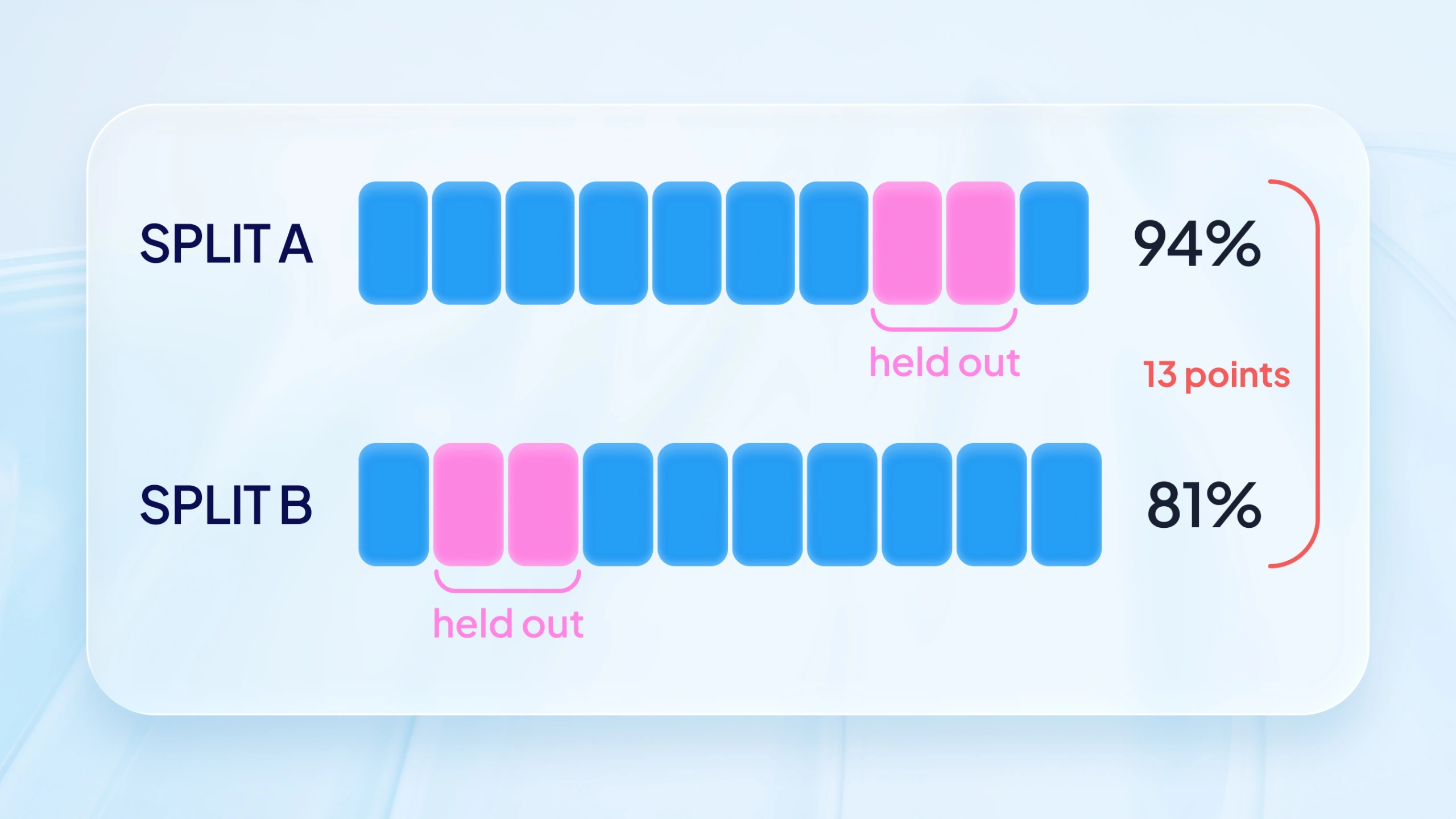
A model that scores 94% on one train-test split can score 81% on a different split of the exact same data. Nothing about the model changed: only which rows landed in the test set. That instability is what k-fold cross-validation is built to remove. It rotates the validation role across several partitions of the data and averages the result, so no single split decides the number.
This matters most right before a model selection decision or a deployment sign-off. Those are the moments when a single lucky or unlucky split can point you at the wrong model. Below: how the procedure works, how to pick k, which variant fits which data, and the leakage mistakes that quietly invalidate the whole exercise.
Understanding cross-validation fundamentals
The mechanic states in one line. Hold back part of the data, fit the model on the rest, and score it on the part you held back. Statistician Mervyn Stone formalized this in 1974 as a general method for assessing how well a fitted model predicts data it has not seen, and the core of it has not changed since1. k-fold cross-validation is the most common implementation of that idea. It rotates the held-out block across the whole dataset, one block at a time, and averages the scores.
Here is why that is worth the extra compute. A model that fits the training data well can still fail on new data, because it memorized patterns specific to that training set and never learned the general structure of the problem. A single train/test split gives you one noisy read on whether that happened. Cross-validation gives you several, which is what makes the resulting estimate of generalization (how the model performs on data it never trained on) trustworthy enough to act on.
The limitations of single train-test splits
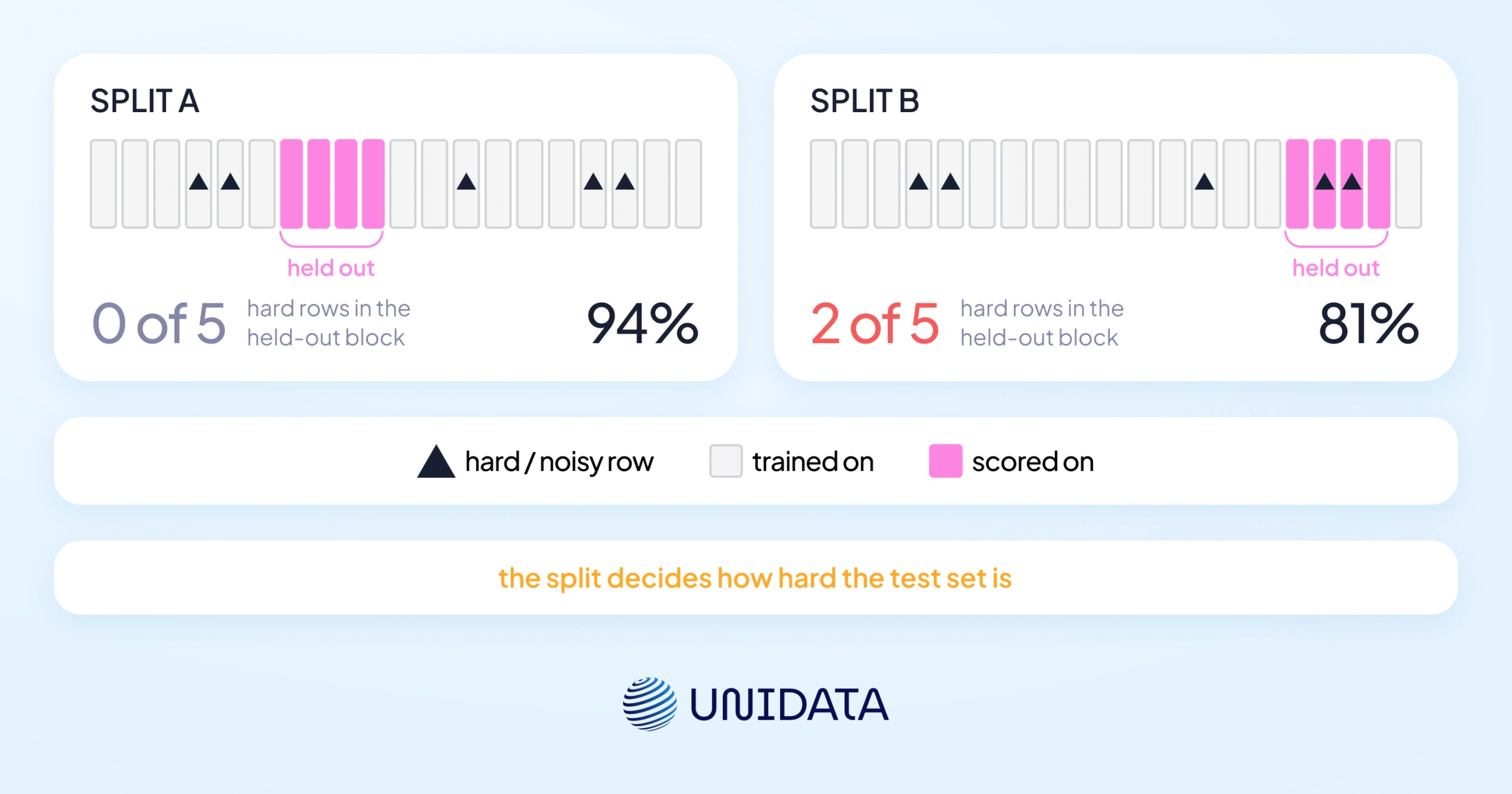
A single split is fast and easy to reason about, and that is also its weakness. The score you get is tied to one random partition, and a different partition of the same data can produce a meaningfully different number. Kohavi's 1995 comparison of validation strategies, run across more than half a million training runs on real-world datasets, found this variance large enough to change which model looks best; it recommended ten-fold cross-validation as the more reliable default2.
Noisy scores are the smaller problem. A split that happens to put the easy examples in the test set makes a weak model look strong; a split that concentrates the hard or noisy examples there makes a strong model look weak. Either way, you are choosing between models based partly on luck. k-fold cross-validation closes that gap by averaging over the sampling variation it cannot remove.
The role of cross-validation in modern machine learning
During experimentation, cross-validation lets you compare algorithms, feature sets, and preprocessing choices on equal footing; during tuning, it stops you from picking hyperparameters that only happen to fit one split. What it buys in both cases is data efficiency. Every row gets to be in a training set and in a validation set at some point, so the estimate firms up without a second dataset set aside for the purpose.
Two situations make it the wrong tool. If a held-out set is already reserved and untouched, that set answers the question cross-validation was going to answer. If a single training run costs GPU-days, the multiplier in the next section decides the matter before any statistical argument does.
What is k-fold cross-validation?
scikit-learn's documentation describes k-fold cross-validation plainly: split the data into k folds of roughly equal size, train on k−1 of them, validate on the one left out, and repeat until every fold has served as the validation set exactly once3. The k scores are then averaged into a single estimate.
This is a form of resampling. The same dataset is re-partitioned in a structured way, k times over, and that structure is what makes the result informative on its own: the k scores are a distribution, and the average is only one reading of it.
Core principles behind cross-validation
The number of folds controls a bias-variance trade-off: how far the estimate sits from the truth in one consistent direction (bias) against how much it swings from one sample to the next (variance). Runtime is only its visible half. Kohavi's study found that fold count trades the two against each other directly. Too few folds (k=2 or k=3) train each model on noticeably less data and can bias the estimate pessimistic. Too many folds increase variance and cost without adding much accuracy for most real-world datasets, which is why ten-fold cross-validation became the practical default rather than the theoretical maximum2.
The second principle is what the spread of fold scores tells you, and it gets its own section below. In short: a model whose scores jump around from fold to fold is sensitive to exactly which rows it sees, and that is worth knowing before it goes into production.
The mechanics of k-fold cross-validation
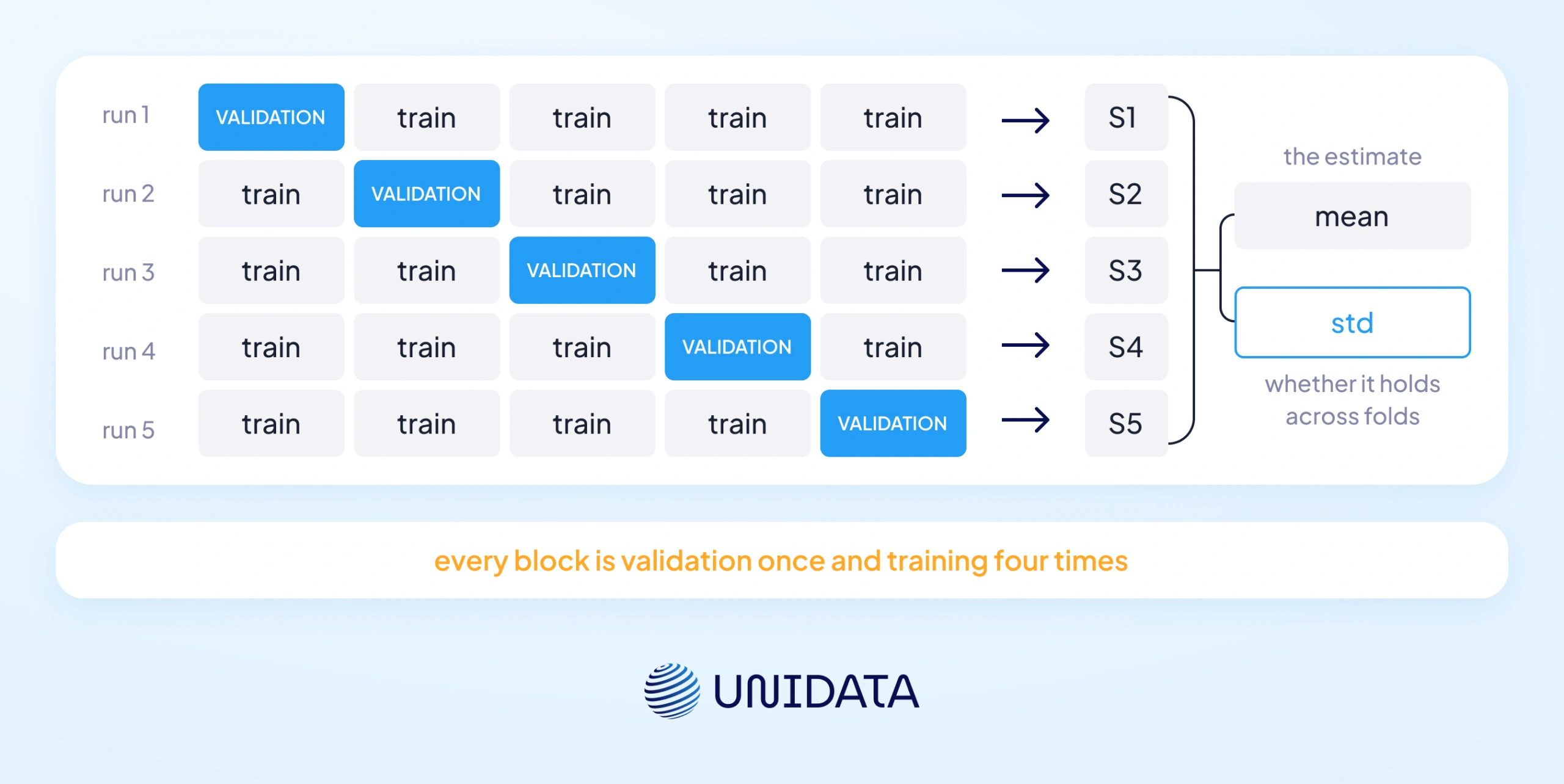
The procedure has few moving parts, but each one affects the result. First the data is shuffled (or kept in order, if order matters) and split into k folds of close to equal size. The model trains k separate times; each run holds out one fold for validation and trains on the rest. After each run you record a metric: accuracy or F1 for classification, RMSE for regression, AUC when what matters is ranking rather than a fixed threshold3.
Once all k runs finish, you report the mean of the k scores and, just as important, their standard deviation. Read that spread as a stability signal. Consecutive folds share most of their training rows, so their standard deviation is not the standard error of the mean, and treating it as one will make the estimate look more precise than it is.
Breaking down the k-fold process
In order, the steps are:
- Split the data into k folds.
- Hold out one fold as validation.
- Train on the remaining k−1 folds.
- Score the model on the held-out fold.
- Repeat steps 2–4 until every fold has been validation once.
- Average the k scores.
In production code, this loop should run inside a pipeline so preprocessing happens fold by fold rather than once on the whole dataset. Fitting it once on everything lets the validation rows shape the model before training starts, which is the leakage the section below is about.
Choosing the optimal value for k
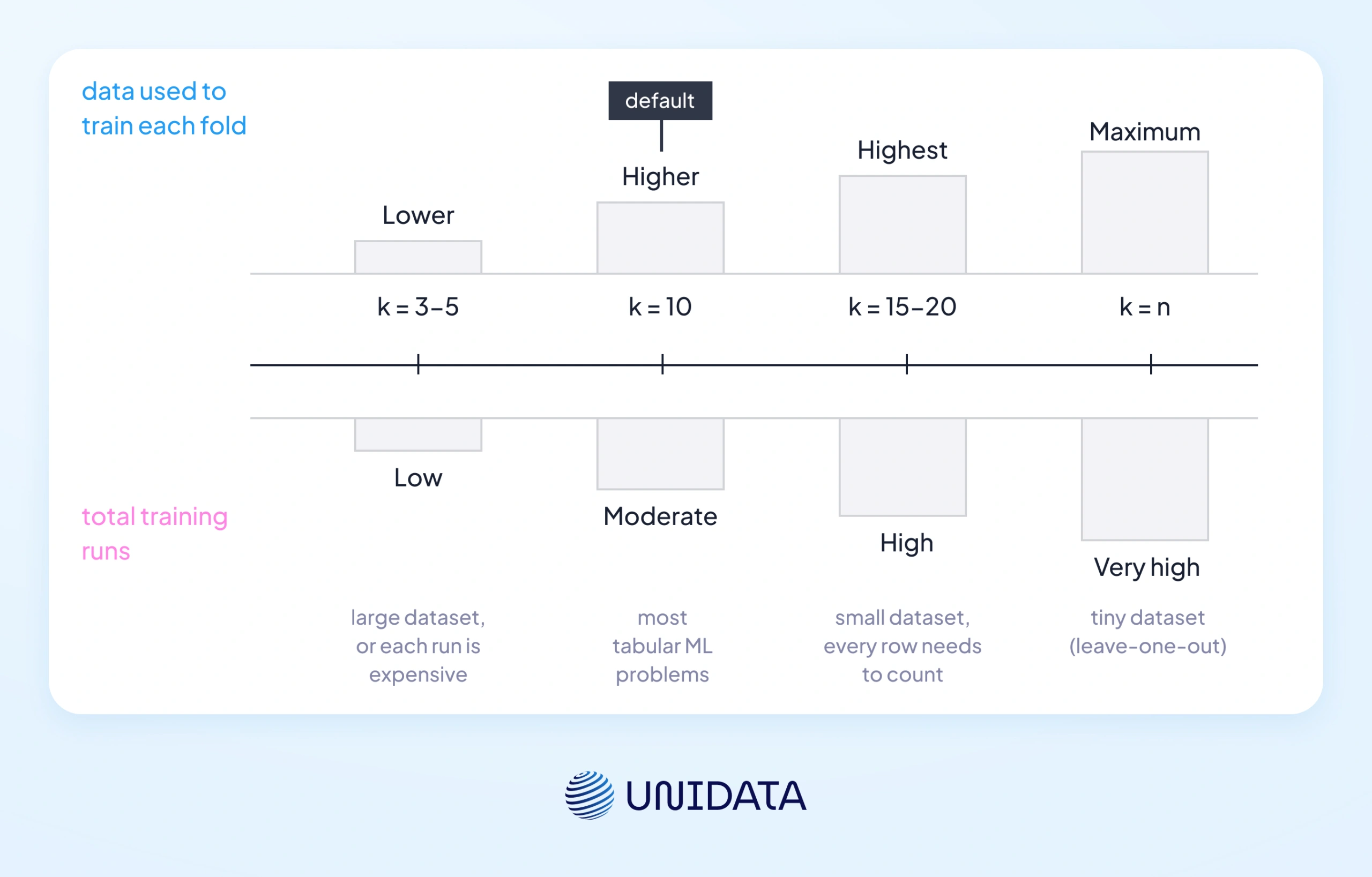
k=5 and k=10 cover most situations, and Kohavi's study is the reason: across a wide range of real-world datasets, ten-fold cross-validation gave the most reliable estimates, and going higher rarely improved on it enough to justify the extra runtime2. Smaller k trains each model on less data per fold but runs faster; larger k trains on more data per fold at the cost of more total training runs.
Calculating and interpreting cross-validation metrics
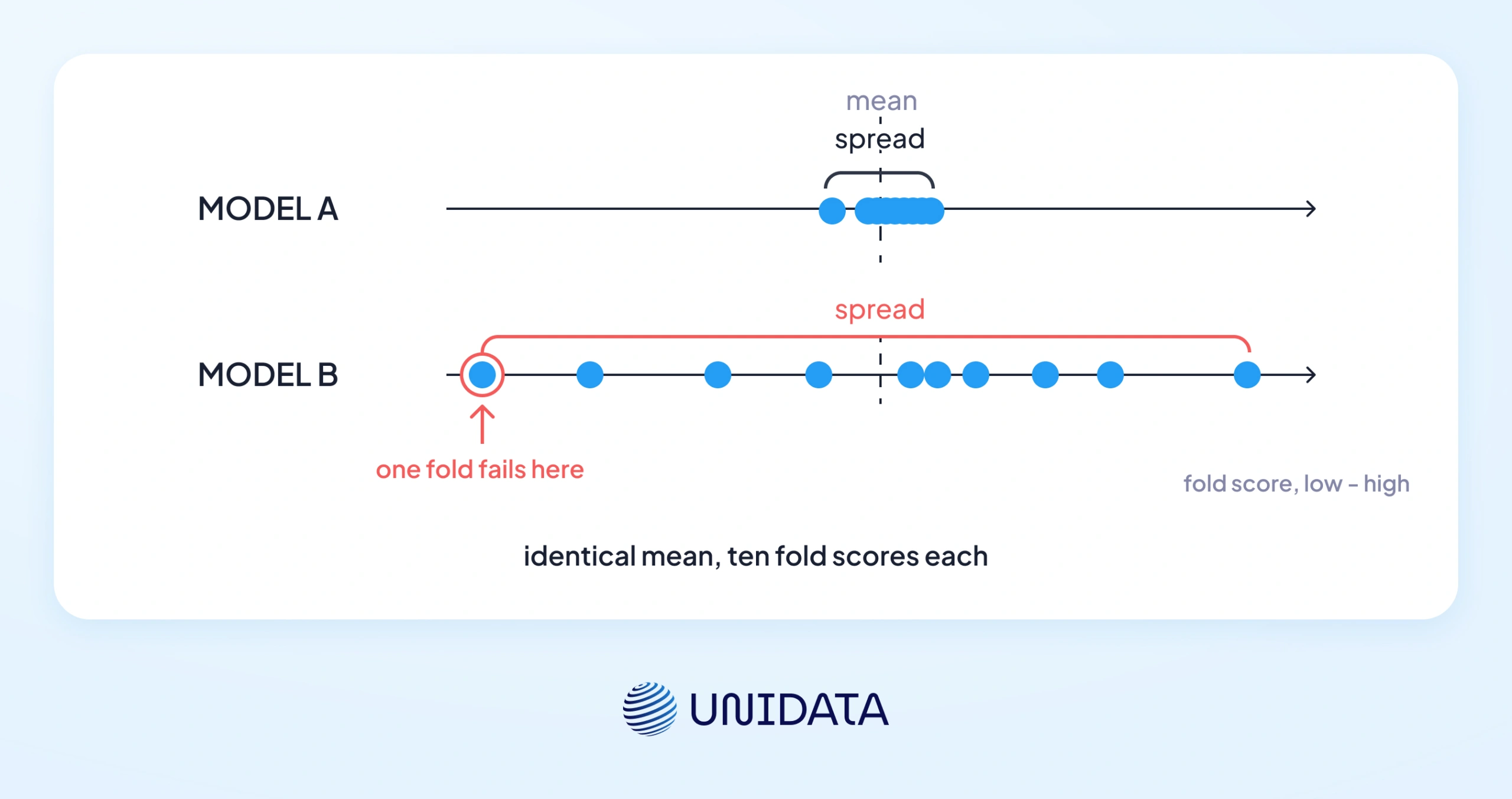
The mean score across folds is the headline number, but the standard deviation is doing the real work of telling you whether to trust it. Two models can post the same mean and differ entirely in reliability: one tight around its average, one swinging from a great fold to a mediocre one. A high mean with a wide spread means at least one fold is hiding a problem the average papers over.
Before blaming the model for that spread, rule out the labels. A handful of mislabeled rows concentrated in one fold can move that fold's score more than the modeling choice under review, and re-running the split will not settle which one moved it. Pull the rows from the worst-scoring fold and read them against the guideline they were labeled under. On the annotation side, the errors that survive review cluster: they sit where the guideline left a case undecided, so a fold carrying a lot of that case carries the errors with it. That is why the labels are the cheaper thing to check first.
If the spread turns out to be real and you still need a steadier estimate, repeat the whole procedure under different shuffles. RepeatedKFold and RepeatedStratifiedKFold average over the choice of partition itself, at the cost of multiplying the run count again.
Implementing k-fold cross-validation with Python
scikit-learn's model_selection module is the standard way to run this in Python, and the basic version takes only a few lines3:
from sklearn.model_selection import KFold, cross_val_score

from sklearn.ensemble import RandomForestClassifier

from sklearn.datasets import load_iris

X, y = load_iris(return_X_y=True)

model = RandomForestClassifier(random_state=42)

kf = KFold(n_splits=5, shuffle=True, random_state=42)

scores = cross_val_score(model, X, y, cv=kf, scoring="accuracy")

print("Fold scores:", scores)

print("Mean accuracy:", scores.mean())

print("Std dev:", scores.std())
This pattern works as a starting point, but it skips a detail that matters in real projects: any preprocessing (scaling, imputation, feature selection) has to happen inside the cross-validation loop, fit only on each fold's training data and never on the whole dataset before the split. The next section covers why.
Using scikit-learn's cross-validation tools
KFold defines the splitting strategy; cross_val_score returns one score per fold; cross_validate adds support for multiple metrics and optional train scores in the same call. For classification, StratifiedKFold is usually the better default because it preserves each class's proportion in every fold, which plain KFold does not guarantee4. For regression, KFold is normally sufficient; for time-ordered data, neither is appropriate, and the time series section below covers what to use instead.
What matters is whether the splitting strategy matches your data structure. A correctly imported tool used on the wrong kind of data still produces a misleading score, and nothing downstream will flag it.
Custom cross-validation implementation for special cases
Standard k-fold assumes every row is independent and interchangeable, which doesn't hold for every dataset. Grouped data (multiple rows per patient, per user, per device) needs every related row kept in the same fold, or the model gets to "cheat" by training and validating on near-duplicate information. scikit-learn's cross-validation API takes custom splitter classes built on the same interface as KFold. That is how grouped and domain-specific splitting gets implemented without forking the library3:
from sklearn.model_selection import GroupKFold

# groups = patient_id (or user_id, device_id) for every row.

# Keeps each group's rows entirely in one fold instead of

# splitting them across folds.

gkf = GroupKFold(n_splits=5)

for train_idx, val_idx in gkf.split(X, y, groups=groups):

    pass  # fit/score as usual on X[train_idx] / X[val_idx]
Whatever the custom logic, the design goal holds: the validation fold has to represent a genuinely unseen case, not a near-duplicate of something the model already trained on.
Variants of k-fold cross-validation
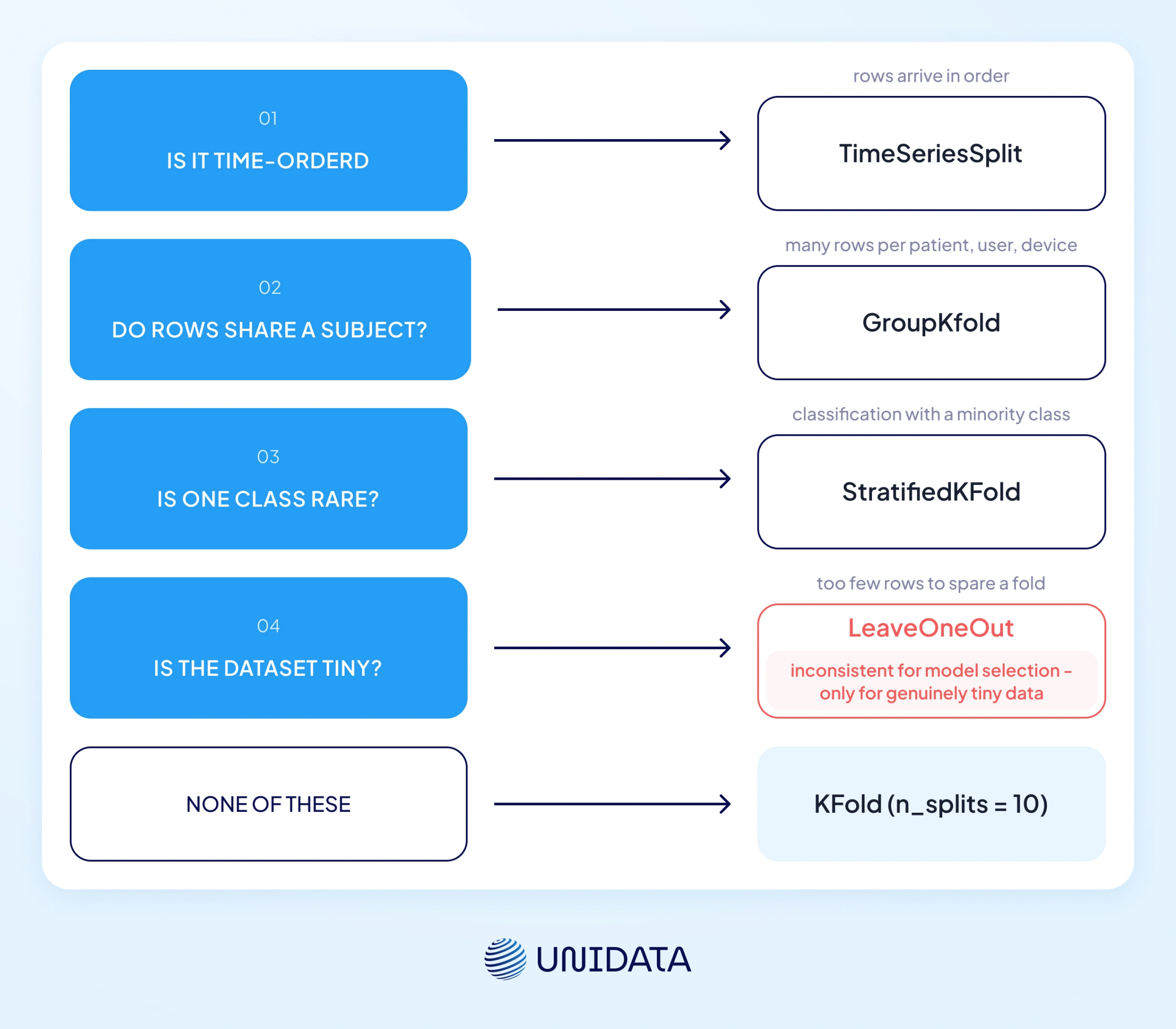
Three common situations break plain k-fold's default assumptions, and each has its own fix: class imbalance, time order, and very small datasets.
Stratified k-fold for imbalanced datasets
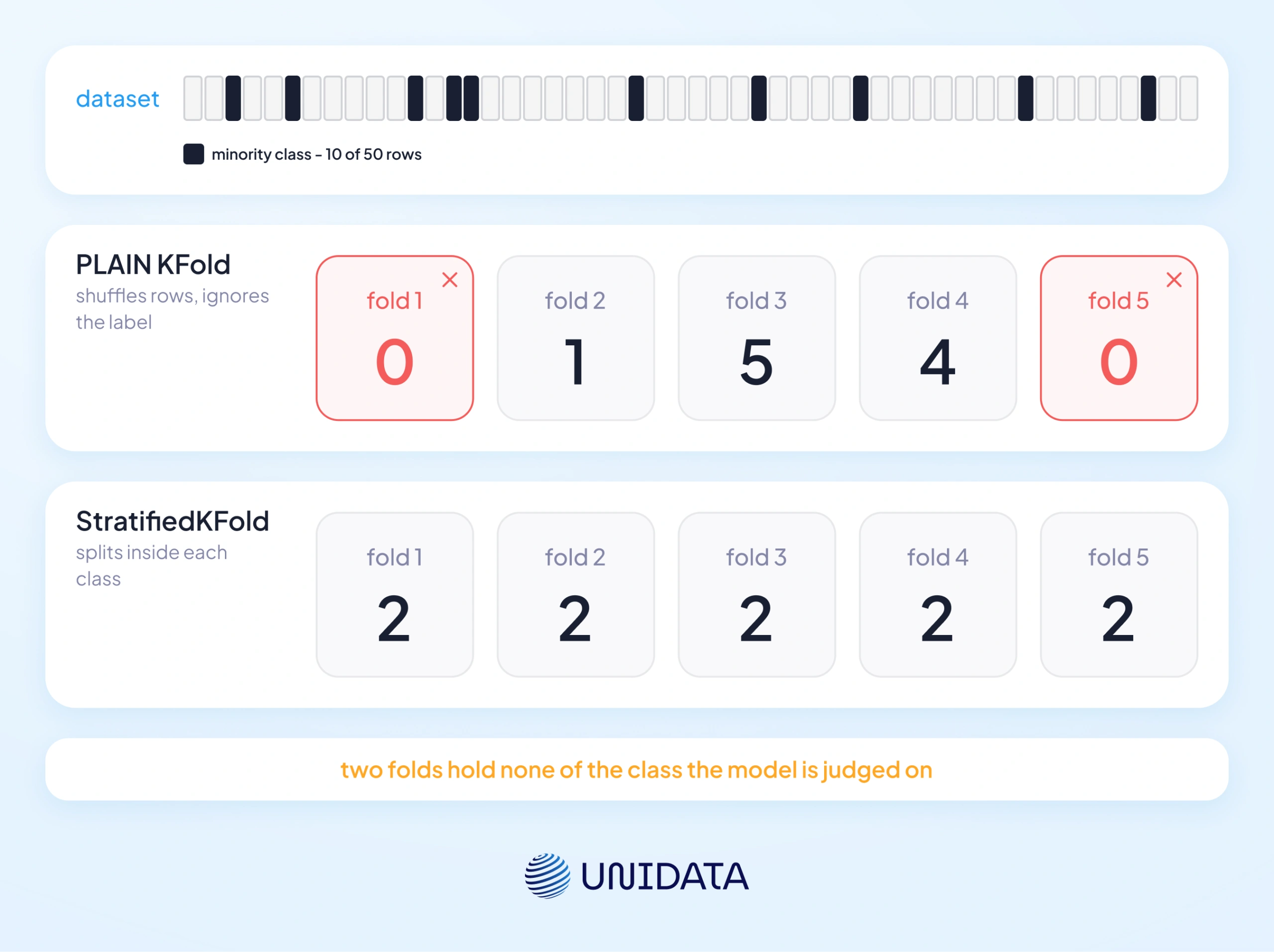
Plain k-fold can accidentally concentrate a rare class into one or two folds, which makes that fold's score unstable and the overall average misleading. StratifiedKFold fixes this by preserving the target class's proportion in every fold, which is the documented reason scikit-learn recommends it as the default cross-validator for classification problems4. The same skew that produces biased models during training distorts validation just as easily if the folds aren't stratified.
It matters wherever the class you actually care about is the minority one: fraud detection, rare-disease screening, anti-spoofing, defect inspection.
What stratification cannot do is create positives. It redistributes the minority class you already have, so a class that is absent rather than thin stays absent in every fold, and every fold will look balanced while telling you nothing about what is missing.
Attack data makes that failure legible, because there the missing part is a geometry. A spoofing set shot frontally splits cleanly across folds and still reports nothing about the angles the attack was never captured from. Frontal-only coverage does not surface as a gap in any fold statistic. It surfaces as a class that looks well behaved.
That is why we produce fabric mask sets covering several presentation angles: the folds can only describe what the capture already contains. So the thing to check first is coverage per presentation type. If your positives already span the setups you deploy against, more collection buys nothing and the split genuinely is what needs fixing.
Time series cross-validation
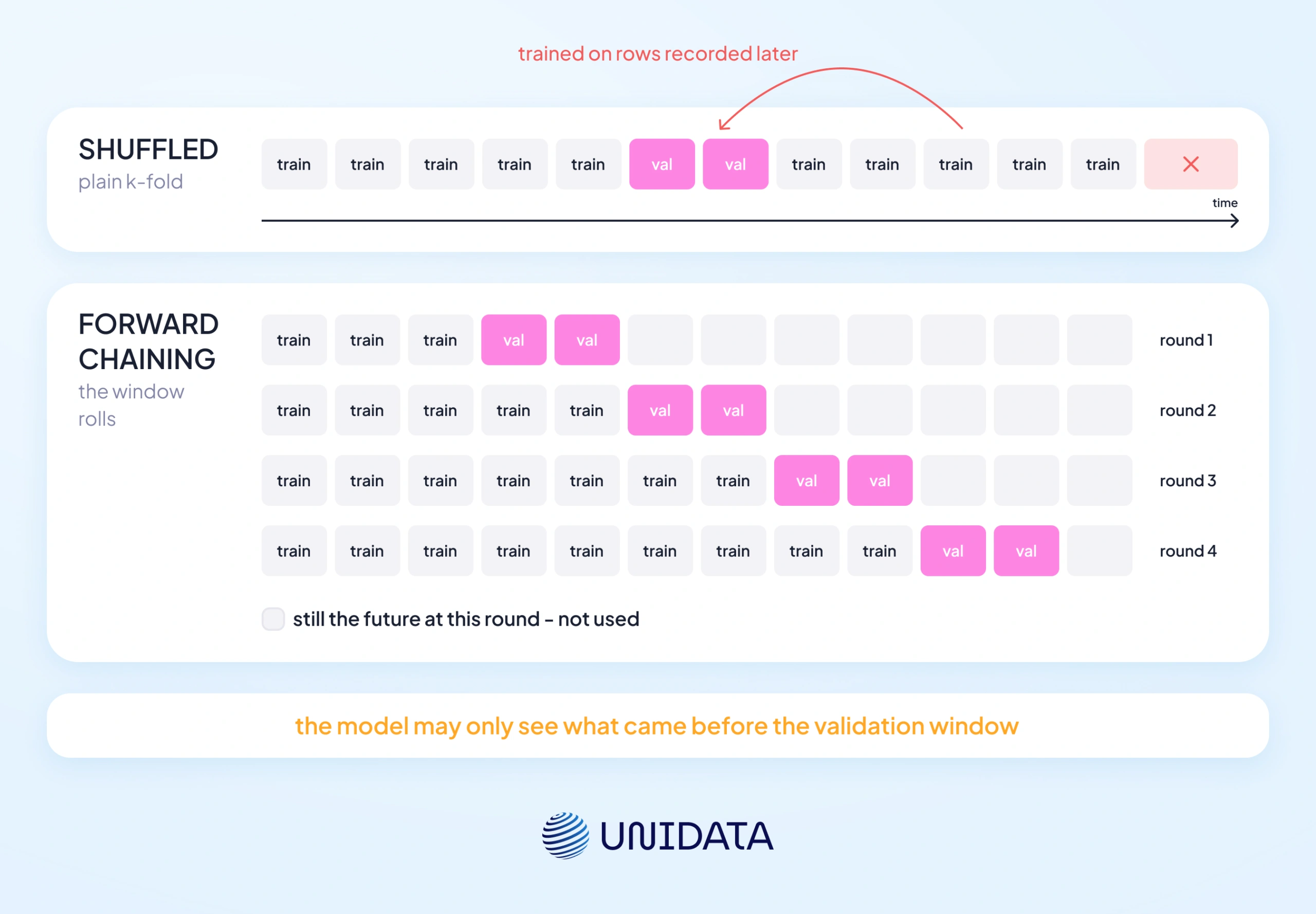
Time series data breaks the independence assumption directly: the past can inform the future, but not the reverse. Shuffling rows before splitting, as plain k-fold does, lets future information leak into training and inflates the score. Bergmeir and Benítez showed that forward-chaining validation converges on the true one-step-ahead prediction error as the series grows, where ordinary k-fold cross-validation does not5.
The fix is structural. Train only on data that precedes the validation window, and roll that window forward through the dataset. In scikit-learn that is TimeSeriesSplit, which yields the expanding-window pattern directly.
Leave-one-out and leave-p-out cross-validation
Leave-one-out cross-validation (LOOCV) is the k=n extreme: every fold holds out exactly one row. It looks appealing for tiny datasets because every model trains on almost all the data, and that data efficiency is the whole case for it. Shao's analysis of linear model selection found LOOCV asymptotically inconsistent for that job: the probability it picks the genuinely best model does not converge to 1 as the dataset grows6. So the two arguments point in opposite directions. Reach for LOOCV when n is small enough that data efficiency dominates, and treat its selections with suspicion on anything larger. Leave-p-out generalizes the idea to holding out p rows at a time, at even steeper computational cost.
Common pitfalls and best practices
A 2023 survey of machine-learning-based research found leakage-related errors in 294 papers across 17 fields, which puts this well past the category of beginner mistake confined to tutorials7. Two patterns cause most of the damage: preprocessing fit on the full dataset before splitting, and reusing the same folds for tuning and for the final reported score.
Before you trust a cross-validation number, five things are worth confirming:
- Every transformation that learns from data sits inside a Pipeline, so it is fitted once per fold.
- Tuning and final scoring do not share the same folds.
- Rows that belong together (same patient, same user, same device) land in the same fold.
- For time-ordered data, no training row postdates its validation window.
- What gets reported is a mean together with a spread.
Preventing data leakage in cross-validation
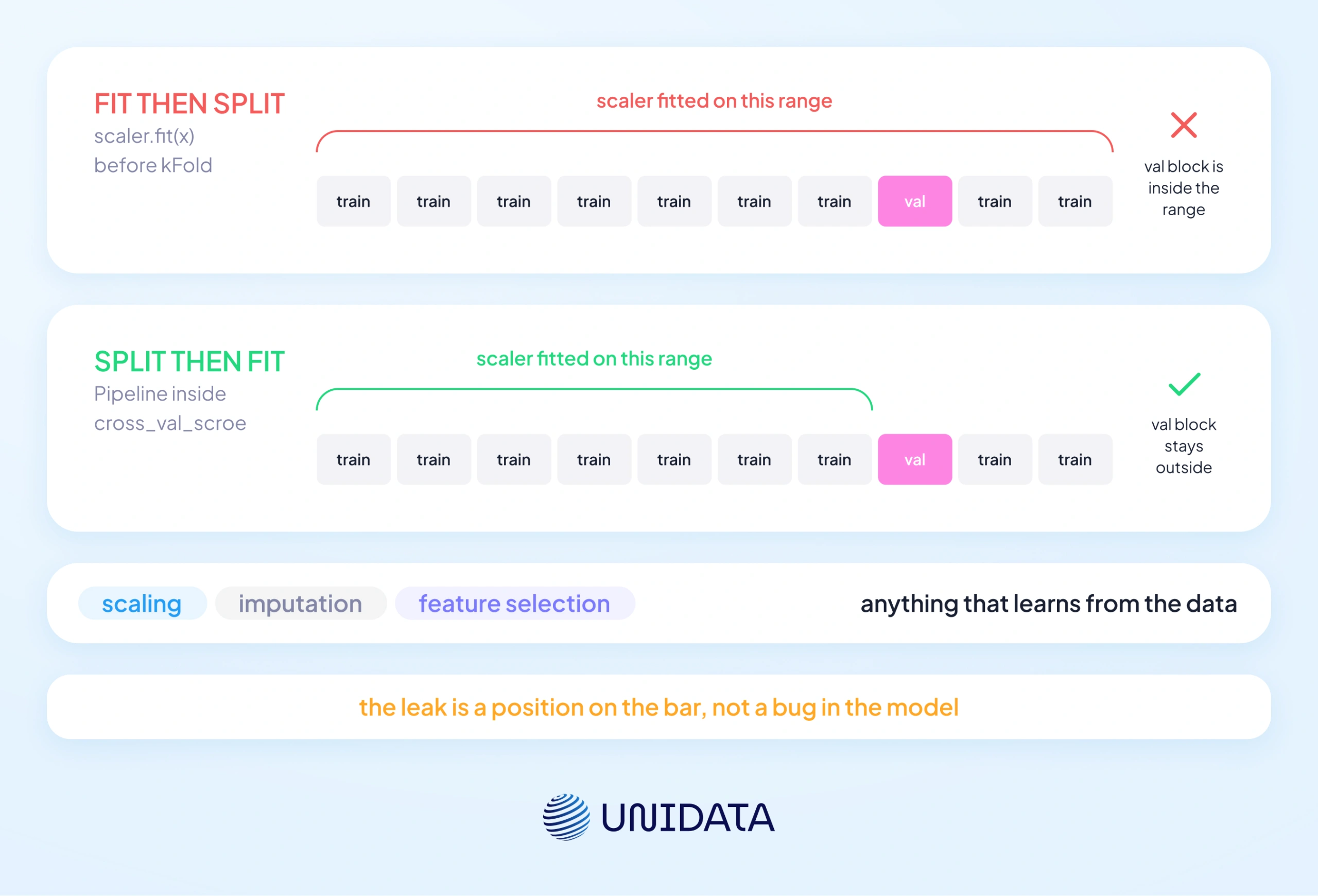
Any transformation that learns from the data (scaling, imputation, feature selection) has to be fit only on the current fold's training rows, never on the validation rows and never on the full dataset before splitting. scikit-learn's own guidance on common pitfalls recommends wrapping these steps in a Pipeline so cross_val_score and cross_validate fit each transformation correctly inside every fold, automatically8:
from sklearn.pipeline import Pipeline

from sklearn.preprocessing import StandardScaler

from sklearn.linear_model import LogisticRegression

from sklearn.model_selection import StratifiedKFold, cross_val_score

pipe = Pipeline([

    ("scaler", StandardScaler()),

    ("clf", LogisticRegression()),

])

skf = StratifiedKFold(n_splits=10, shuffle=True, random_state=42)

scores = cross_val_score(pipe, X, y, cv=skf, scoring="f1")
If you scale or impute before calling cross_val_score on the raw arrays, the validation fold has already influenced those parameters. The leak happened before training even started.
Cross-validation for hyperparameter tuning
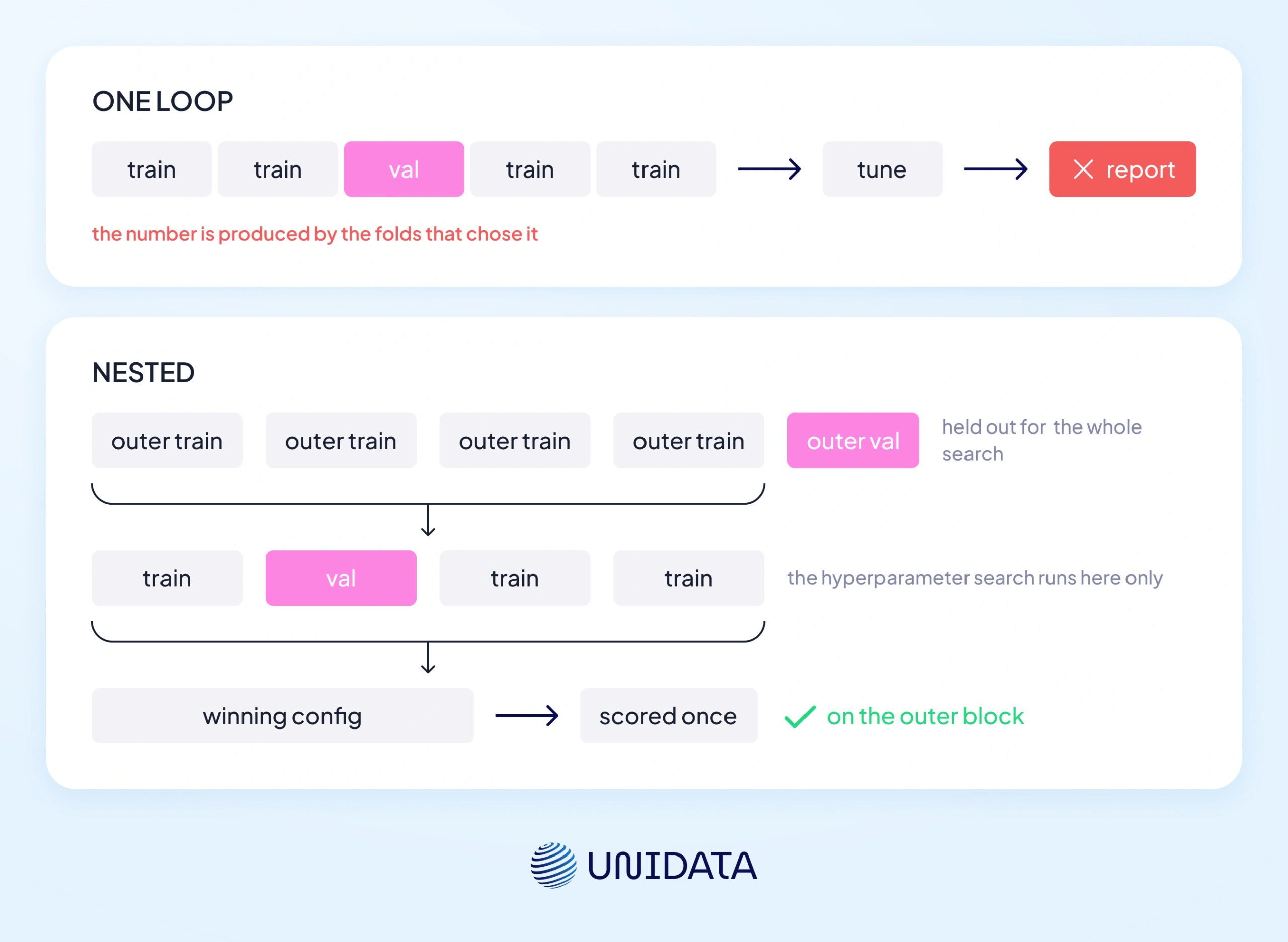
Tuning hyperparameters on the same folds you use for the final reported score quietly inflates that score, because the model selection process has effectively seen the evaluation data. Cawley and Talbot's analysis of this bias found that nested cross-validation, with an inner loop for tuning and an outer loop strictly for evaluation, measurably reduces it compared to using one set of folds for both jobs9.
Nested cross-validation multiplies runs. A ten-fold outer loop around a five-fold inner loop fits each candidate configuration five times inside each of the ten outer folds, which is fifty fits per configuration. What that buys is the only number you can defend as expected production performance.
Understanding bias-variance tradeoff in cross-validation
Fold count, stratification and nesting are all versions of the same bias-variance tradeoff: the push and pull between an estimate that is systematically off in one direction (bias) and one that swings unpredictably from sample to sample (variance)2. Smaller validation folds tend to push variance up; larger ones tend to push bias up slightly while training on more data per round. No setting eliminates both at once, so the right choice depends on which failure mode is more expensive for your decision.
Advanced applications of cross-validation
The k-fold loop produces more than a score. It produces a full set of predictions on rows the model never trained on, which cross_val_predict returns, and both cross-validated feature selection and stacked ensembles are built on those.
Cross-validation for feature selection
Feature selection can overfit just as easily as a model can: a subset that looks strong on one split may be fitting that split's noise. scikit-learn's RFECV scores each candidate feature subset across multiple folds before settling on a final count10.
Using cross-validation results for ensemble methods
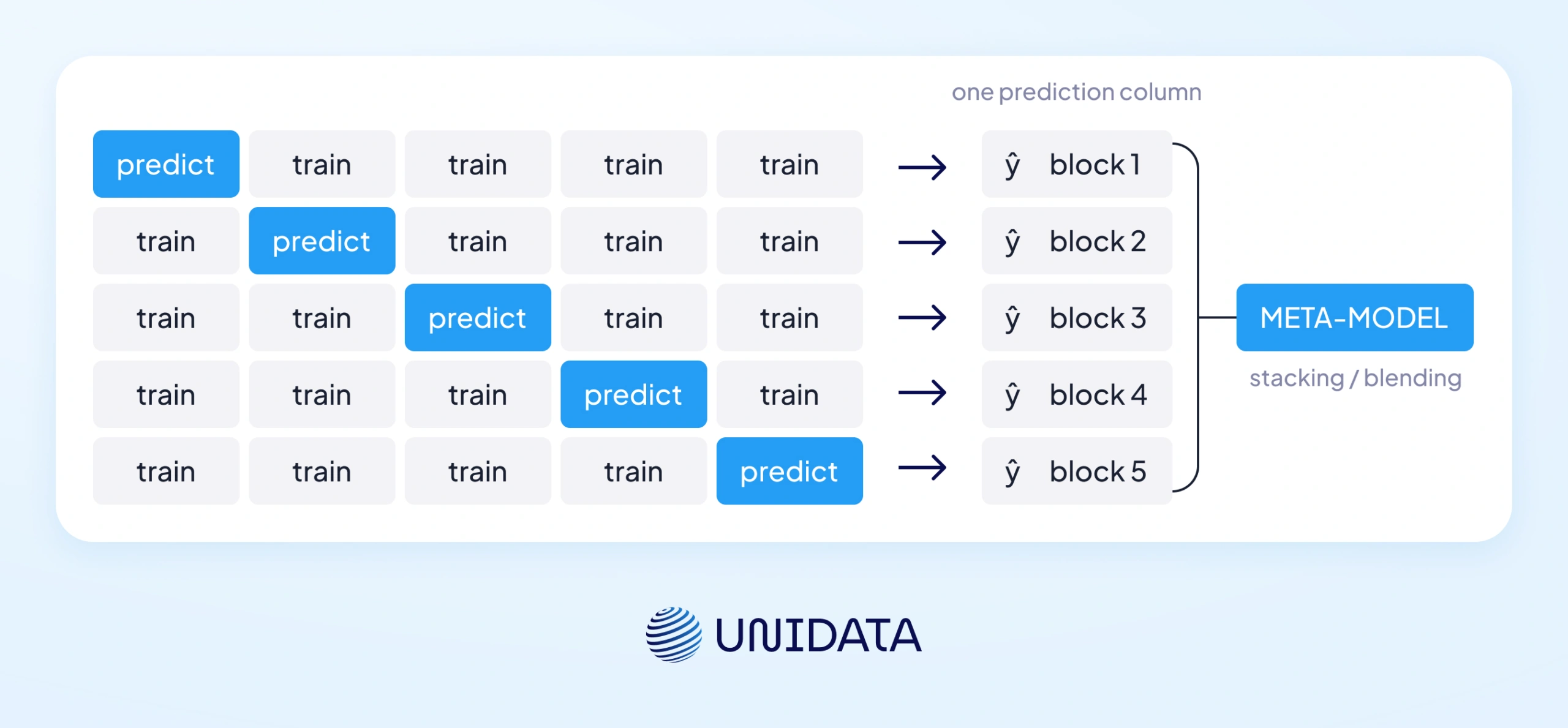
Out-of-fold predictions are usable as training data in their own right. A meta-model fitted on them learns to combine base models without seeing any row a base model was trained on, which is what keeps a stacked ensemble from leaking training information into the final prediction. Wolpert introduced this as stacked generalization in 1992, and the predictions it needs come out of the k-fold loop as a byproduct11.
Computational costs and time considerations
Cross-validation multiplies training cost by roughly k. Ten-fold cross-validation means ten full training runs, and for a deep learning model that takes hours to train once, that multiplier decides which k is feasible before any statistical preference gets a vote.
It helps to put a number on it. A model that fits in twenty minutes becomes a three-and-a-half-hour ten-fold run, and the same model inside the fifty-fit nested loop above is closer to seventeen hours unless the folds run in parallel.
Two practical levers help. Run folds in parallel where the environment allows it (n_jobs in cross_val_score and in the search classes), and lower k for expensive models while keeping it higher for cheap ones. What the remaining cost buys is protection against shipping a model whose single-split score didn't hold up.
Real-world case studies
One diagnostic step precedes every stratification decision, and it is easy to skip: whether the minority class is thin or absent. If it is sparse but its variety is covered, stratified folds redistribute real signal, and the estimate holds up; targeted collection at that point would be an expensive way to buy nothing. If whole subtypes are missing, every fold is missing them too, and no splitting strategy recovers what was never collected.
We ran into that line on a medical-AI collection: alopecia images collected and graded along a severity scale. Severity runs as a continuum, and the population you can recruit thins out precisely at the advanced end, so a shortfall never spreads evenly across stages. Coverage per subtype is what decides whether stratification is enough. Total volume in the minority class says very little about it.
Forecasting work fails in the opposite direction, and the tell is a score that looks too good. Demand planning and financial series carry the leak inside the shuffle itself, so the number improves as the validation gets less honest. That is why the forward-chaining check belongs in the review as much as in the code5.
Label quality shows up as fold variance too, and it is the easiest of the three to misread. A model validated against inconsistently graded images produces fold-to-fold swings that look like a modeling problem when the grading is what moved. Domain-expert review of the labels matters as much for the rows feeding validation as for the rows feeding training, because the validation rows are the ones the score is computed on.
Conclusion and next steps
k-fold cross-validation earns its place in the standard ML workflow because it replaces one noisy split with several, averaged into an estimate you can act on. It surfaces overfitting earlier and makes model comparison fairer. All of that holds only when the folds are built correctly: preprocessing inside the loop, and a splitting strategy that matches the structure of the data.
The fastest check on your current setup: run plain k-fold and stratified k-fold on the same classification dataset and compare the spread of the scores rather than the means. If tuning and final scoring currently share folds, the number you are about to report is optimistic, and nested cross-validation is the fix to apply before sign-off.
If fold variance keeps pointing at the labels, a 3-tier QC pass (annotator, reviewer, QA audit) over the worst-scoring fold's rows tells you whether the labels are what moved the score, start here.
Frequently Asked Questions (FAQ)
K-fold cross-validation splits a dataset into k roughly equal parts and trains the model k times, each time validating on a different part and training on the rest. The k scores are then averaged into one estimate. It exists to replace a single, potentially lucky or unlucky train-test split with a more stable average.
The data is divided into k folds. Each round holds out one fold for validation and trains on the remaining k−1 folds, repeating until every fold has been the validation set exactly once. The final reported score is the mean of the k individual scores, ideally alongside their standard deviation.
The main advantage is a more reliable performance estimate than a single split, using the data efficiently since every row serves as both training and validation data at some point. The downside is computational cost, since the model trains k times instead of once, plus the risk of leakage if preprocessing isn’t fit inside each fold correctly.
Five and ten are the most common choices, with ten generally giving the most reliable estimate across typical datasets without excessive runtime. Smaller k is faster but trains on less data per fold; larger k trains on more data per fold at higher computational cost. Dataset size and how expensive a single training run is should drive the decision.
Scikit-learn’s KFold or StratifiedKFold paired with cross_val_score or cross_validate covers most cases. The detail that matters most: wrap any preprocessing in a Pipeline so it fits only on each fold’s training data, not on the full dataset before splitting.
A train-test split evaluates the model once, on one partition. k-fold cross-validation evaluates it k times across k different partitions and averages the results, which reduces how much the score depends on which rows happened to land in the test set.
It shows whether a model’s performance holds steady across different subsets of the data or swings depending on which rows it sees. Wide swings between folds are a sign the model may be fitting noise specific to parts of the training data rather than the underlying pattern.
Stratified k-fold preserves class proportions in every fold for imbalanced classification. Time series cross-validation (forward chaining) preserves chronological order for time-ordered data. Leave-one-out cross-validation holds out a single row per fold and is reserved for very small datasets.
Because the model is scored on several different held-out folds rather than one, the resulting estimate depends less on a single random split and gives a more realistic picture of how the model will perform on data it hasn’t seen.
Use it whenever you need a dependable performance estimate for model comparison or hyperparameter tuning, especially with limited data where every row matters. It needs to be adapted (not used as-is) for time-ordered data, where forward-chaining validation is the correct choice instead.
Yes, and it’s one of the most common ways to do it. The safer version is nested cross-validation, where an inner loop tunes the hyperparameters and a separate outer loop evaluates the tuned model, which avoids the optimistic bias that comes from tuning and reporting on the same folds.
Further Reading & References:
- [1] Stone, M. "Cross-Validatory Choice and Assessment of Statistical Predictions" — Journal of the Royal Statistical Society, Series B — 1974 ↩︎
- [2] Kohavi, R. "A Study of Cross-Validation and Bootstrap for Accuracy Estimation and Model Selection" — Proceedings of the 14th International Joint Conference on Artificial Intelligence (IJCAI) — 1995 ↩︎
- [3] Scikit-learn developers. "3.1. Cross-validation: evaluating estimator performance" — scikit-learn documentation — 2026 ↩︎
- [4] Scikit-learn developers. "StratifiedKFold" — scikit-learn documentation — 2026 ↩︎
- [5] Bergmeir, C., Benítez, J.M. "On the Use of Cross-Validation for Time Series Predictor Evaluation" — Information Sciences, Vol. 191 — 2012 ↩︎
- [6] Shao, J. "Linear Model Selection by Cross-Validation" — Journal of the American Statistical Association, Vol. 88 — 1993 ↩︎
- [7] Kapoor, S., Narayanan, A. "Leakage and the Reproducibility Crisis in Machine-Learning-Based Science" — Patterns, Vol. 4(9) — 2023 ↩︎
- [8] Scikit-learn developers. "Common Pitfalls and Recommended Practices" — scikit-learn documentation — 2026 ↩︎
- [9] Cawley, G.C., Talbot, N.L.C. "On Over-Fitting in Model Selection and Subsequent Selection Bias in Performance Evaluation" — Journal of Machine Learning Research, Vol. 11 — 2010 ↩︎
- [10] Scikit-learn developers. "RFECV" — scikit-learn documentation — 2026 ↩︎
- [11] Wolpert, D.H. "Stacked Generalization" — Neural Networks, Vol. 5 — 1992 ↩︎