
The Task
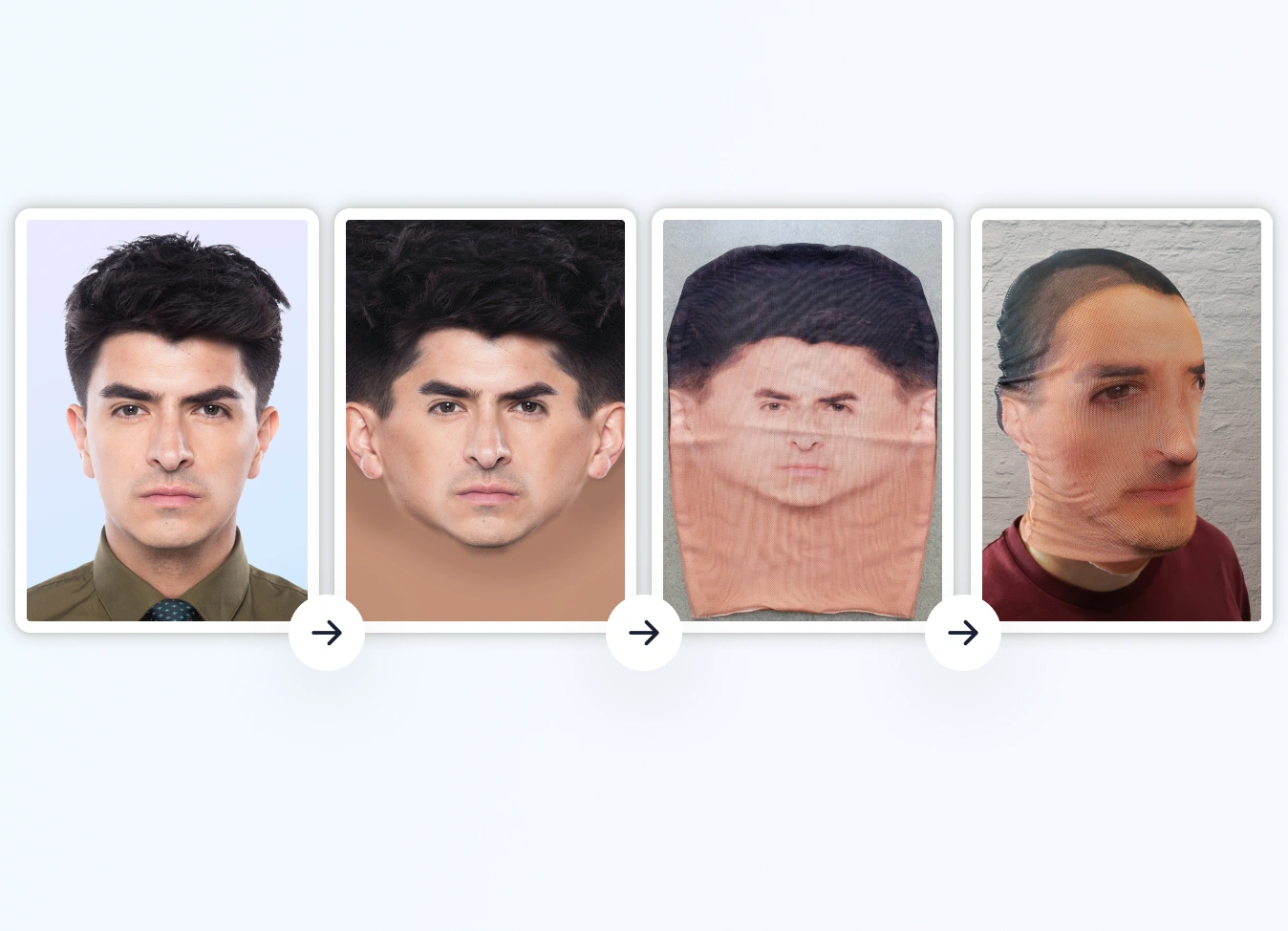
The goal was to create fabric masks that accurately mimic human facial features for biometric testing. Standard masks typically cover only the front of the face (180°), but our dataset required full coverage, including the back and sides, so respondents could move naturally without compromising data integrity.
Key requirements included:
- Full head contour for multi-angle recognition
- High-quality, realistic prints with modular replaceable
- Material flexibility, including thinner fabrics similar to nylon hosiery for enhanced biometric testing accuracy
The Solution
3D Design and Production
We developed a 3D breakdown of the head structure to guide the supplier. This allowed:
- Integration of fabric with complete head coverage
- Customizable inserts for facial features to increase realism
- Post-production assembly that preserves the head’s natural shape
Material Selection and Printing
Different fabrics were tested, including lightweight, semi-transparent options, which better simulate skin and allow anti-spoofing testing. Prints were optimized for:
- Hyper-realistic textures and pigmentation, including micro-details like freckles or subtle wrinkles
- Multi-layered construction for durable, realistic results
Process Optimization
Even with a capable supplier, fabric mask production involves scaling challenges. We:
- Standardized instructions for assembly and quality control
- Monitored consistency across samples and materials
- Ensured flexibility to swap parts for live testing scenarios
| Stage | Input | Workflow Scope | Main Quality Checks |
|---|---|---|---|
| Concept Setup | Client requirements & biometric testing goals | Requirement analysis, use-case definition, design constraints | Requirement clarity / Feasibility validation |
| 3D Design | Head structure specifications | 3D modeling, full head contour development, feature modularity design | Geometric accuracy / Full coverage integrity |
| Material Selection | Fabric samples, print specifications | Testing fabrics, selecting textures, optimizing print quality | Material realism / Print fidelity |
| Production | 3D models, selected materials | Fabric mask manufacturing, assembly of modular facial features | Structural consistency / Assembly precision |
| Quality Control | Produced mask samples | Inspection, consistency checks, defect identification | Visual realism / Production consistency |
| Optimization & Scaling | Validated mask prototypes | Process standardization, workflow optimization, scalability setup | Repeatability / Scalability readiness |
2 weeks
Concept & Requirements Alignment
4 weeks
3D Design & Prototyping
4 weeks
Material Testing & Printing
3 weeks
Production Setup & QC Standardization
The Results
- Successfully produced initial samples for early-stage testing with full head coverage
- Created a scalable workflow for future production of hyper-realistic fabric masks
- Established expertise in multi-angle, realistic mask fabrication for biometric validation
Biometric testing requires physical artifacts that behave like real human features under all conditions. Realism is achieved through accurate geometry, material selection, and consistent production quality across all samples.

- Hanna Parkhots
- Data Collection Project Manager