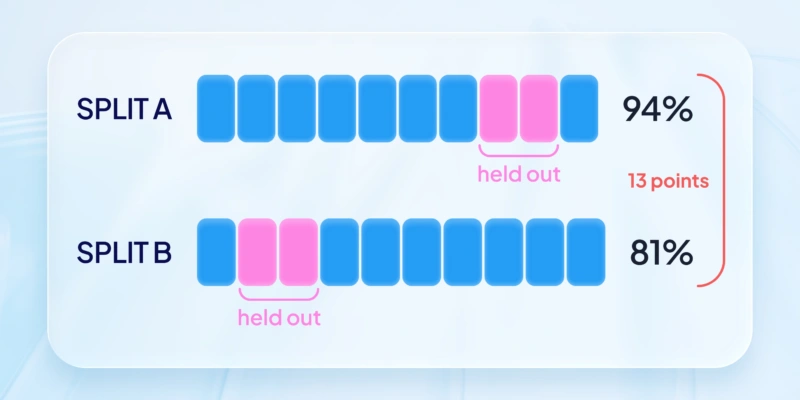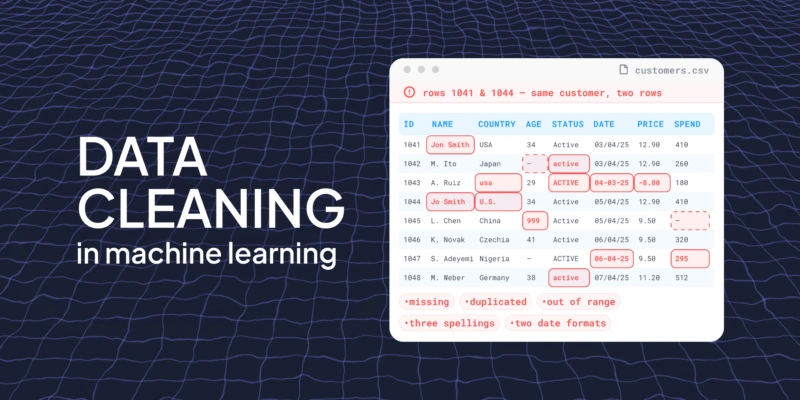

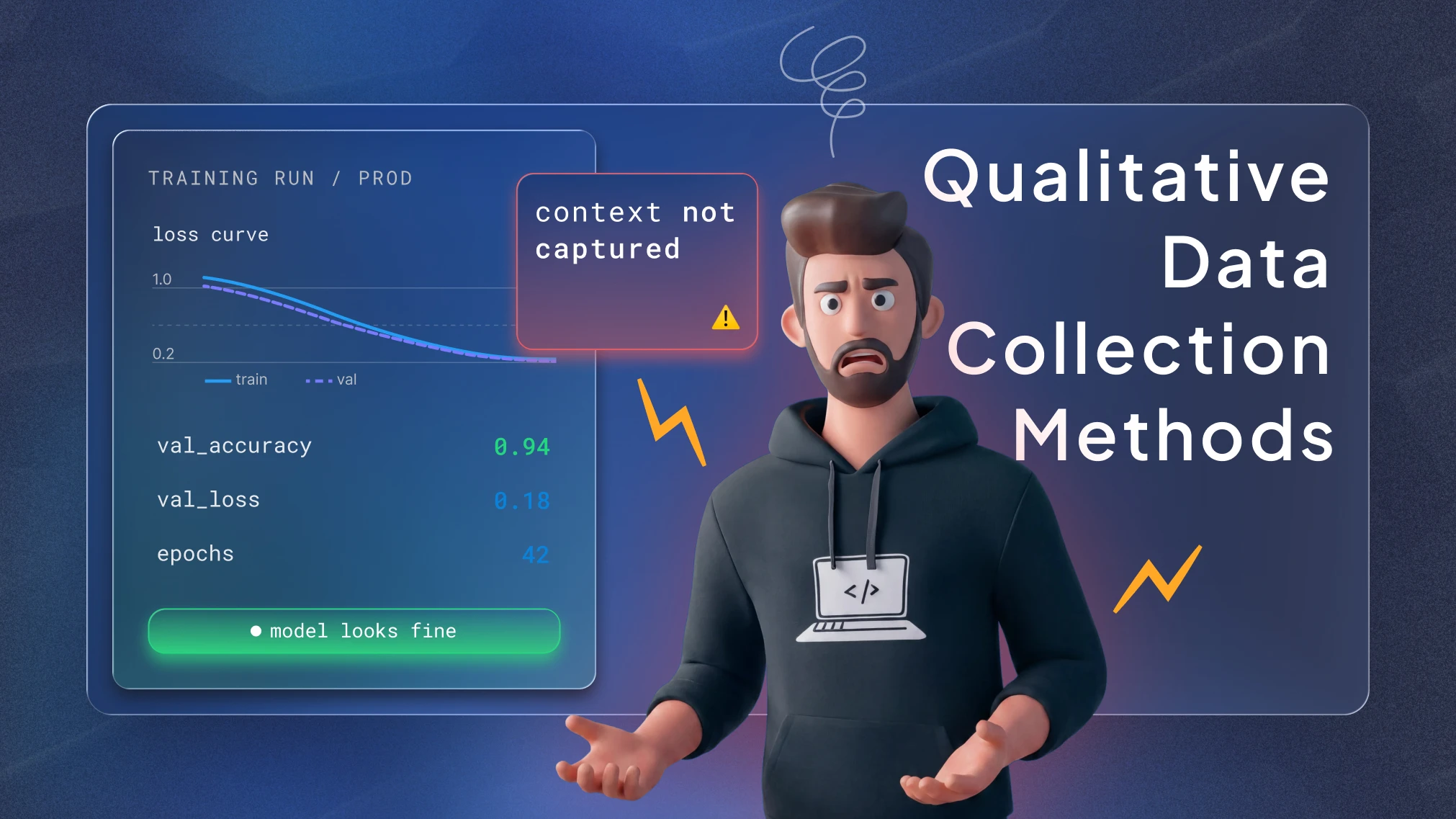
Your model's accuracy metrics look fine. Then it ships — and falls apart on cases you never anticipated. The issue is almost never the algorithm. It is the data: labels defined without consulting people who do the task, edge cases that never made it into the training set, annotation guidelines written without observing a single annotator interpret them.
Qualitative data collection is the practice that closes that gap — producing the human context that makes the difference between a dataset that looks right and one that actually works.
Why Numbers Alone Miss the Most Expensive ML Failures
Most ML failures are upstream problems dressed as model problems. The loss curve converges, the validation accuracy looks strong, and then the model fails on edge cases the training set never included — because no one talked to the people who generate the input data before building the taxonomy.
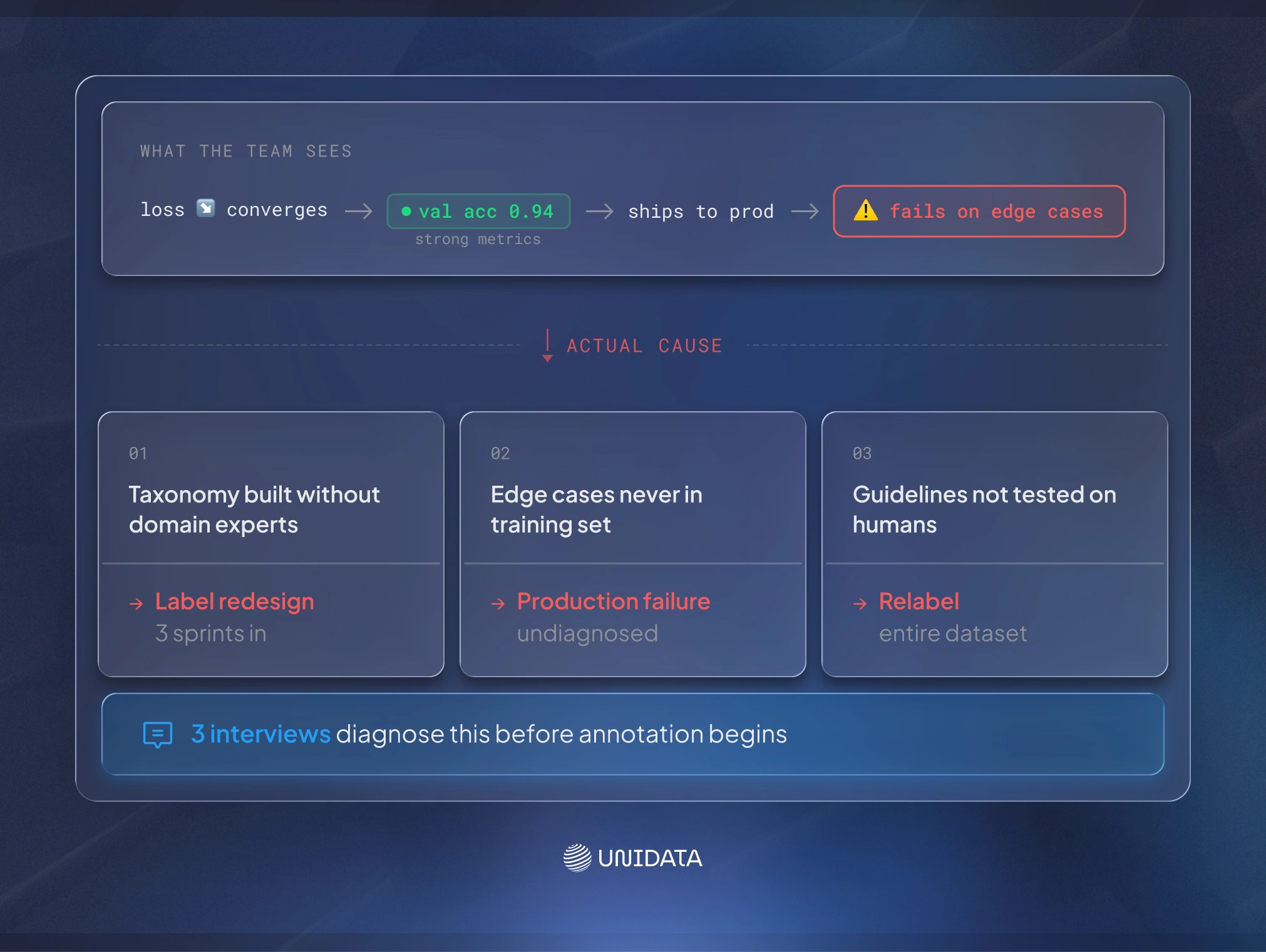
Quantitative methods tell you the shape of the problem: how many users dropped, what the error rate is by class, which annotator has the highest disagreement rate. Qualitative methods tell you the mechanism: why the drop happens, what "ambiguous" means to the person labeling the data, where the taxonomy breaks in natural human language.
The combination matters more than either alone. Teams that skip qualitative groundwork spend months on model iteration for problems that three interviews would have diagnosed. [1]
Four places where qualitative data collection produces the highest ROI for ML teams:
- Taxonomy and label design — before any annotation begins, qualitative work defines what the labels actually mean in human terms, where they overlap, and which edge cases belong in which class
- Annotation guideline calibration — observation of annotators in real sessions reveals where instructions fail in ways that inter-annotator agreement scores cannot surface until you have annotated thousands of items
- Edge case discovery — structured elicitation pulls out the cases that break your model in production but are rare enough to never appear in an unstructured dataset
- Evaluation and test set design — qualitative work tells you what to test, not just how much; confusable pairs, real-world noise, and rare-but-critical scenarios only come from human elicitation
How to Collect Data for Machine Learning: A Practical Guide for ML Teams
Learn more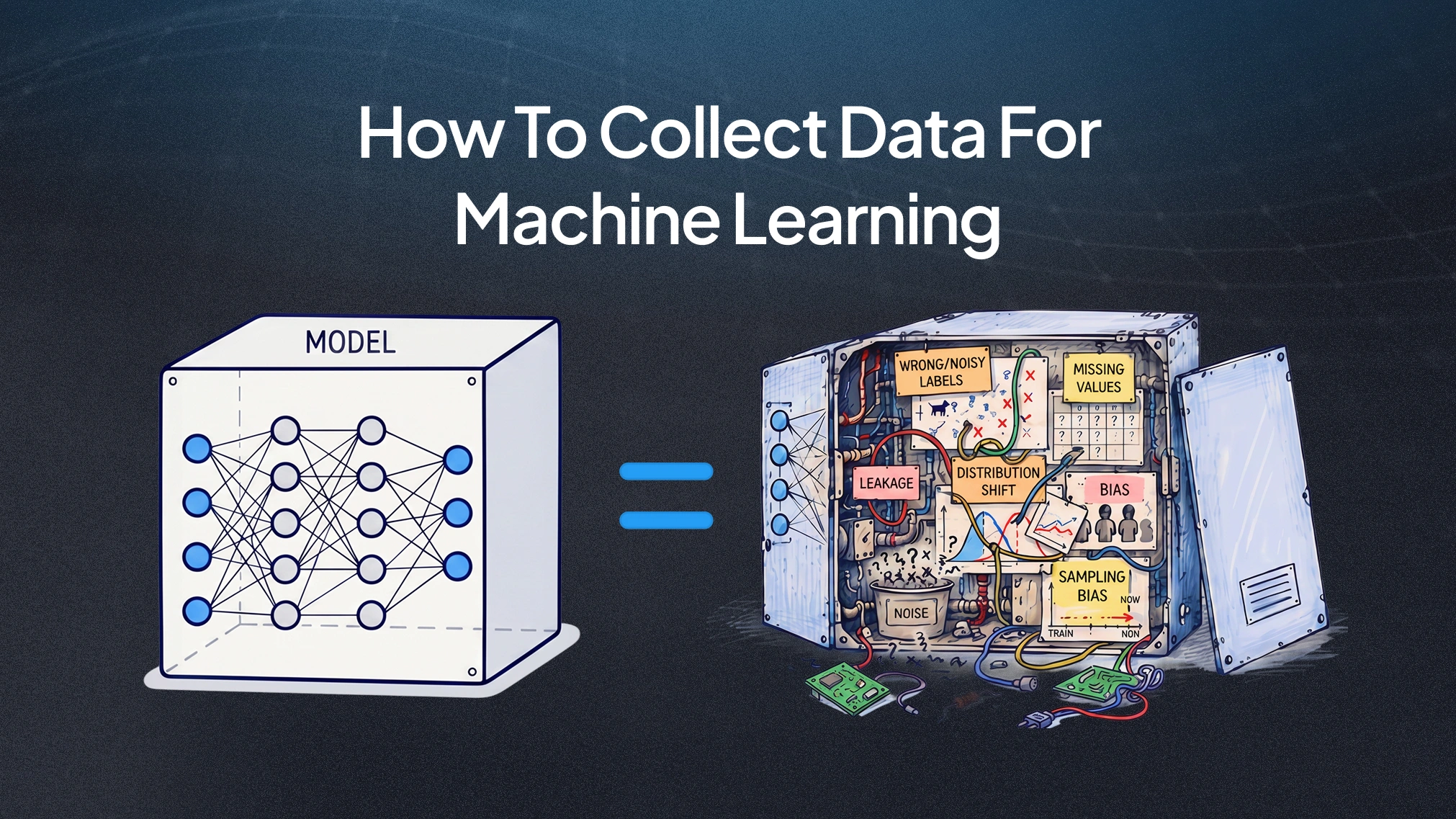
Which Qualitative Data Collection Method Fits Your Situation?
The seven established qualitative methods are consistent across fields — what changes is the instrument (the specific protocol) and the context. [8] The table below maps each method to its primary use case, typical output, and the most common scenario where it underperforms.
| Method | Best for | Primary output | Where it underperforms |
|---|---|---|---|
| Semi-structured interviews | Motivations, decision logic, label interpretation | Transcript + themes | Actual real-time behavior; social desirability bias |
| Focus groups | Shared language, group norms, reactions to prototypes | Discussion notes + vocabulary map | Sensitive topics; individual workflows |
| Observation | Real behavior as it unfolds | Field notes, timing data, workaround log | Intent — it shows what, not why |
| Contextual inquiry | Behavior + reasoning in-the-moment | Observation + annotated rationale | Requires a skilled moderator to avoid disrupting the task |
| Ethnography | Deep context, tacit knowledge, complex multi-actor workflows | Long-form field notes, cultural model | Time and cost; hard to scale |
| Diary studies | Longitudinal experience; episodic events | Entries, voice notes, screenshots | Drop-off; uneven quality across participants |
| Document and artifact analysis | Operational reality already captured in your own systems | Coded themes from tickets, logs, SOPs | What the system records, not everything that happens |
You can combine methods — and in most production ML contexts, you should. The practical sequence for annotation projects: artifact analysis (mine what your system already has) → interviews (understand intent and boundary cases) → observation (calibrate annotation guidelines against real labeling behavior). That three-method stack covers most of the ground without months of fieldwork.
Interviews: The Fastest Path to Understanding What Users Actually Mean
Interviews are the default starting point because they are fast to set up, flexible across domains, and directly productive for the kinds of outputs ML teams need: label definitions in natural language, edge case catalogs, and mental models that reveal where taxonomies will break.
The deciding criterion for when interviews are the right choice: you need to understand why, not what. Clickstream data tells you a user abandoned at step four. An interview tells you they abandoned because the terminology on that screen did not match what they expected. A label taxonomy tells you there are three sentiment classes. An interview with a domain expert tells you that "frustrated" and "complaint" are not the same thing in this context and here are the four cases that look like one but are the other.
How to Write an Interview Guide That Does Not Ruin Your Data
A good interview guide is not a script — it is a bias-reduction tool. [4] The design principles that apply to every qualitative interview, regardless of domain:
- Start with real experiences, not opinions. "Tell me about the last time you labeled something you were not sure how to classify" beats "What do you think about our annotation guidelines?" The first gets a story. The second gets a performance.
- Ask for artifacts and examples. "Can you show me the item that caused the confusion?" grounds the answer in evidence rather than memory.
- Separate what happened from why. Get the sequence first; probe for motives after. Mixing them produces rationalized stories, not real accounts.
- Use neutral language. Words that signal the correct answer ("did you find the process frustrating?") will produce the answer they telegraph.
- One question per turn. Multi-part questions produce half-answers to the easier half.
What Interview Outputs Look Like as ML Assets
Interviews produce ML-relevant artifacts directly, not just insights:
- A vocabulary map: how participants phrase intents, requests, and errors in their own words — input for NLP label definitions and entity lists
- An edge case catalog: situations where the task does not map cleanly to any existing class, with real examples from the participant's experience
- A draft taxonomy with inclusion and exclusion rules written in plain language, not abstract categories
- A confusion cluster map: groups of items that participants consistently treat as interchangeable, predicting where inter-annotator agreement will be low before annotation begins
For semi-structured interviews on homogeneous populations with narrowly defined objectives, empirical research shows theme saturation is typically reached within nine to seventeen interviews. [5] For broader populations or multi-site studies, the threshold rises — meaning saturation (where new interviews stop changing your interpretation of themes, not just the theme count) requires 24 or more. [6] Run a saturation check after every six sessions rather than committing to a fixed number upfront.
Observation and Contextual Inquiry: What People Do Versus What They Say They Do
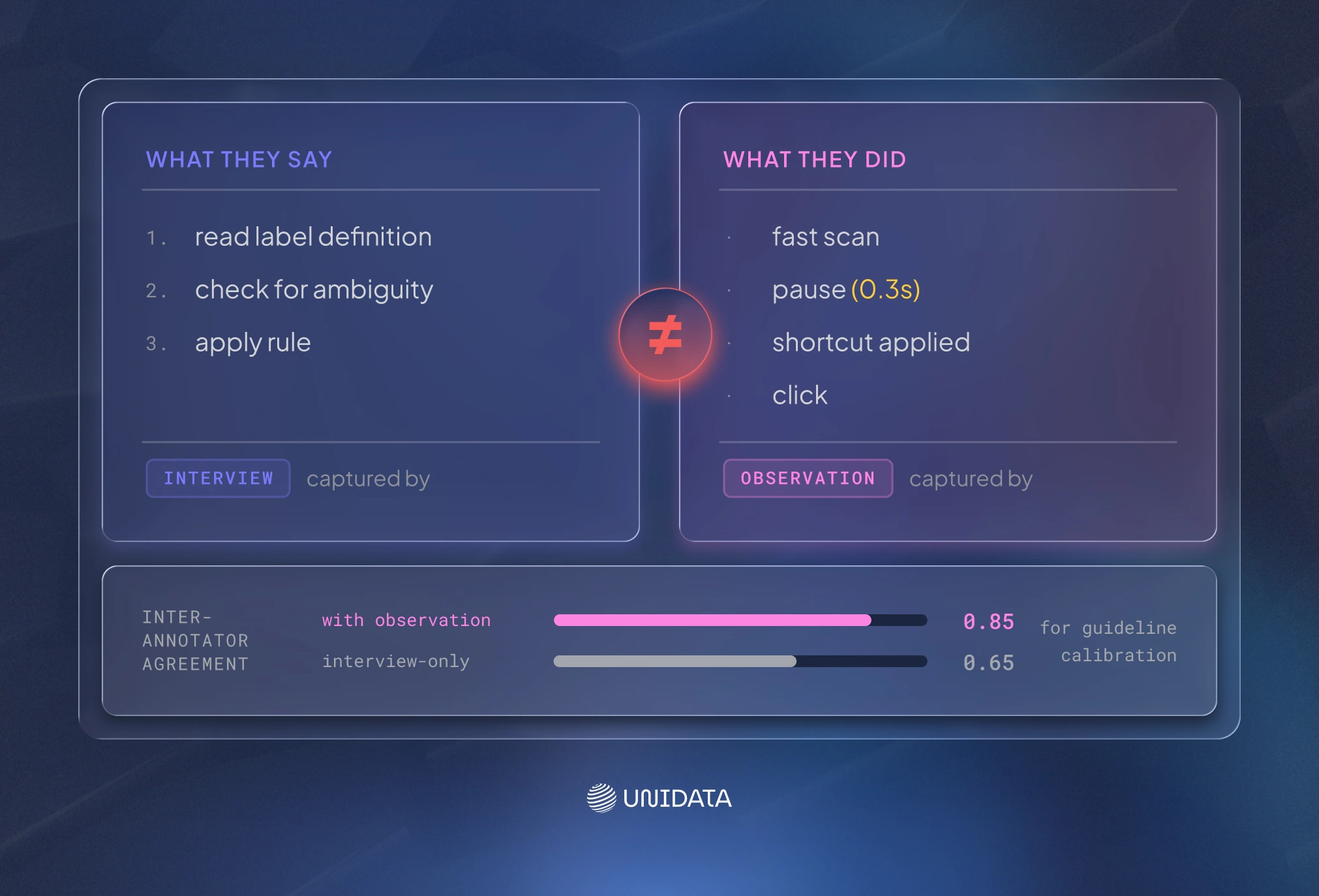
Humans are unreliable narrators of their own routines. Not deliberately — cognitively. When you ask an annotator why they labeled item X as class Y, they will give you a coherent reason. That reason may have nothing to do with what they actually processed in the two seconds it took to make the decision.
Observation is the method that closes that gap. You watch the task unfold in its real setting and record what actually happens: the steps taken, the shortcuts used, the moments of hesitation, the workarounds that the official workflow never anticipated.
When Observation Beats Interviews
Observation outperforms interviews for:
- Annotation workflow calibration. A guideline review tells you whether instructions are grammatically clear. Observation tells you whether annotators read them the same way. The difference often determines whether your inter-annotator agreement is 0.85 or 0.65 before you have touched a single line of training data.
- Field data collection environments. Lighting conditions, noise levels, device limitations, and workflow interruptions shape the quality of collected data in ways participants cannot fully articulate. Observation in the actual environment catches these before they compound into dataset-wide biases.
- Operator behavior in data collection pipelines. When collection depends on human operators — whether running egocentric video capture sessions, recording speech data, or conducting structured image collection — observation of the first real sessions reveals where protocols break down and what on-the-ground improvisation looks like.
In our annotation projects the same thing happens every time: instructions that pass internal review in a document still produce disagreement once real annotators meet the edge cases the authors did not anticipate. Catching this early — before disagreement compounds across thousands of labeled items — is one of the clearest returns on observation as a method.
Contextual Inquiry: Observation with Light Probing
Contextual inquiry adds short, targeted questions during the task without converting the session into an interview. [3] Useful prompts: "What are you looking for right now?", "What makes this step slower than expected?", "What would happen if you skipped this check?"
The advantage is that answers are grounded in what the participant is actually doing, not a post-hoc reconstruction. The risk is disruption — asking too frequently changes the behavior you came to observe. The practical rule: probe at natural pause points, never mid-task.
Focus Groups, Ethnography, and Diary Studies: When to Use Each
These three methods serve more specific situations than interviews or observation. Knowing when they earn their overhead is more useful than a detailed walkthrough of each.
Focus groups produce value in one specific situation: when you need to understand how people talk about a topic in a social setting — the shared vocabulary, the points of consensus, and the disagreements that surface when discussion is collective rather than individual. For taxonomy design, a well-run focus group with domain experts can surface label vocabulary and edge-case definitions faster than a series of individual interviews. The risk is groupthink: one confident participant can anchor the entire discussion. Mitigate with individual written responses before group discussion, and rotate speaking order so the loudest voice does not set the frame. [9]
Ethnography is worth the time cost in one class of ML problems: when the domain has strong tacit knowledge that practitioners cannot articulate in interviews because they have stopped noticing it. Medical triage, moderation decision-making, and complex logistics workflows fall into this category. You cannot interview your way into understanding what an expert knows implicitly. Lightweight versions — field visits with structured note-taking rather than full immersion — deliver most of the value at a fraction of the time.
Diary studies are the right tool when the experience is distributed across time and cannot be captured in a single session: onboarding friction over a two-week period, recurring annotation fatigue patterns across a project, trust erosion in a user-facing product. The main failure mode is dropout. Keep prompts simple, limit required entry time, and ask for "tiny" entries that still carry signal — one screenshot and two sentences beats a weekly essay that participants stop submitting by day four.
How Do You Know When You Have Collected Enough?
The answer is saturation — the point at which new sessions stop producing information that changes your conclusions. Saturation is not a vague concept: it is measurable, and recent empirical research gives useful guidance on what to plan for. [5] [6]
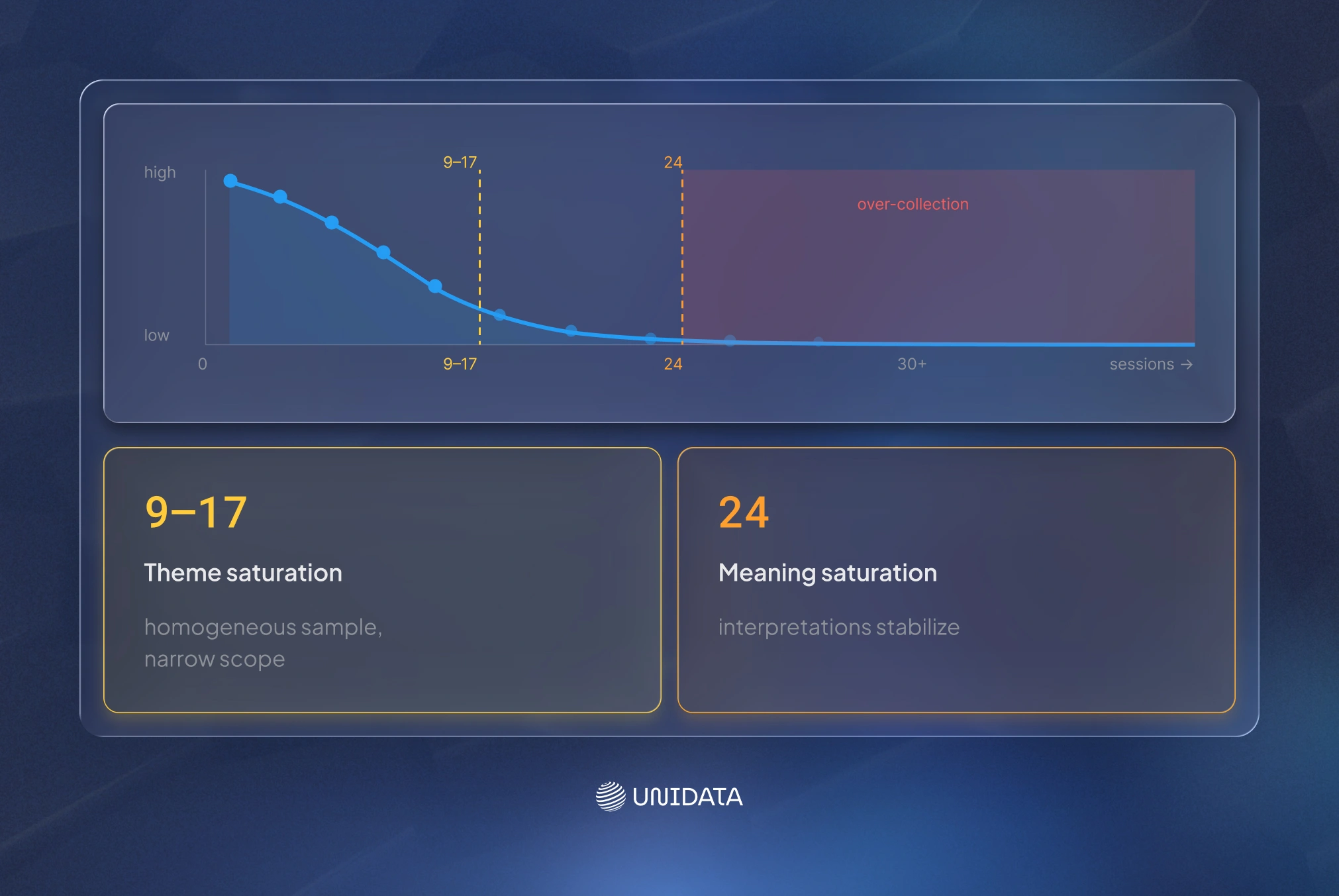
Theme saturation (no new codes emerging) for homogeneous samples with narrow objectives: nine to seventeen interviews, or four to eight focus group sessions. Meaning saturation (where the meaning and interpretation of themes stabilizes, not just the count) requires roughly twenty-four interviews — significantly more. For cross-cultural or multi-site work, metatheme saturation requires twenty to forty interviews per site.
Practical approach: after every six sessions, run a quick thematic check — count how many new codes the last two sessions produced. When that number approaches zero, you are close. Add two to three confirmatory sessions and stop. Over-collecting past saturation produces returns that do not justify the analysis overhead. Under-collecting produces findings that do not hold up when the data surfaces edge cases you missed.
The corollary for annotation projects: if you are using interviews to develop a taxonomy, build in a calibration round of annotation after your first eight to ten interviews. New edge cases will surface in annotation that your interview guide did not elicit. Loop back for two to three targeted interviews on those cases before finalizing the guidelines.
Sampling, Recruiting, and Consent: The Layer That Decides Data Quality
Every qualitative finding is only as valid as the population it came from. Who you include determines what you can learn — and what blind spots you will carry into production.
Purposive sampling — selecting participants because they match a specific profile — is the default for most ML and product work. "Annotators with high disagreement rates on class X" and "users who churned within the first week" are both purposive samples; they are selected because of what they know, not to represent the whole population.
Maximum variation sampling is useful specifically for taxonomy and boundary work. You recruit participants who differ maximally on dimensions relevant to the task — domain expertise, language background, annotation experience — because label boundaries fail most visibly at the extremes, not in the center of your distribution.
Snowball sampling helps in niche domains where participants are hard to reach: rare medical conditions, specialized technical roles, hard-to-recruit demographic groups. The risk is cluster homogeneity — people refer people like themselves, which narrows variation faster than your collection plan anticipated.
When you need participants matching specific criteria — domain experts for clinical labeling tasks, speakers of low-resource languages for NLP evaluation, participants in a specific age bracket for age-recognition model development — structured participant platforms like Prolific provide filtered access to consented pools with demographic, professional, and location filters. We recruit through Prolific for exactly this reason: the consent record is produced by the collection protocol itself, so nothing has to be reconstructed once the dataset is already distributed.
Sampling choices introduce the same biases that affect ML training sets: convenience sampling, selection bias, and demographic skew compound in the final model the same way they compound in your findings.
On consent: first-person video and audio recordings are personal data under GDPR from the moment they are captured, and become Article 9 biometric data only when they are processed through means that allow unique identification of a person. [7] Both statuses require a lawful basis and documented consent, so the practical minimum does not change. The minimum protocol before any collection begins: written consent from participants covering the capture purpose, storage, and retention period; environment consent from anyone who may appear incidentally on camera; and data minimization — if you do not need personal identifiers, do not collect them. Treat consent as a design constraint, not a compliance checkbox. Retroactive fixes to consent gaps in a distributed dataset are not practically achievable.
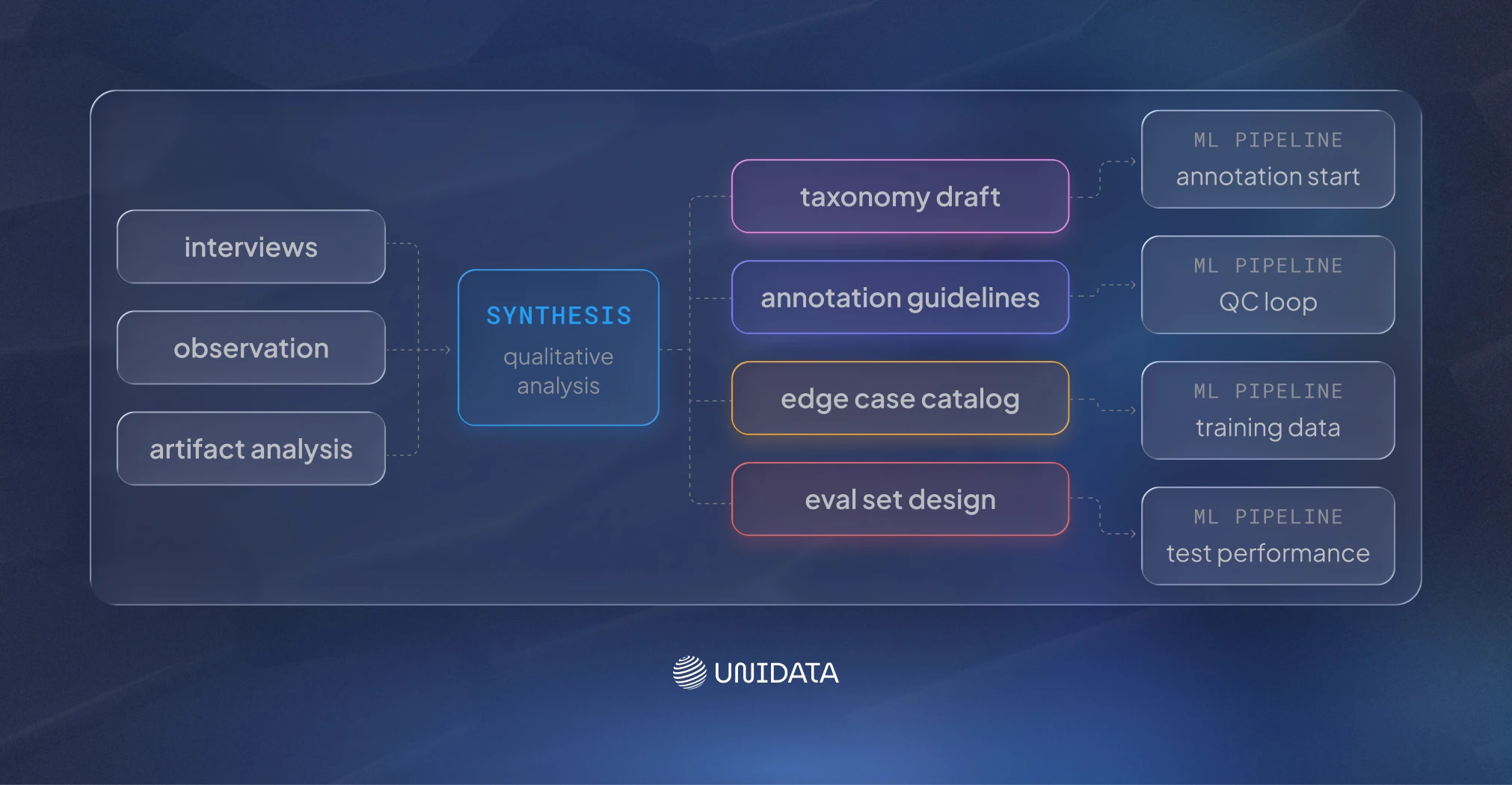
How to Turn Qualitative Findings into ML-Ready Assets
Qualitative data that produces themes without changing decisions is trivia. The synthesis step — where raw transcripts and field notes become actionable outputs — is where most teams underinvest.
Building a Workable Label Taxonomy
Use interviews, artifact analysis, and edge-case elicitation to build a taxonomy that is stable enough to label consistently and specific enough to handle the real distribution of your data:
- Define classes in the language participants actually use, not the terminology of your spec document
- Add inclusion and exclusion rules: "label as X when condition A; label as Y when condition B even if it looks like X"
- Collect positive and negative examples for every class, including examples that look like one class but belong to another
- Mark the gray zones explicitly — cases the taxonomy does not resolve cleanly — and decide on a handling rule before annotation begins
A good taxonomy is not complete by definition. It is stable enough to produce consistent labels and flexible enough to accommodate the edge cases that annotation will surface. [2]
Writing Annotation Guidelines That Reduce Disagreement
Qualitative findings reveal why annotators disagree — and the causes are almost always the same: concepts that overlap in real language, missing context, instructions that assume domain knowledge the annotator does not have, and examples that are too clean to cover the messy cases.
Across our annotation projects the pattern is consistent: a taxonomy that reads as unambiguous in a spec document surfaces disagreement in the first real annotation round. We ran into this directly working on a toxic content classification project — the disagreement did not come from careless annotators, it came from class boundaries that look sharp in a definition and stop looking sharp the moment someone has to apply one to a real message. Asking annotators about the specific items they hesitated on resolved more of it than rewriting the definition did. The fix goes into the guidelines:
- Decision trees for tricky cases that the main definition does not resolve
- Counterexamples: "this looks like class X, but label it Y when condition Z is present"
- Escalation rules for items that genuinely cannot be resolved by the guidelines
Our 3-tier QC loop — annotator → reviewer → QA audit — exists for exactly this: a reviewer who keeps overturning the same class is telling you the definition is broken, not the annotator.
Designing Evaluation and Test Sets from Qualitative Work
Qualitative work helps you decide what to test, not just how much. Use it to curate:
- Confusable pairs — items that trigger false positives between adjacent classes (what annotators and the model will both get wrong for the same structural reason)
- High-risk edge cases — rare but consequential scenarios that surface in interviews and field observation but are too infrequent to appear in a random sample
- Real-world noise — the typos, slang, mixed-intent inputs, and incomplete records that clean academic datasets strip out
That is how you prevent a model from looking strong on a held-out validation set and failing immediately in production.
Which Tools Are Actually Useful for Qualitative Work in 2026?
The tool landscape has changed significantly since 2023. The distinction that matters: collection tools, transcription tools, and analysis tools are three separate layers — and the integration between them is where friction accumulates.
Collection tools:
- Zoom + Otter.ai / Rev — standard for interview capture; Otter provides real-time transcripts, Rev offers higher accuracy for complex domain language. Both produce timestamped output that maps directly into MAXQDA or NVivo.
- Open-ended surveys: Typeform, Qualtrics, Google Forms — the first two support conditional logic that improves response quality in longer qualitative surveys.
- Field notes: Notion, Dovetail — Dovetail specifically integrates field notes, transcripts, and insights in one record, reducing the transfer overhead that causes context loss between collection and analysis.
Analysis tools:
Traditional CAQDAS (computer-assisted qualitative data analysis software) tools — NVivo, MAXQDA, and ATLAS.ti — have all added AI-assisted coding features in their 2025–2026 releases. [10] NVivo's AI Assistant suggests child codes within existing coding structures. MAXQDA's AI Assist supports automatic transcription across multiple languages and automated keyword coding. ATLAS.ti added GPT-powered collaborative coding support.
The practical tradeoff: AI-assisted coding in these tools accelerates deductive analysis (coding against a predefined framework) more than inductive analysis (where themes emerge from the data). For taxonomy development from scratch, the manual coding iteration still produces more reliable output than AI-suggested codes on unfamiliar domain data.
AI-native platforms — Dovetail, Cauliflower, LiGRE — are faster for teams that prioritize speed and collaboration over methodological depth. Cauliflower auto-detects topics and sentiments without manual training; LiGRE adds multilingual transcription and collaborative dashboards. [10] These tools are the right choice when volume or turnaround time is the primary constraint; they are the wrong choice when intercoder reliability and audit trails are requirements.
For GDPR-compliant local transcription: Adobe Premiere Pro's speech-to-text pipeline runs offline and produces ATLAS.ti/MAXQDA-compatible timestamped output — a practical option for sensitive data that cannot leave the collection environment.
Where Qualitative Projects Go Wrong — and the Fixes That Actually Work
Most qualitative failures are predictable. The four we see most often in production projects:
Leading questions. The question "did you find the annotation guidelines unclear?" produces confirmations. The question "walk me through how you handled the last item you were unsure about" produces real data. Rephrase every guide question into a neutral, experience-first prompt before running a single session.
Treating confident stories as behavioral truth. People tell clean, logical accounts of decisions that were actually fast and intuitive. The fix: ask for artifacts ("can you show me the item?"), ask for exceptions ("tell me about a time this went differently"), and use observation to complement interviews wherever the task is observable.
Treating anecdote as prevalence. Qualitative data is rich, not representative. A finding that appears in three interviews is a hypothesis, not a conclusion. Use qualitative findings to generate the specific hypotheses you then validate at scale with quantitative data.
Analysis without an audit trail. If you cannot show the chain from raw excerpt to code to theme to decision, your findings will not survive internal review. Keep the chain: raw excerpt → code → theme → decision, with the excerpt linked to the code at every step. Tools like NVivo and Dovetail maintain this linkage natively; a well-structured spreadsheet does it for smaller datasets.
Checklist for Your Next Qualitative Data Collection Project
Define the purpose before choosing the method
- What decision will this data support? (taxonomy design / annotation guideline calibration / edge case discovery / evaluation set design)
- What does "usable output" look like? (taxonomy draft / field note themes / annotation rules / confusable pair list)
Choose the method based on the shape of the question
- Behavior in real time → observation or contextual inquiry
- Mental models, intent, vocabulary → semi-structured interviews
- Shared language, reactions → focus group
- Experience over time → diary study
- What your system already recorded → artifact analysis
Design the collection to reduce bias
- Neutral prompts; no embedded answers
- Purposive or maximum-variation sampling matched to the decision
- Consent protocol finalized before collection begins
Plan synthesis before you collect
- Code structure defined in advance (or rules for how it will emerge)
- Output format agreed: what does the artifact look like when done?
- Who approves interpretations before they become dataset decisions?
Conclusion
Qualitative data collection is not a research methodology borrowed from social science. It is a precision diagnostic tool for the ambiguity that quantitative pipelines cannot resolve. When you use it before building a taxonomy, you avoid the label redesigns that happen three sprints into annotation. When you use it to calibrate annotation guidelines, you avoid the inter-annotator agreement problems that require relabeling entire datasets. When you use it to design evaluation sets, your model's test performance predicts its production behavior.
Frequently Asked Questions (FAQ)
Qualitative data collection methods are approaches that capture non-numeric information — experiences, motivations, behaviors, and language — rather than counts or measurements. The seven established methods are semi-structured interviews, focus groups, observation, contextual inquiry, ethnography, diary studies, and document or artifact analysis. The method you choose depends on what you need to understand, not on a fixed protocol.
Quantitative data collection produces numbers you can aggregate and compare: error rates, conversion rates, inter-annotator agreement scores. Qualitative data collection produces meaning: the reason behind the error, the intent behind the conversion, the interpretation that produced the disagreement. The two methods are complementary — quantitative data shows you the shape of a problem; qualitative data explains the mechanism.
It depends on what you need to learn. Use interviews when you need to understand individual motivations, decision logic, or vocabulary. Use focus groups when you need shared language and social norms — how people talk about a problem together. Use observation when you need real behavior, not a remembered account of it. In annotation and data collection work, the sequence that covers the most ground is artifact analysis first, then interviews, then observation of the first annotation sessions.
Qualitative sampling is driven by saturation — the point at which new sessions stop producing new themes. Empirical research shows that for homogeneous populations with narrow objectives, theme saturation is typically reached in nine to seventeen interviews or four to eight focus group sessions. Meaning saturation — where interpretations stabilize, not just theme counts — requires around twenty-four interviews. Build in a saturation check every six sessions rather than committing to a fixed number before collection begins.
Thematic analysis is a method for identifying, analyzing, and reporting patterns (themes) across a qualitative dataset. You code the data — label excerpts with descriptive tags — then group codes into themes, and interpret what those themes mean in the context of your research question. It is the right default for most ML-adjacent qualitative work: flexible, auditable, and directly useful for producing annotation guidelines and taxonomy definitions from interview transcripts.
Contextual inquiry is observation combined with targeted questions during the task. Instead of asking an annotator to explain their process after the fact, you watch them work and ask short questions at natural pause points (“what are you looking for right now?”, “what made this item harder?”). The advantage is that answers are grounded in what the person is actually doing, not a post-hoc rationalization. For annotation guideline calibration, one or two contextual inquiry sessions often reveal more about where instructions fail than weeks of QA analysis.
The main sources of bias are the interview guide (leading questions), the sample (convenience selection that underrepresents important sub-groups), and the analysis (coding driven by what you expected to find). Mitigations: use neutral, experience-first prompts; recruit for maximum variation on dimensions relevant to your decision; develop your coding framework before you start analysis and have a second researcher apply it independently to a subset of the data; and keep the chain from excerpt to code to theme visible so interpretations can be challenged.
NVivo, MAXQDA, and ATLAS.ti remain the standard CAQDAS tools, all of which have added AI-assisted coding features in their 2025–2026 releases. AI-native platforms — Dovetail (UX-research focused), Cauliflower (automated topic and sentiment detection), and LiGRE (multilingual transcription and collaborative dashboards) — trade methodological depth for speed and collaboration. For collection and transcription, Otter.ai and Rev integrate with standard recording platforms and produce output compatible with major analysis tools. Tool choice depends primarily on whether methodological control or speed is the binding constraint.
Start from the edge cases and ambiguous items that interviews and observation surface — these are the inputs your guidelines need to resolve. For each, write an inclusion rule (“label as X when condition A is present”), an exclusion rule (“do not label as X if condition B applies”), and a counterexample (“this looks like X but label it as Y when condition Z appears”). Test the draft guidelines in a calibration annotation round before full production. The number of items that produce disagreement in calibration is the most reliable indicator of where the guidelines still need work.
Audio recordings and first-person video are personal data under GDPR from the moment they are captured, and become Article 9 biometric data only when processed through means that allow unique identification of a person. Either way you need a documented consent basis. The minimum before any session begins: explicit written consent covering the recording purpose, data use, storage location, and retention period; environment consent from anyone who may appear incidentally; and data minimization by design — collect only what your research question requires. Anonymize participant IDs at the point of transcription, not in a post-processing step. Once footage or recordings are distributed without documented consent, there is no practical retroactive fix.
Further Reading & References:
- [1] Denzin, N. K., & Lincoln, Y. S. (2018). The SAGE Handbook of Qualitative Research (5th ed.). SAGE Publications
- [2] Braun, V., & Clarke, V. (2006). Using thematic analysis in psychology. Qualitative Research in Psychology, 3(2), 77–101
- [3] Beyer, H., & Holtzblatt, K. (1998). Contextual Design: Defining Customer-Centered Systems. Morgan Kaufmann
- [4] Kvale, S., & Brinkmann, S. (2009). InterViews: Learning the Craft of Qualitative Research Interviewing (2nd ed.). SAGE Publications
- [5] Hennink, M., & Kaiser, B. N. (2022). Sample sizes for saturation in qualitative research: A systematic review of empirical tests. Social Science & Medicine, 292, Article 114523
- [6] Wutich, A., Beresford, M., Bernard, H. R., et al. (2024). Sample Sizes for 10 Types of Qualitative Data Analysis: An Integrative Review, Empirical Guidance, and Next Steps. International Journal of Qualitative Methods, 23
- [7] European Commission. (2016). Regulation (EU) 2016/679 (General Data Protection Regulation). Official Journal of the European Union
- [8] Chand, S. P. (2025). Methods of Data Collection in Qualitative Research: Interviews, Focus Groups, Observations, and Document Analysis
- [9] Neupane, A., Dahal, L. K., Dhakal, S., et al. (2026). Data collection methods in qualitative research: researchers' reflections. Frontiers in Research Metrics and Analytics
- [10] VWO. (2026). 8 Best Qualitative Data Analysis Tools in 2026