

Key takeaways
One decision sits under everything below: which content belongs in a structured store, and which belongs in a lake.
- The dividing line is the schema question. Do you know the fields before the data arrives, or do you discover the structure later, when you read it? That one answer sets storage, query pattern, governance, and what analysis is possible fast.
- Run two lanes rather than one. Raw content stays in the lake as the evidence record; the five to ten fields you actually report on get extracted into structured tables, connected back by IDs and metadata.
- Force-fitting unstructured content into tables is the expensive mistake. The data survives, the meaning doesn't, and the normalization work never fully resolves.
- Both sides bill you, at different times. Structured data charges up front, and after that every schema change is a production deployment rather than a config edit. Unstructured data charges on the way out, in the classification, metadata, and access controls that no BI tool will do for you.
- Semi-structured is not a resting place. Schema-optional is not schema-free: keep flexible payloads as-is while producers keep changing them, and promote fields into tables once reporting or governance depends on them.
Introduction
Structured and unstructured content routed into the same pipeline is the quiet cause behind slow reports, accumulating governance gaps, and the "we have that somewhere" answer to basic questions. The fix is an explicit routing decision: which content belongs in a structured store — transaction DB, then warehouse — and which belongs in a lake. Nothing in a stack forces that call, so it tends to get settled by default instead.
The three calls below cover exactly that, plus how to govern the unstructured side without forcing it into a table. With an estimated 80% of organizational data sitting in unstructured formats, getting the routing right is what separates a stack that answers questions from one that only stores them.
What are structured and unstructured data?
The schema question — do you know the fields up front, or do you discover structure later when you read the data? — drives everything: storage choice, query pattern, governance controls, and what kind of analysis is possible fast.
Structured data is "table-first": fields, types, and constraints are defined before any records exist, and every record must conform. [1] Unstructured data is "native-format-first": you keep the content as-is and decide how to interpret it later. [2] Semi-structured data sits between them — it has self-describing markers but doesn't enforce a table schema.
Mixing formats into one workflow creates hard downstream problems: SQL running against data that has no SQL-compatible fields, or pipelines trying to apply schema constraints to content that has none.
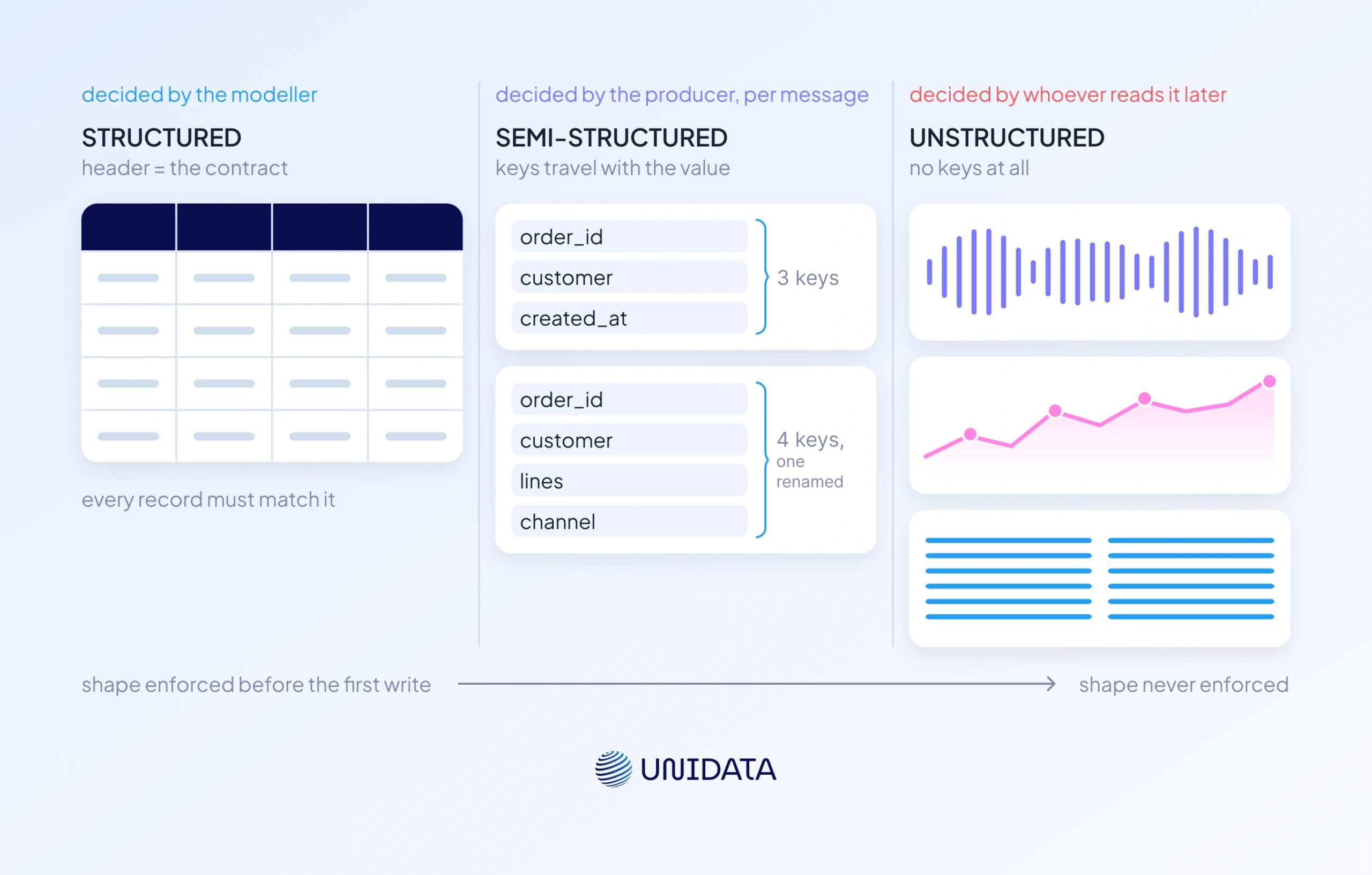
Structured data: the organized framework
Use structured data when the business needs a single, agreed-upon definition of a metric — and when every record must follow the same shape.
Structured data fits into rows and columns, follows a fixed schema, and maps naturally to relational databases and SQL. [1] In practice: customer records, orders, inventory counts, invoice lines. The schema is the contract. Producers know what format to send; consumers know what to expect. That consistency is why BI tools — business-intelligence apps like Tableau, Looker, or Power BI — can connect to a warehouse and run reports without custom extraction logic. [6] Relational systems also enforce ACID transactional properties — Atomicity, Consistency, Isolation, Durability (a write either completes in full or rolls back entirely, and committed data stays correct) — which matters for financial and operational correctness where ambiguous records create downstream problems. [16]
Quick test before modeling data as structured:
- Fields you'll query most: can you list them and confirm they won't change weekly? → model as structured.
- Business users need consistent dashboards with stable definitions? → keep the canonical version structured.
- Correctness matters per transaction (money, entitlements, compliance)? → default to structured storage with constraints.
Unstructured data: the raw information landscape
Unstructured content accumulates faster than it becomes usable. Call recordings, support tickets, image archives, PDF contracts: all retained, none of it analyzable until something adds structure. That gap isn't a storage problem. It's a labeling and governance problem.
NIST defines unstructured data as formats that often lack explicit structure: text, pictures, audio, and video. [2] Cloud data lake designs explicitly support storing this content "as-is" so different types of analytics can be run later. [4] A common enterprise estimate puts roughly 80% of organizational data in unstructured formats, which is why governance and discovery become the primary bottlenecks. [3] NIST's Big Data Interoperability Framework describes volume, velocity, and variety as the defining characteristics of these repositories — all three apply here. [8]
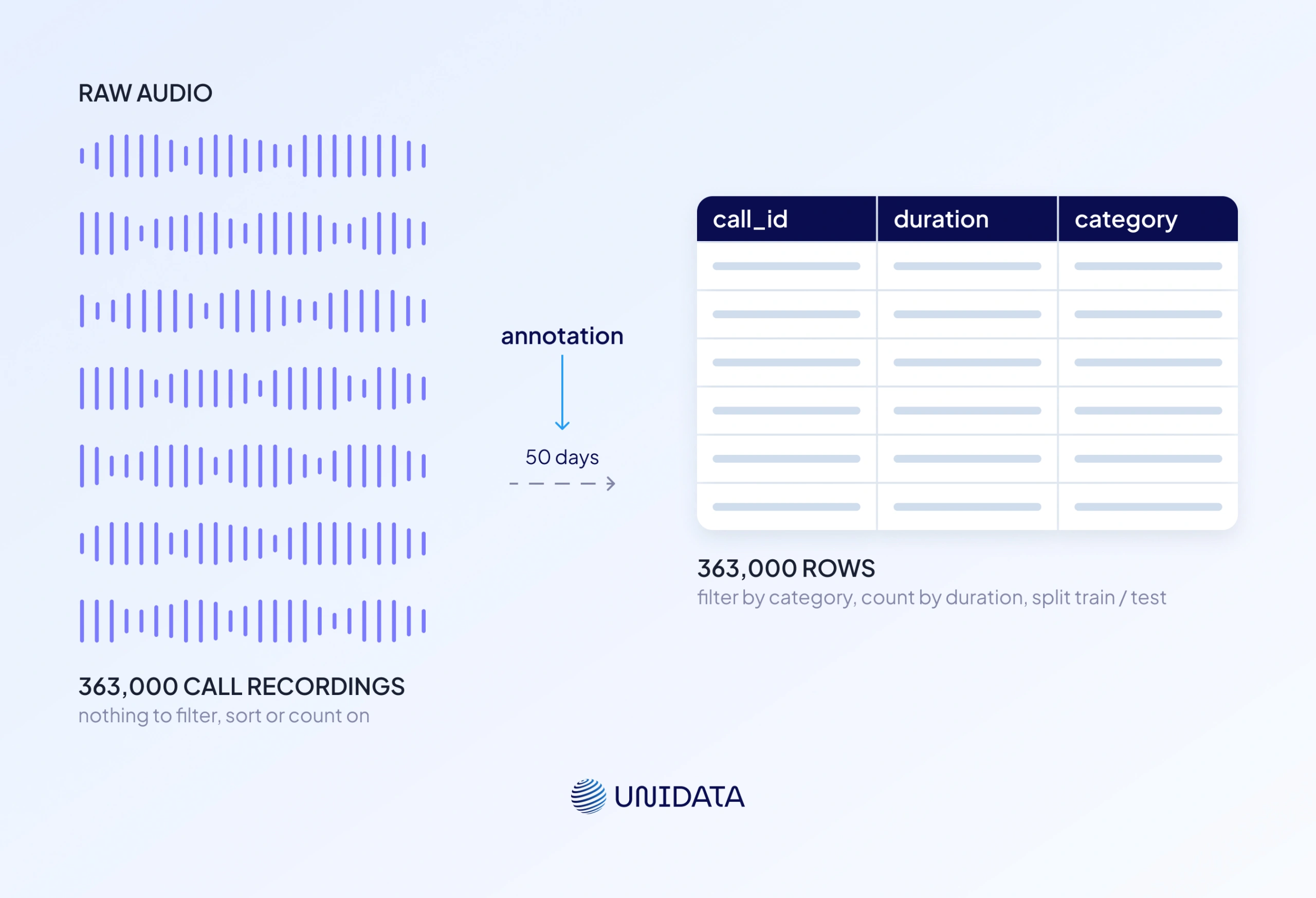
For ML training data pipelines, unstructured content makes up the majority of what teams need to organize before models can learn from it. Annotation is how that structure gets added.
For a bank automating its call centre, we categorized 363,000 recordings in 50 days, a rate that only holds up as a managed pipeline rather than a tagging task. The recordings stayed audio throughout; what became structured was the label layer alongside them, and that is what their own team could train on.
How to start:
- Inventory where unstructured content lives (email, documents, tickets, recordings) and decide what's in scope for analytics vs. retention only.
- Add metadata: owner, system, sensitivity, retention class.
- Only then invest in extraction — classification, tagging, entity fields — so the content becomes queryable.
Semi-structured data: the important middle ground
The common mistake with JSON and XML payloads is treating them as "structured enough" for direct reporting without deciding where validation lives. Schema-optional is not the same as schema-free — and that distinction determines whether your ingestion pipeline holds or breaks under schema drift, when the shape of incoming data quietly changes as upstream systems evolve.
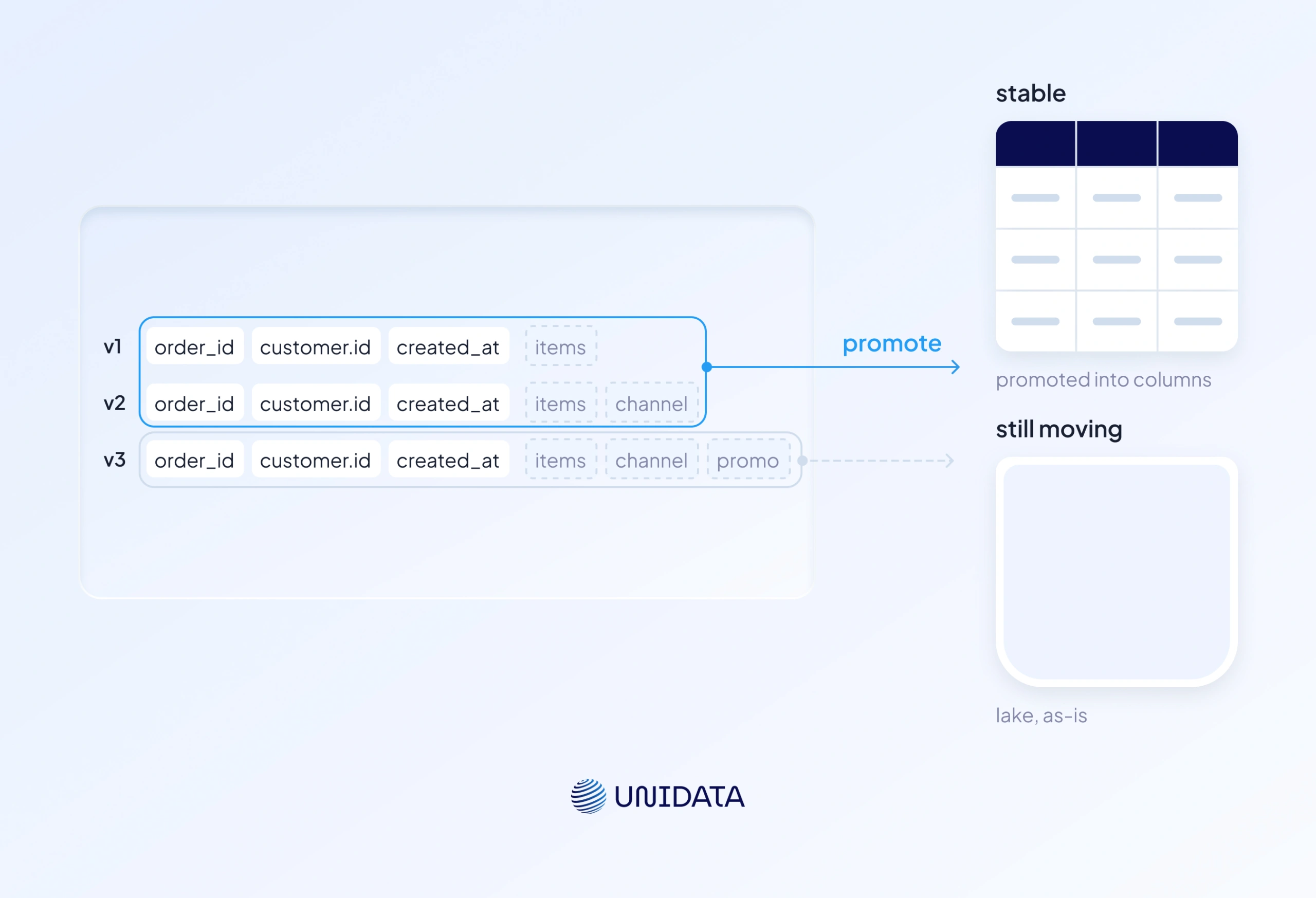
Semi-structured data has internal markers (keys, tags, nesting) but doesn't require a rigid table schema. JSON is the standard lightweight carrier in APIs and event streams. [10] XML handles document-style integrations. [11] Document-oriented stores like MongoDB are designed for flexible, nested models that evolve as requirements change. [9] Snowflake groups JSON, Avro, ORC, and Parquet (common data-exchange and columnar file formats) under explicit "semi-structured" support. [12]
Example JSON payload from an API ingest:
{

  "order_id": "A-10291",

  "customer": {"id": "C-77", "tier": "pro"},

  "items": [{"sku": "S-1", "qty": 2}, {"sku": "S-9", "qty": 1}],

  "created_at": "2026-03-04T10:30:00Z"

}
Rule of thumb: keep semi-structured as-is in a lake when producers change fields often. Promote stable fields — order_id, timestamps, customer ID — into structured tables when they become reporting- or governance-critical.
Key differences between structured and unstructured data
The differences are operational, not philosophical: schema expectations, storage patterns, and how you query and govern the data. Use the table below as a routing tool before committing to an architecture.
Quick comparison table
| Dimension | Structured data | Unstructured data |
|---|---|---|
| Shape | Fixed schema; fits data tables | No fixed schema; stored in native formats (text, images, audio, video) |
| Typical stores | Relational DBs and data warehouses, accessed via SQL and BI clients | Data lakes and object storage (raw file buckets, e.g. Amazon S3); NoSQL stores (non-relational databases like MongoDB) for flexible ingestion |
| Query style | SQL (ISO/IEC 9075 standard) | Requires metadata, indexing, and extraction before analysis |
| Governance | Schema-enforced; formal data governance applies naturally | Classification and labels matter more than columns; harder to enforce consistently |
| Best for | Transactions, reporting, consistent KPIs | Voice-of-customer, documents, media, "why did this happen?" context |
Data organization and format
The most expensive mistake in data modeling is force-fitting unstructured content into tables. You don't lose the data — you lose the meaning, and you spend months on normalization work — reshaping content to fit clean relational tables — that never fully resolves.
Structured data "fits neatly into data tables" with discrete types: numbers, dates, short text fields. [1] Unstructured data doesn't fit into a table because of its size or nature — audio, video, long-form text. [2] The routing rule: if you need joins, aggregations, and consistent dimensions, model the core entities as structured tables. If you need the full artifact — PDF, transcript, image — keep it unstructured and add metadata and extracted fields alongside it.
Storage methods and requirements
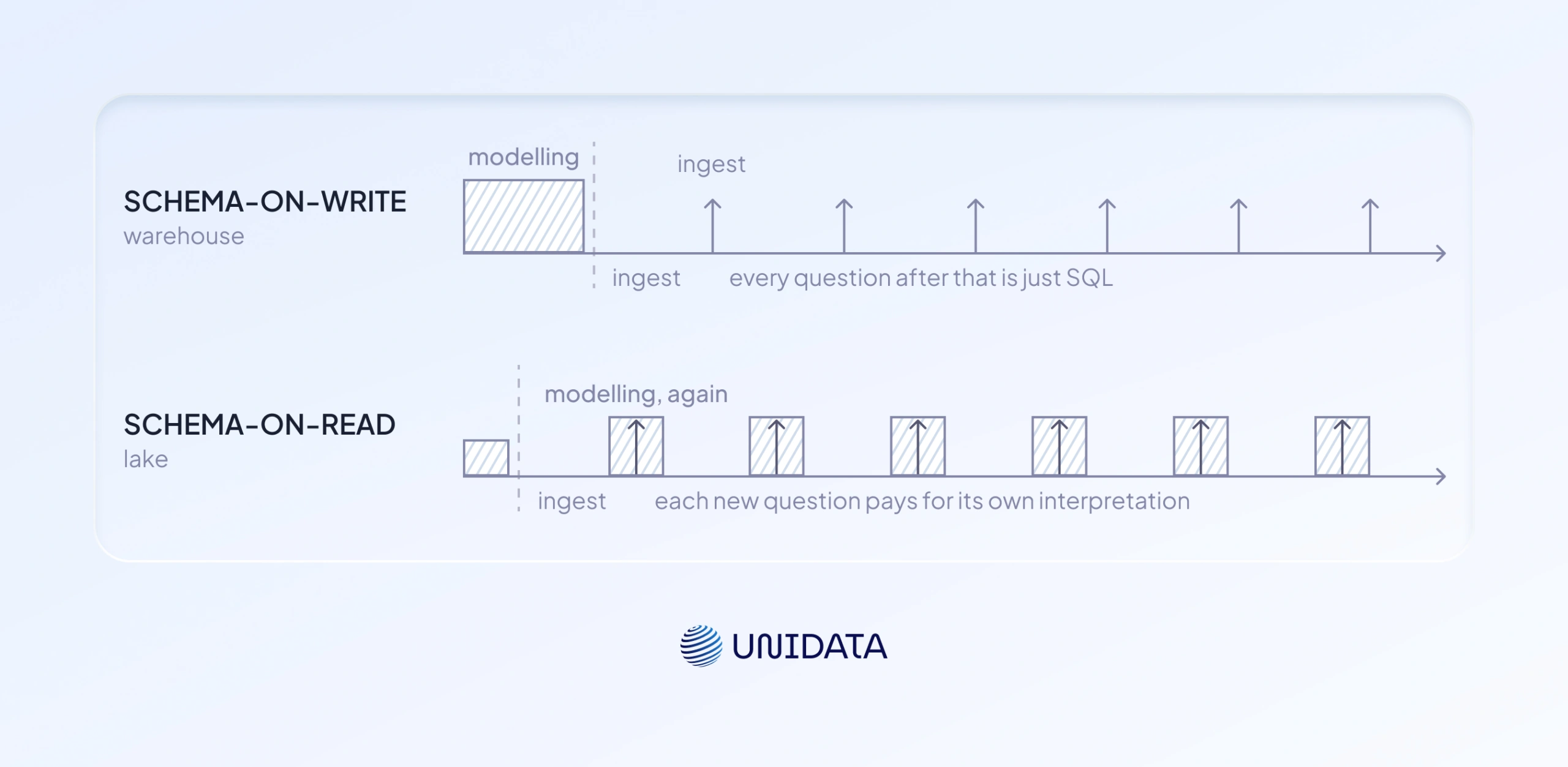
The cost difference between warehouses and lakes isn't storage price — it's when you pay to model the data. Warehouses make you pay up front to define structure; lakes make you pay later when you interpret content.
AWS describes a data warehouse as a central repository analyzed via BI tools and SQL clients to support informed decisions. [6] A data lake stores structured and unstructured data "as-is" at any scale and supports analytics from dashboards to machine learning. [4] Microsoft's architecture guidance adds that schema-on-read — applying structure when you query the data rather than when you store it — enables experimentation, but requires discipline in metadata, cataloging, and access controls for reliable outcomes. [5]
Default storage choices:
- Transactional structured data → relational system designed for consistency and predictable writes.
- Analytics-ready structured data → warehouse layer for SQL and BI access.
- Raw and mixed-format data → lake, with metadata and classification required at ingestion.
Querying and analysis capabilities
The assumption that unstructured data is "queryable later — once we figure out the schema" consistently fails in practice, because "later" means after a classification, tagging, and indexing step. When that step has no owner and no budget line, "later" never arrives. If you need fast, shared-definition answers, keep the answer layer structured even when the source evidence is unstructured.
SQL has an international standard (ISO/IEC 9075), which is why it remains the default interface for structured querying across most platforms. [7] Data warehouses are designed to be accessed via BI tools and SQL clients for decision-making.
Unstructured data analysis starts by turning content into signals: metadata fields, categories, extracted entities, searchable indexes. NIST's classification guidance frames this as a discovery problem — you can't query what you haven't labeled and organized. [15]
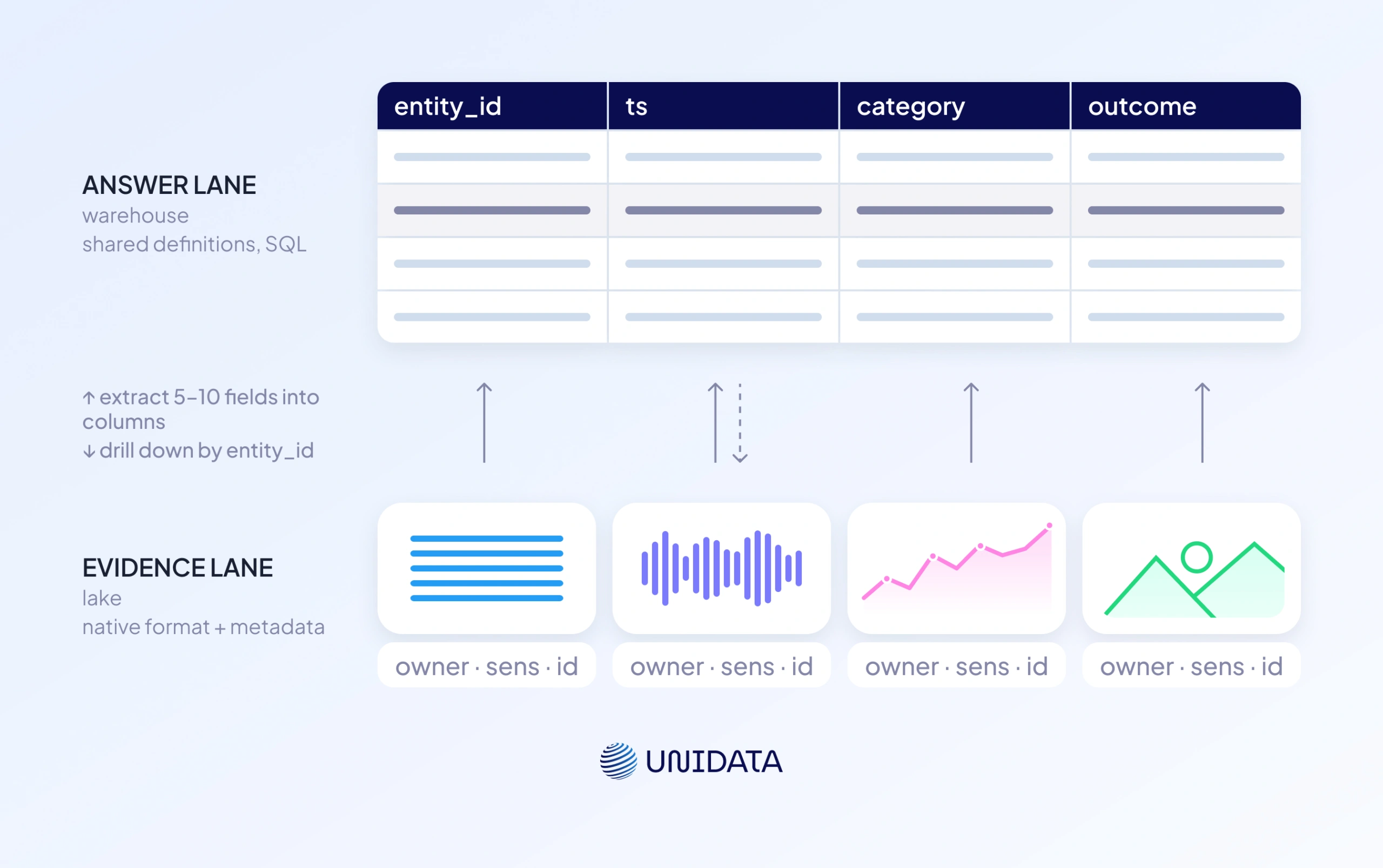
Two-lane pattern:
- Keep raw content in the lake (evidence lane).
- Extract the fields needed for reporting into structured tables (answer lane).
- Govern both: access controls on evidence, quality rules and definitions on answer tables.
Advantages and limitations of structured data
Structured data wins on speed, shared definitions, and governance. The cost is rigidity: schema changes can disrupt concurrent access at scale, especially on high-traffic production systems.
What structured data does well
If two teams need to agree on a number — revenue, active users, inventory on-hand — structured data is where that agreement lives. SQL and warehouse tooling exist specifically because organizations can't function without a shared, consistently-defined metrics layer.
Structured storage enforces a schema as a contract: producers know what format to send, consumers know what to expect, and governance works because fields are explicit and auditable. Relational systems add ACID transactional reliability — Atomicity, Consistency, Isolation, Durability — which matters for financial and operational correctness where ambiguous records create real downstream problems. [16] That combination of SQL standardization and transactional reliability is what makes structured data the default for dashboards, KPIs, and any workflow where a shared definition isn't optional.
Where structured data hurts
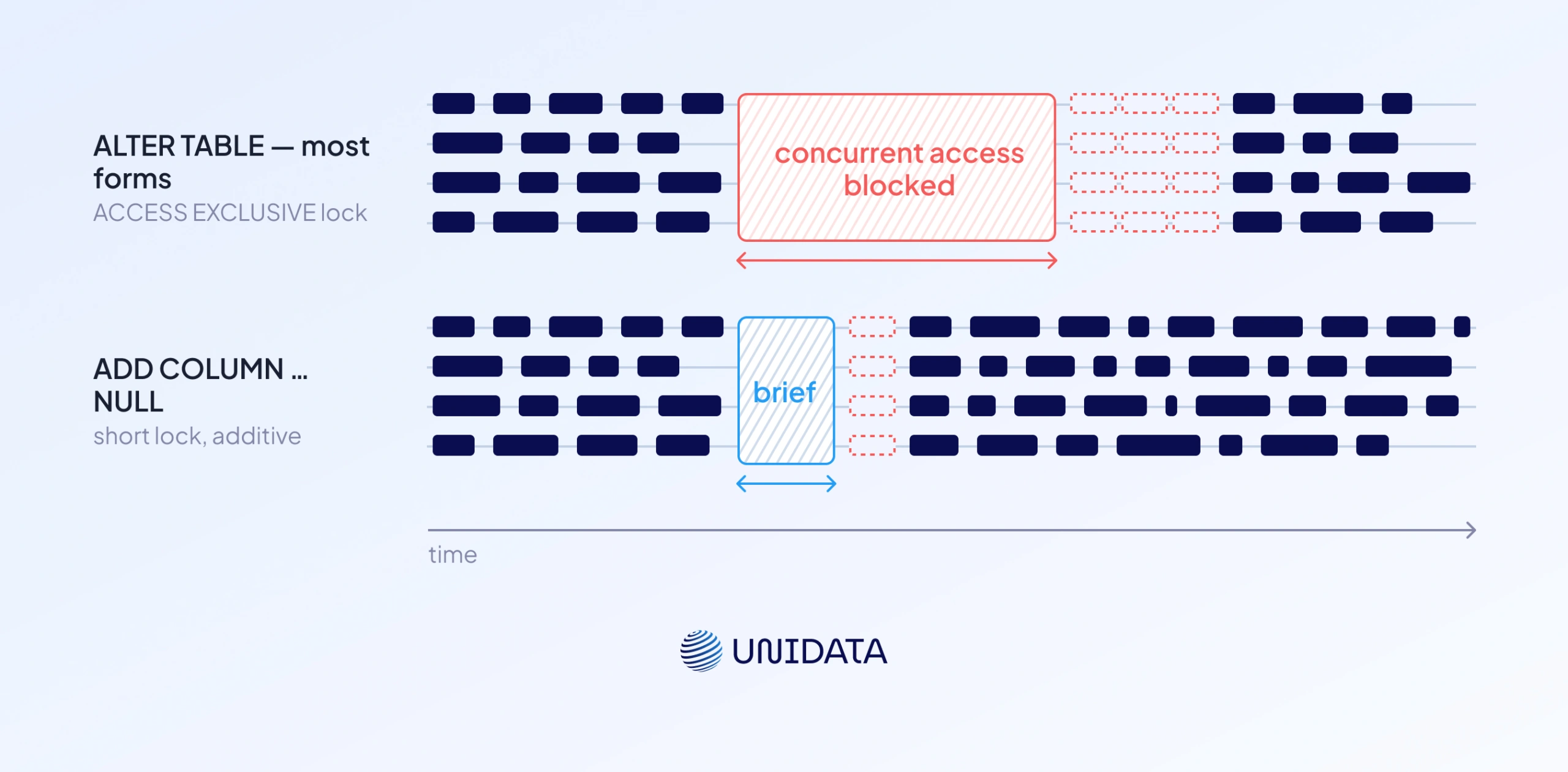
Schema changes in production are not a DBA task — they're a deployment. PostgreSQL documents that ALTER TABLE may acquire an ACCESS EXCLUSIVE lock unless noted, which blocks concurrent access while the change runs. [17] In a high-traffic table, that means downtime or degradation without careful planning.
The structural cost is front-loaded: you pay to define the schema before any querying is possible, and when requirements change frequently — new attributes, evolving event shapes — that investment repeats. For systems with a stable, predictable data model, this is manageable. For anything still being discovered, the rigidity becomes a tax on iteration — every schema change is a production engineering event, not a configuration adjustment.
When structured data shines
Use structured data when precision and repeatability matter more than narrative context — and when a compliance report or shared KPI depends on it.
Transaction processing (orders, payments, inventory movements) needs strong consistency and clear field constraints to avoid ambiguous records. Financial and operational reporting both require stable definitions so that different teams can read the same number and reach the same conclusion. The shared factor: any data where ambiguity would be unacceptable — money, access rights, regulated records — belongs in a structured store. The same applies to any metric that needs to mean the same thing across teams; the moment two people define "active customer" differently, the downstream reporting becomes unreliable.
Overcoming structured data challenges
In practice, schema migrations take longer than expected because ALTER TABLE on a high-traffic table isn't a configuration change — it's a production deployment with rollback planning. PostgreSQL notes that lock levels vary by subcommand and can be highly restrictive.
The standard mitigation is a layered architecture: a raw landing zone where upstream changes land without immediately breaking downstream reporting, and a curated structured layer where only stable, business-critical fields live. Within the hot path, additive changes — new nullable columns rather than destructive operations — reduce lock time and migration risk. The goal is to make schema evolution a routine engineering event rather than an emergency.
Advantages and limitations of unstructured Data
Unstructured data holds the context that structured tables can't capture — but the richness has a cost: harder governance, harder querying, harder self-serve analytics. The approach that works is keeping content in native format while adding structure through metadata and extraction where it earns its keep.
What unstructured data does well
Structured tables tell you what happened and when. They rarely tell you why — that's what unstructured content is for.
Unstructured data preserves original meaning and context: the full transcript of a support call, the actual wording of a complaint, the image of a defect. [2] Data lake architectures store this content "as-is" without forcing a schema, which means structure can be applied at read time and the data model can evolve as understanding develops. [4] New formats and new data sources can be ingested without schema rework — which is why exploratory and ML workflows almost always start from a lake rather than a warehouse. [5]
This flexibility plays out directly in annotation work. We annotated 100,000 chat messages for toxic-content classification, and none of the messages were reshaped to fit a schema: they stayed in native format while the class labels were added alongside them. That gave the client's moderation team something to filter and train on while the original wording stayed intact as the evidence record, which is the two-lane split at the scale of a single project.
Where unstructured data hurts
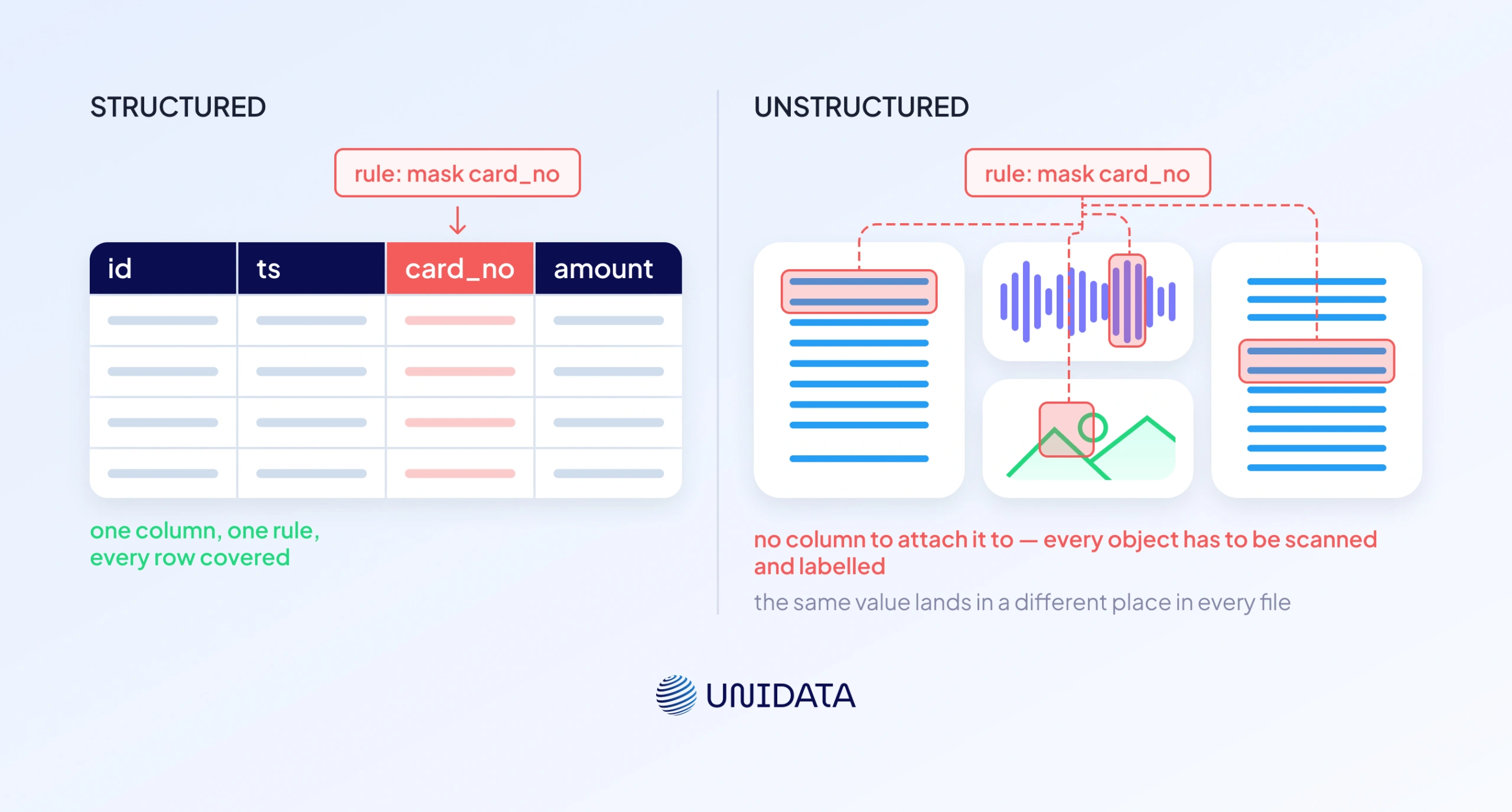
The governance problem with unstructured content: you can't apply quality rules, access controls, or shared definitions to columns that don't exist. [14] Sensitive data — a credit card number in a support ticket, personally identifiable information (PII) buried in a contract PDF — can appear anywhere without any schema enforcing constraints around it.
NIST's classification guidance frames this as a discovery and labeling problem: organizations have to identify and label content before they can manage it. [15] Without that step, search is unreliable because there's no consistent catalog or indexing; self-serve analytics is limited because BI tools expect fields, not paragraphs and PDFs; and unstructured sources introduce harder-to-detect bias into ML training sets, since quality rules can't be applied at the schema level.
When unstructured data delivers
For context that doesn't appear in transactional tables — customer language, recurring complaints, the actual reasons behind churn — unstructured content is often the only source. Transactional metrics tell you a customer left. Unstructured content tells you why.
Customer reviews, support tickets, call transcripts, and social content surface product issues and satisfaction signals that structured tables don't capture. Data lakes are positioned for exploratory analytics and ML workloads precisely because they retain diverse content in raw form.
The practical extraction pattern: pull "who/what/when" fields (customer ID, product, timestamp, channel) into structured tables for reporting, keep the original content as the evidence record linked via IDs and metadata, and build search and classification so teams can find relevant slices without manual review. The evidence stays unstructured; the derived signals become structured.
Taming the unstructured data challenge
The goal isn't to convert unstructured data into perfectly structured tables. It's to make it manageable with three controls: metadata, classification, and access governance.
NIST defines metadata as information that describes characteristics of data, including structural and descriptive labels such as security classifications. [13] Without that layer, unstructured repositories become dark storage — content exists, nobody can safely find or audit it.
Simple operating model:
- Classify at ingestion: assign sensitivity, owner, system, and retention class as metadata.
- Control access consistently: enforce policies through a governance model, not ad hoc folder permissions.
- Extract just enough structure: create a minimal set of standardized fields — five to ten — so you can filter and route work without rebuilding everything as a table.
Real-world applications and use cases
Most businesses need both types running in parallel: structured data for "what happened and how often," unstructured data for "why and in whose words." The practical architecture is a joint workflow — lake for raw evidence, warehouse for curated answers, connected by IDs and metadata.
Data lakes support exploratory analytics, data science, and ML workloads because they retain raw data and support schema-on-read. Data warehouses serve BI tools and SQL clients for operational decision-making.
Copy-paste decision matrix for stakeholder reviews:
- Question is "how many / how much / how often?" → start with structured metrics in tables.
- Question is "why are customers upset / what are they saying?" → start with unstructured content plus metadata and extraction fields.
- Source is API events or flexible payloads → treat as semi-structured; promote stable fields into structured models over time.
Fast validation pilot (one week):
- Pick one problem where context matters: support tickets for churn, contracts for risk, call summaries for QA.
- Store raw content in a lake, require minimal metadata (owner, sensitivity, timestamp, entity ID).
- Extract 5–10 fields into a structured table so stakeholders can slice and verify value quickly.
- Scale based on whether extracted fields improve decisions — not pipeline complexity.
If your team needs annotation pipelines that turn unstructured content — audio, images, text, video — into labeled structured formats for ML training, start here: unidata.pro/data-annotation/
Conclusion
Structured data and unstructured data are not competing choices — they solve different problems. Structured data gives you the answer layer: consistent definitions, fast querying, shared metrics. Unstructured data gives you the evidence layer: original context, customer language, the "why" behind the numbers.
The practical question is never which type is better. It's whether the routing decision has been made explicitly — which content goes where, what governance applies, and whether there's a pipeline connecting the evidence to the answers. Most of the "we have the data but can't use it" problems trace back to a routing decision that was never made at all.
- Data Collection
- AI Data Collection
- Crowdsourcing
- Biometric Data
- Synthetic Data

Frequently Asked Questions (FAQ)
Structured data fits into a predefined schema, organized in rows and columns for direct SQL querying. It powers transactional and reporting workflows where BI dashboards and data warehouses rely on consistent field definitions. Common examples include customer records, orders, inventory tables, and financial line items — each record following the same shape.
Unstructured data lacks explicit structure — formats like text, images, audio, and video that don’t come with a fixed schema. Organizations typically store it “as-is” in data lakes, then use metadata and extraction to make it searchable and analyzable. It represents the majority of enterprise information, which is why governance and discovery become primary operational challenges at scale.
Structured data fits into tables with a fixed schema and can be queried directly with SQL. Unstructured data doesn’t fit into tables and requires classification, metadata, or extraction before it becomes analyzable. The operational differences extend to storage (warehouse vs. lake), governance approach, and tooling required for any analysis.
Semi-structured data contains organizational markers like keys, tags, or nesting, but doesn’t require a rigid table schema. Common examples include JSON and XML payloads from APIs and event streams, which can be stored flexibly and later mapped into structured fields for reporting. It’s the default format in most modern application integrations.
The working pattern is two lanes: raw structured and unstructured content lands in a lake “as-is,” and curated structured tables serve dashboards and decision workflows. Shared IDs and metadata link the two, so stakeholders can drill from a KPI into the underlying evidence — tickets, transcripts, documents.
Structured data supports fast SQL querying, consistent BI reporting, and easier governance because it follows a predefined schema. Its main drawback is rigidity: schema changes can require operations that block concurrent access or disrupt production systems depending on the database and change type.
Unstructured data preserves full context — text, images, audio, video — which is valuable for customer insights and document-heavy workflows. Its drawback is operational: governance, discovery, and self-serve analytics are harder without consistent metadata, classification, and access controls.
The practical approach is not to convert everything — it’s to extract the specific fields that support decisions. Store raw content in a lake, add metadata and labels, then populate structured tables with extracted attributes: IDs, timestamps, categories, outcomes. For ML training data, annotation pipelines handle this extraction step.
Common examples include customer records, transaction logs, inventory tables, and financial line items, where each record follows a consistent set of fields. These are typically stored in data warehouses and queried with SQL and BI tools for repeatable reporting.
Common examples include emails, PDFs, chat messages, support transcripts, images, audio recordings, and video. Organizations manage these with classification and labeling so sensitive content can be controlled and repositories can be searched across large volumes.
Further Reading & References:
- [1] The difference between structured data and unstructured data — AWS — (n.d.)
- [2] Unstructured data (Glossary term) — NIST CSRC — (n.d.)
- [3] Dark data: Analyzing unstructured data — Deloitte Tech Trends 2017 — 2017
- [4] What is a data lake? — AWS — (n.d.)
- [5] What is a data lake? — Azure Architecture Center (Microsoft Learn) — 2025
- [6] What is a data warehouse? — AWS — (n.d.)
- [7] Database languages SQL (ISO/IEC 9075-1:2023) — ISO — 2023
- [8] NIST Big Data Interoperability Framework, Volume 1 — NIST — 2019
- [9] Data Modeling in MongoDB — MongoDB Manual — (n.d.)
- [10] The JavaScript Object Notation (JSON) Data Interchange Format (RFC 8259) — IETF — 2017
- [11] Extensible Markup Language (XML) 1.0 (Fifth Edition) — W3C — 2008
- [12] Semi-structured data types — Snowflake Documentation — (n.d.)
- [13] Metadata (Glossary term) — NIST CSRC — (n.d.)
- [14] Data governance (Glossary term) — NIST CSRC — (n.d.)
- [15] Data Classification Practices (SP 1800-39 initial public draft) — NIST CSRC — 2026
- [16] Transaction Processing in PostgreSQL — PostgreSQL (Tom Lane) — 2000
- [17] ALTER TABLE — PostgreSQL Documentation — (current)