
This article walks you through the key differences, the real trade-offs, and a practical way to decide, especially when you are integrating supplier or partner feeds into an analytics stack.
What’s the Difference Between ETL and ELT?
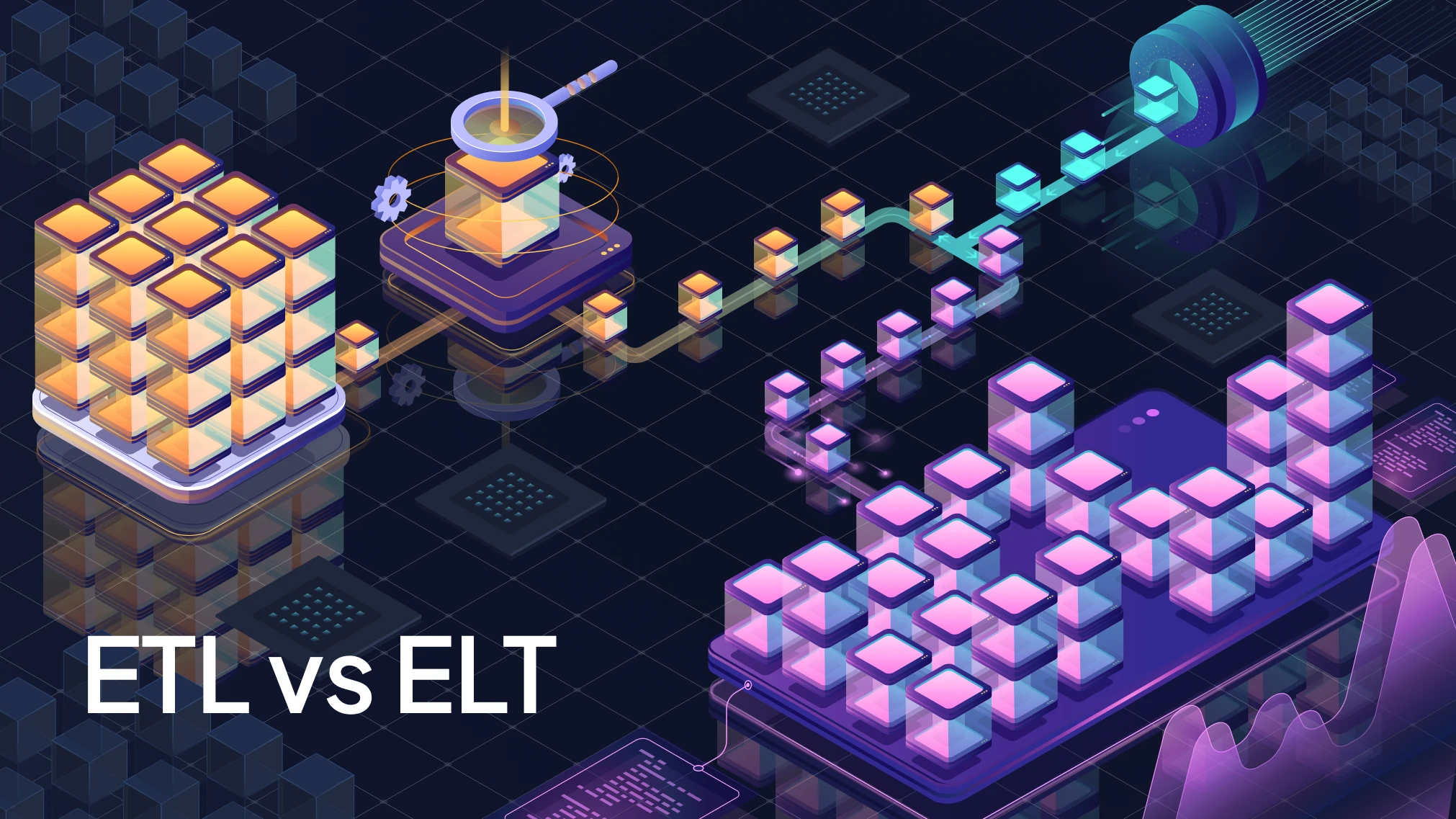
Both approaches move data from a source system into an analytics environment. The split is not whether you transform, but when you do it and where the compute runs.
In practice, “transform” usually means things like filtering out irrelevant rows, fixing types, handling missing values, standardizing field names, unpacking nested JSON, and shaping data into tables that are easy to query. The same business logic can be implemented in either pattern. The difference is which system carries that workload.
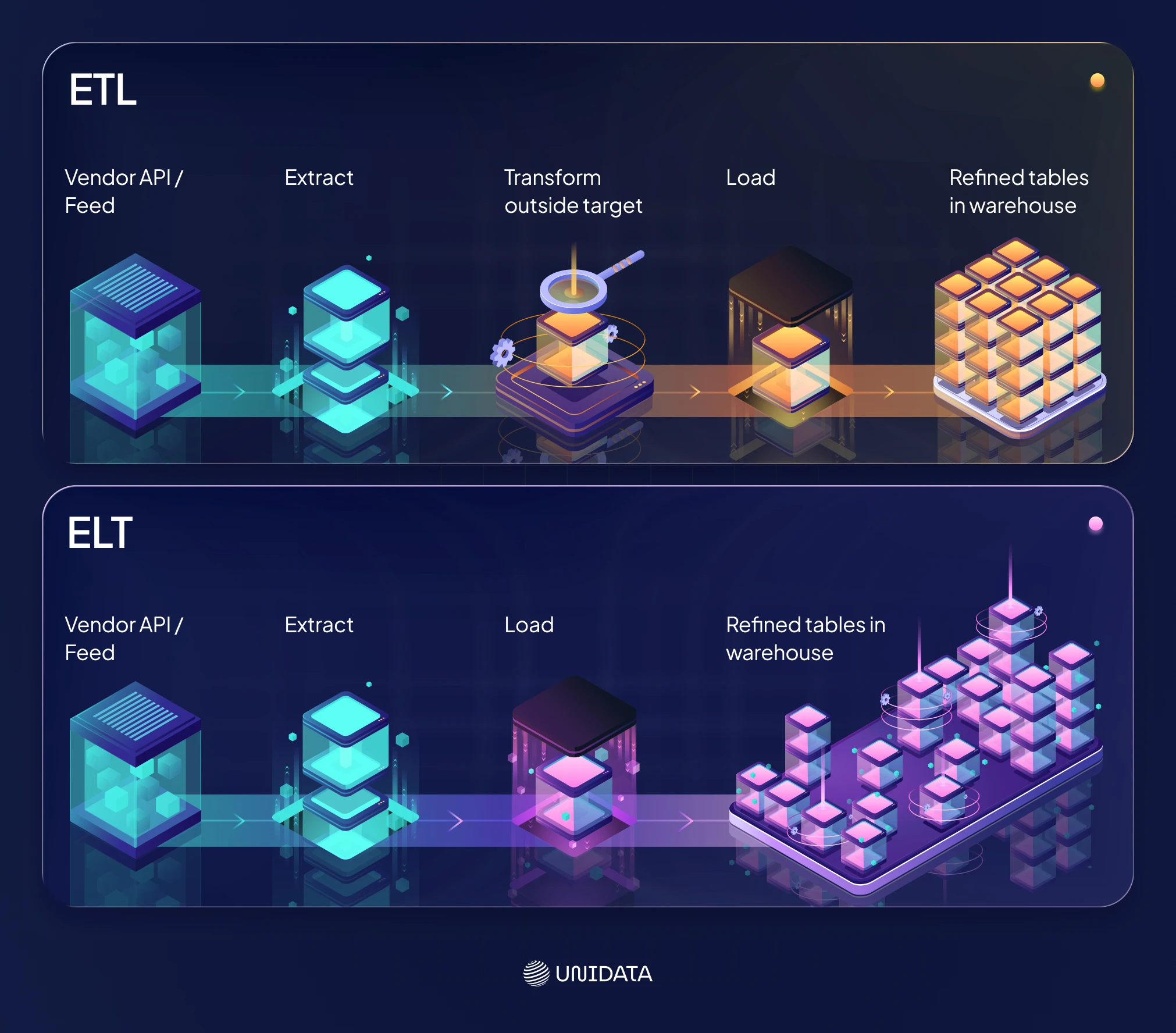
- ETL (Extract, Transform, Load): you extract from source systems, transform outside the target (in an ETL engine or processing layer), then load clean, shaped data into the target.
- ELT (Extract, Load, Transform): you extract and load raw data into the target first (often a cloud warehouse or lakehouse), then transform inside the target using its compute.
A quick way to picture it with vendor feeds: with ETL, you “clean the shipment at the dock” and store only the curated boxes. With ELT, you “store the shipment first,” then build curated shelves from the raw inventory.
In plain terms: ETL curates before storage, ELT stores before curation.
Quick Comparison Table: What Changes When You Flip T and L?
Use this table as a map of trade-offs, not a scorecard. If a row matters for your business, it should show up in your decision criteria and SLAs.
| Aspect | ETL (Extract → Transform → Load) | ELT (Extract → Load → Transform) |
|---|---|---|
| Where transformation runs | Outside the target (ETL engine, Spark, Python jobs, dedicated service) | Inside the target (warehouse SQL, dbt models, lakehouse engines) |
| What lands in the target | Mostly refined, analysis-ready tables | Raw or lightly structured data plus refined tables built later |
| Time-to-raw availability | Slower (transform adds latency before load) | Faster (raw data lands quickly) |
| Scalability pattern | ETL layer can become a bottleneck at high volume | Scales well when the target has elastic compute |
| Flexibility for new questions | Lower if you discard raw fields early | Higher because raw history stays available |
| Governance posture | Easier to block or mask sensitive fields before storage | Requires strong controls in the target because raw data lands first |
Keep in mind: most modern stacks mix the two. You may load raw like ELT, but still apply a small “safety transform” like ETL before anything becomes widely accessible.
When ETL Is the Safer Bet
Choose ETL when transforming before storage reduces risk or avoids technical pain later. This is less about ideology and more about blast radius: where can raw vendor data exist safely, and who can touch it?
You Handle Sensitive or Regulated Fields
If vendor feeds contain regulated data, ETL lets you enforce policies before anything lands in the warehouse. That can mean masking, tokenizing, dropping fields you do not need, or routing sensitive columns to a different governed store.
The practical caveat: ETL can reduce exposure, but it also means you must be confident your masking and filtering rules are correct. If you remove something you later need, you may have to re-extract from the vendor.
You Want Strict Data Minimization
Some teams do not want “store everything” as a default. ETL supports a lean target by filtering early. That helps when storage cost, retention rules, or internal governance pushes you toward “only what we need.”
The trade-off is flexibility. If downstream teams later ask for an attribute you filtered out, ETL makes that request harder because the raw history is not sitting in your target.
Your Target Is Not Built for Heavy Transformations
If your target is an older on-prem warehouse, a smaller database, or a constrained environment, pushing complex transforms into it can create slowdowns or contention. ETL lets a separate compute layer do the work, then loads the result.
This matters most when your warehouse also serves interactive users. A heavy in-warehouse transform can compete with business queries unless you have strong workload isolation.
Your Transformations Are Complex and Easier in Code
Some pipelines need heavy cleansing, enrichment, or custom business logic that is easier in Python, Spark, or specialized ETL tooling than in SQL. ETL keeps that logic closer to a full programming environment.
The gotcha is maintainability. Complex code transforms need version control, tests, and a clear release process, otherwise debugging becomes “guess which script changed last week.”
Your Requirements Are Stable and Well-Defined
If you already know the reporting schema and it rarely changes, ETL’s upfront structure is not a downside. It can be a benefit: everyone queries the same clean tables and you avoid “multiple versions of truth.”
The caution: “stable” must be real. Vendor integration often evolves as vendors add fields, change formats, or send new edge cases.
A clean ETL mental model is: block bad data early, load only what you trust.
When ELT Is the Better Default
Choose ELT when speed, scale, or adaptability matters more than upfront curation. The key assumption is that your target platform can store raw data safely and transform it reliably.
You Ingest Large or Fast-Growing Volumes in the Cloud
Cloud warehouses and lakehouses are designed to store lots of data and transform it with parallel compute. ELT takes advantage of that by loading quickly and pushing transforms into the platform that scales.
The practical cue: if you are already paying for elastic warehouse compute, ELT lets you use it rather than building a separate transformation layer as the primary workhorse.
You Want Raw History for Future Questions
Vendor integration rarely stays still. Today you track price and availability. Tomorrow you need defect rates, fulfillment exceptions, or new attributes that only exist in the raw payload. ELT keeps the original data so you can rebuild models without re-ingesting from scratch.
The caveat is governance. Keeping raw history is only useful if it is discoverable and controlled, not scattered across uncontrolled tables.
You Support Ad-Hoc and Iterative Analytics
If analysts and data scientists routinely explore new ideas, ELT makes it easier to create new derived tables from raw sources. You keep a stable raw layer and iterate on transformations as code (often in SQL).
The risk is inconsistency if people bypass curated datasets. ELT works best when raw is treated as a restricted source layer and refined tables are the standard interface.
You Need Near-Real-Time Ingestion
ELT aligns well with streaming or frequent micro-batches. You can land data continuously, then run incremental transforms on a schedule that matches your SLAs.
A useful way to frame this: if “data must land quickly” is non-negotiable, ELT usually gets you there. You can then decide how quickly the refined layer must update.
You Ingest Semi-Structured Data
Vendor APIs often deliver nested JSON. ELT lets you land the payload as-is, then parse and normalize fields as your downstream model matures.
The caveat is model discipline. Without a clear transform layer, semi-structured data can remain “forever raw,” which makes downstream usage slow and error-prone.
A clean ELT mental model is: ingest first, model later, keep options open.
A Practical Hybrid: The Pattern Many Teams End Up Using
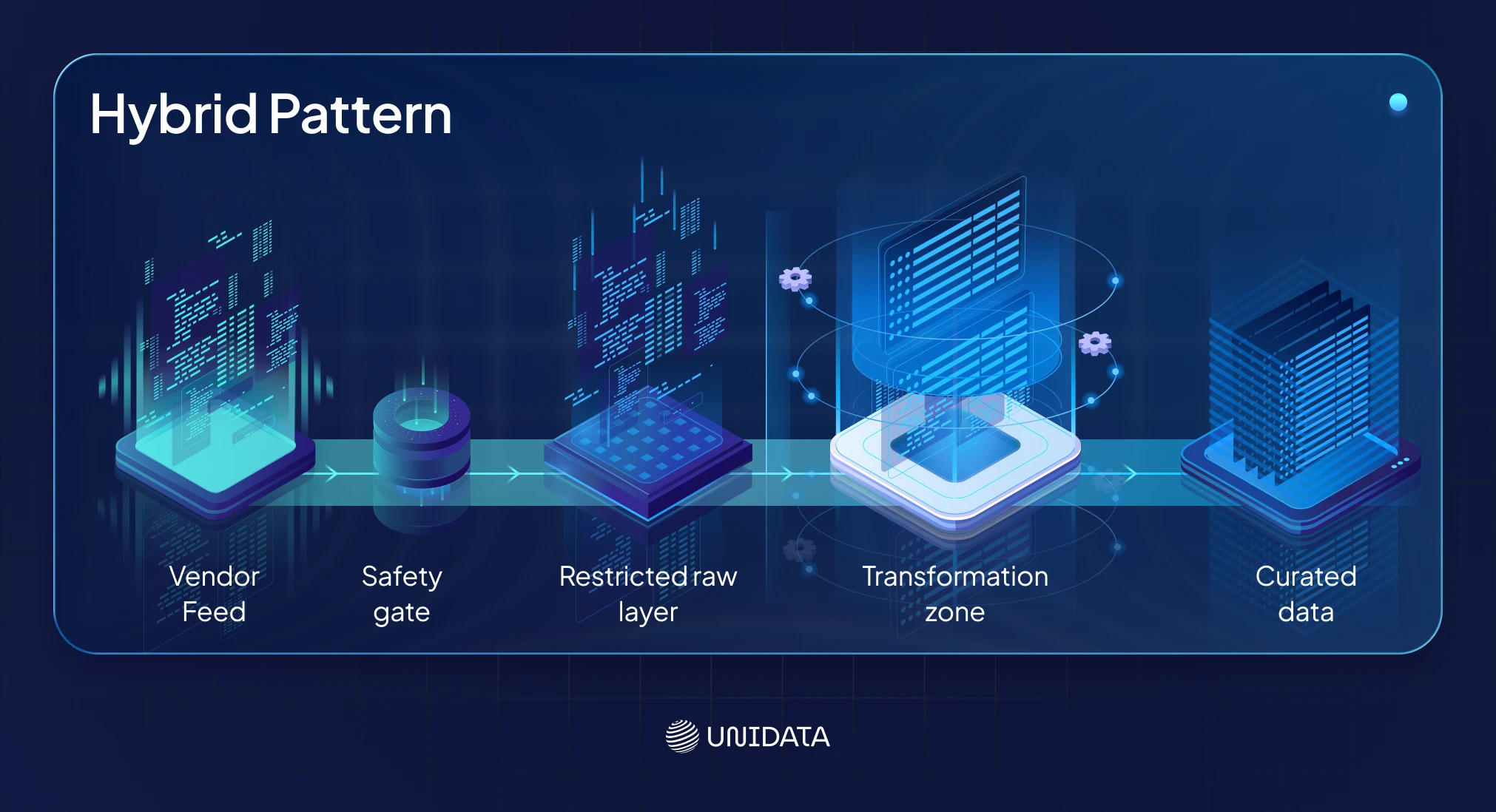
ETL and ELT are not mutually exclusive. A common hybrid approach is:
- Extract
- Light transform for safety (mask, tokenize, drop high-risk columns, validate critical keys)
- Load raw or lightly structured
- Transform inside the target to create analytics-ready tables
This gives you ELT’s flexibility while still preventing the “raw sensitive data everywhere” failure mode.
The key is restraint in step 2. Keep it to controls that reduce risk or stop obvious pipeline breakage. Do not rebuild the full analytics model before load if your goal is ELT-style flexibility.
Compliance and Governance: What Actually Changes in Your Risk Profile?
Compliance is not a property of ETL or ELT. It is a property of your controls. The pipeline choice changes where those controls must be strongest, and where mistakes are most costly.
The Key Difference: Where Sensitive Data First Lands
- With ETL, you can prevent sensitive fields from entering the analytics store at all, or you can store only protected versions.
- With ELT, raw data arrives in the target early, so you must rely on access control, encryption, masking, and policy enforcement at the storage and query layer.
A useful rule: if you adopt ELT, treat the raw layer as a restricted zone by default. Your “public” datasets should be the refined layer.
Governance Needs a Clear “Raw vs. Refined” Contract
ELT works best when you publish curated datasets as the default interface for most users. If everyone queries raw tables directly, you get inconsistent logic, duplicated transforms, and messy auditability.
This is where the “contract” matters: raw is the record of what arrived, refined is the approved shape for analysis, and changes to refined logic are tracked like software releases.
Audit Trails and Monitoring Still Matter
Regardless of approach, you need to track what was ingested, what changed in transformations, who accessed what, and how failures are handled.
The difference is emphasis:
- ETL often centralizes visibility around pipeline runs and pre-load checks.
- ELT often centralizes visibility around transformation jobs, SQL history, and orchestration logs.
Retention and Deletion Workflows Get Harder When You Copy Raw Widely
If ELT leads to raw data being duplicated into multiple derived tables, deletion requests and retention policies become more complex. A disciplined layering approach helps: raw is the source of truth, refined tables are rebuildable, and retention rules are applied consistently.
Performance and Scalability: Speed Is Not One Thing
“Fast” can mean at least two different outcomes: raw data appears quickly, or usable tables appear quickly. ETL and ELT optimize different points on that timeline.
Ingestion Latency vs. Usability Latency
- ELT usually wins on time-to-raw, because you load immediately.
- ETL often wins on time-to-clean, because you only load after shaping.
If stakeholders need a query-ready dataset on a fixed cadence (for example, morning dashboards), ETL’s front-loaded work can feel simpler. If you need data to land continuously and tolerate delayed refinement, ELT fits better.
Bottlenecks Move With Your Design
- ETL can bottleneck in the transformation layer if the ETL compute cannot keep up.
- ELT can bottleneck in the warehouse if heavy transforms compete with user queries and you do not isolate workloads.
This is why “ELT is faster” is only true when you also design for isolation and scheduling.
Cost Is Tied to Where Compute Runs and How Much You Store
ETL can reduce storage and warehouse compute by filtering early, but it may require separate transformation infrastructure. ELT can simplify architecture, but it may increase storage and can shift heavy compute into warehouse credits. Many teams choose ELT and then add scheduling, incremental models, and workload isolation to control cost.
Error Handling Shifts From “Before Load” to “After Load”
ETL can stop bad data earlier. ELT tends to accept raw data and handle quality issues downstream. Neither is “more correct,” but your operational playbook changes. With ELT, you typically need clearer downstream checks so raw landing does not become silent corruption in refined tables.
Tools and Platforms: How They Typically Map to ETL and ELT
Tool choice does not force your strategy, but it nudges it.
Azure Data Factory (ADF)
ADF can support both patterns. You can use it for data movement (ELT-style) and for transformations (ETL-style) depending on how you design pipelines and where you run compute (native data flows, Databricks, Synapse, SQL scripts).
Fivetran (and Similar Managed Loaders)
Managed ELT tools focus on extract + load. They shine when you want reliable ingestion with low maintenance. Transformations typically happen downstream using SQL-based tools and modeling layers.
Informatica (and Enterprise Integration Suites)
Enterprise platforms often excel at complex transformation, data quality, and managed workflows. Many can also “push down” transforms into targets, but they are frequently used where you want robust orchestration, governance integration, and strong control over transformation logic.
The Missing Piece in Most ELT Stacks: The Transform Layer
If you adopt ELT, treat transformations as first-class production code. Many teams standardize on SQL-based modeling tools, version control, test suites, and clear release processes for data models. Without that, ELT becomes “raw data plus spreadsheets,” which is not a strategy.
Hands-On Example: The Same Vendor Feed as ETL and as ELT
Assume a vendor API returns product records. You want a clean table of active products with consistent types and a safe stock value.
ETL Example (Transform Before Load)
import requests
import pandas as pd
from sqlalchemy import create_engine

# Extract
resp = requests.get("https://api.vendor.example/products", timeout=30)
resp.raise_for_status()
df = pd.DataFrame(resp.json())

# Transform
df = df[df["status"] == "active"].copy()
df["last_update"] = pd.to_datetime(df["last_update"], errors="coerce")
df["stock_qty"] = pd.to_numeric(df["stock_qty"], errors="coerce").fillna(0).clip(lower=0)

# Keep only the fields you publish
df = df[["product_id", "name", "price", "stock_qty", "last_update"]]

# Load
engine = create_engine("postgresql+psycopg2://user:password@host:5432/warehouse")
df.to_sql("dim_vendor_products", engine, if_exists="replace", index=False)
Here the warehouse receives a refined table. Inactive products never land in the target, and the schema is controlled at load time.
ELT Example (Load Raw, Transform Inside the Target)
import requests
from sqlalchemy import create_engine, text

# Extract
resp = requests.get("https://api.vendor.example/products", timeout=30)
resp.raise_for_status()
records = resp.json()

# Load raw JSON
engine = create_engine("postgresql+psycopg2://user:password@host:5432/warehouse")
with engine.begin() as conn:
    conn.execute(text("""
        CREATE TABLE IF NOT EXISTS raw_vendor_products (
            data JSONB
        )
    """))
    conn.execute(text("TRUNCATE TABLE raw_vendor_products"))
    conn.execute(
        text("INSERT INTO raw_vendor_products (data) VALUES (:payload)"),
        [{"payload": r} for r in records],
    )

# Transform in-warehouse
with engine.begin() as conn:
    conn.execute(text("""
        CREATE OR REPLACE VIEW dim_vendor_products AS
        SELECT
            data->>'product_id' AS product_id,
            data->>'name' AS name,
            (data->>'price')::numeric AS price,
            GREATEST(COALESCE((data->>'stock_qty')::int, 0), 0) AS stock_qty,
            (data->>'last_update')::timestamp AS last_update
        FROM raw_vendor_products
        WHERE data->>'status' = 'active';
    """))
In this ELT flow, you keep the raw payload, then publish a refined view (or table) for analysts. If your business rules change, you can rebuild the refined layer without re-pulling from the vendor.
Industry Patterns: How the Choice Often Plays Out
These are not hard rules, but they reflect common constraints.
Manufacturing
Operational planning systems often prefer curated, consistent datasets, so ETL is common for vendor master data and standardized feeds. ELT is often used for high-volume logs and exploratory analytics, where keeping raw history supports deeper investigation.
Retail
ETL is common for operational use cases that impact customers immediately (inventory availability, pricing rules, SKU mapping). ELT is common for fast vendor onboarding, broad analytics, and experimentation across many feeds and channels.
Healthcare
Sensitive data and strict privacy requirements often push teams toward ETL or hybrid designs that protect identifiers early. ELT is still used in analytics and research settings, usually with strong restrictions and clear data layering.
A Decision Checklist You Can Actually Use
When you are choosing ETL vs ELT for vendor data integration, answer these in order.
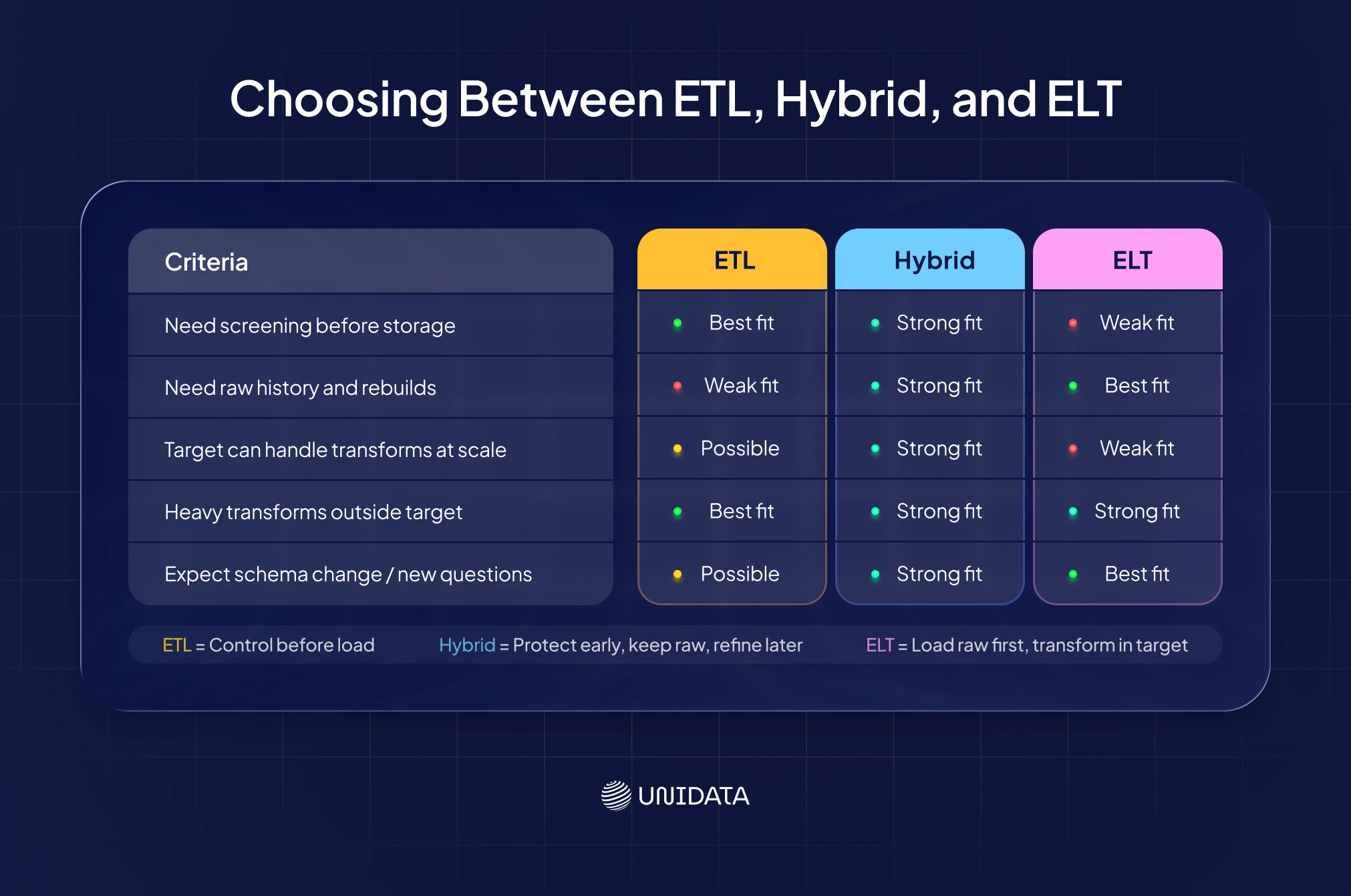
- What is your primary constraint? Compliance risk, time-to-data, cost, flexibility, or operational simplicity.
- Do you need raw history for future questions? If yes, ELT or hybrid usually fits better.
- Can your target handle transformations at your scale? If not, ETL or a separate compute layer is safer.
- How sensitive is the incoming data? If high, decide where masking and minimization must happen.
- How stable are your requirements? Stable schemas lean ETL. Evolving schemas lean ELT.
- What is your team best at maintaining? ETL engines and code transforms, or SQL models and warehouse-native workflows.
- What is your operating model for data quality? Block before load (ETL) vs accept raw then enforce contracts (ELT).
If you cannot answer one of these clearly, choose a hybrid: protect what is sensitive early, land raw for flexibility, and publish curated datasets as the default interface.
Conclusion: A Clean Choice Beats a Perfect Label
ETL and ELT are both valid. The difference is where you want complexity to live.
- Pick ETL when you need strong control before storage, complex preprocessing, or a target that should not carry the transformation workload.
- Pick ELT when you want fast ingestion, scalable transformations inside a modern platform, and the ability to reshape history without re-ingesting.
- Pick a hybrid when you need both: safety gates up front and flexibility downstream.
If you want one north star, use this: design the pipeline so your downstream users mostly touch curated, tested datasets, even if you keep raw data behind the scenes. That is what turns vendor feeds into something your business can trust.
- Data Collection
- AI Data Collection
- Crowdsourcing
- Biometric Data
- Synthetic Data

Frequently Asked Questions (FAQ)
A data lake is usually used in an ELT pattern: you load raw vendor data first, keep the original files or JSON payloads, and then run transformations later to create curated datasets for analytics. This works well when vendor data changes often, when you need raw history for new questions, or when you ingest semi-structured data. A lake can also support ETL when you transform before writing to the lake, but that is less common unless you have strict governance rules that require filtering or masking before storage.
ELT is about building your analytics foundation: you extract data from vendor systems, load it into a warehouse or lakehouse, then transform it into cleaned, query-ready tables. Reverse ETL flips the direction of delivery: you take curated data from your warehouse or lakehouse and sync it back to operational tools (CRM, marketing platforms, ticketing, product systems) so teams can act on it. In other words, ELT moves vendor data into analytics and models it; reverse ETL moves modeled data back out into business apps.
Neither is universally better. ETL is usually safer when you need strict control before data lands anywhere widely accessible, especially with sensitive fields, tight retention rules, or complex preprocessing that is easier outside the warehouse. ELT is usually better when you need fast ingestion, scalable transformations inside a cloud warehouse, and flexibility to rebuild curated datasets as vendor schemas evolve. If you want a practical default for vendor data integration, many teams use a hybrid: a small ETL-style safety step (masking, validation) before load, then ELT-style modeling inside the target.
For vendor data integration, pick ETL if vendor feeds contain regulated fields that must be filtered or masked before storage, or if your target system cannot handle heavy transformations. Pick ELT if you want raw vendor history available quickly, if vendor schemas change often, or if you are building on a cloud warehouse or lakehouse where transformations are easy to manage as SQL models. If you are unsure, a hybrid approach is typically the most practical: land raw data in a restricted layer, publish curated datasets for most users, and keep transformation logic versioned and testable.