
Task
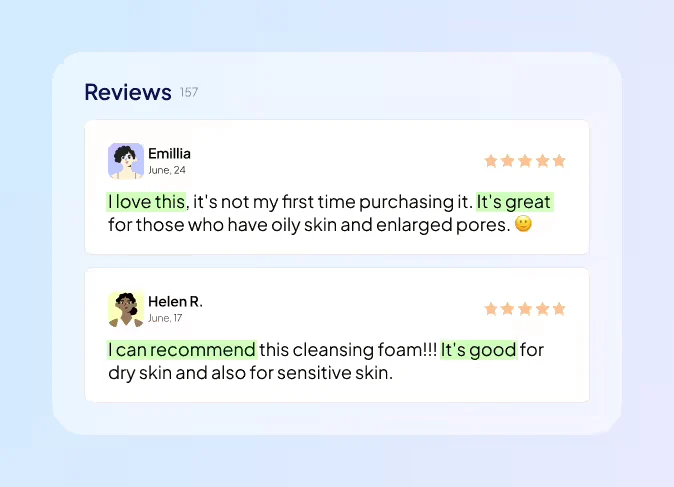
The client needed annotated data for training a sentiment analysis model. The task was to classify each text snippet by its emotional tone — positive, negative, or neutral — while considering the nuances of informal language, sarcasm, and context.
Key challenges included:
- Subtle sentiment cues: Sentiment was often implied rather than explicit, especially in short-form content like tweets or support chats.
- Ambiguity and subjectivity: Many texts were borderline in sentiment, requiring annotators to apply consistent interpretation rules.
- Domain variation: The dataset spanned multiple domains (e.g., e-commerce, tech support, entertainment), each with its own tone, jargon, and sentiment indicators.
Solution
Preparation and guidelines
- Created domain-specific sentiment annotation guidelines with real-world examples
- Defined detailed rules for handling sarcasm, negation, and mixed signals
- Provided initial batches with expert-reviewed annotations as reference sets
- Conducted remote training sessions with interactive exercises and QA discussion
Annotation process
- Annotators labeled text samples using a structured 3-class system (positive, negative, neutral)
- Borderline or uncertain cases were flagged for team review
- Domain shifts were handled by tagging each sample with context metadata for future fine-tuning
Quality control
- Weekly quality audits were performed on random samples by expert validators
- Implemented a double-review process for low-agreement cases
- Annotators received regular feedback based on error patterns and validation reports
| Stage | Input | Workflow Scope | Main Quality Checks |
|---|---|---|---|
| Guidelines & Pilot | Domain-specific text samples | Develop annotation rules, examples, pilot batches | Guideline clarity / Pilot consistency |
| Annotator Training | Annotators, reference sets | Remote training, exercises, QA discussions | Understanding of nuance / Rule adherence |
| Full Annotation | Text samples across domains | 3-class sentiment labeling, borderline flagging, context tagging | Consistency / Context-aware labeling |
| Quality Control | Annotated batches | Weekly audits, double-review of low-agreement cases, feedback | Inter-annotator agreement / Error reduction |
| Final Delivery | Validated annotated dataset | Consolidation, final QA, submission to client | Dataset completeness / Quality compliance |
Guidelines & Pilot Annotation
1 week
Annotator Training & Setup
1 week
Full Annotation Cycle
3 weeks
Quality Control & Final Delivery
2 weeks
The Results
- Accurately annotated 12,000 text samples with sentiment polarity
- Achieved inter-annotator agreement of over 92% on final batches
- Developed scalable sentiment labeling workflows adaptable to new domains
- Enabled the client to improve their model’s performance on noisy, real-world text data
Accurate sentiment annotation depends on understanding nuance, context, and domain-specific cues, especially when emotions are implied rather than stated outright.

- Vladislav Barsukov
- Head of SLM&LLM Annotation