
Most medical AI projects stall at the same step: the team has a model architecture and a deadline, but no dataset that is both clinically accurate and legally usable. Medical data collection is the work that closes that gap — gathering patient and clinical information from records, devices, and direct observation in a form a model can actually learn from.
This guide walks through the data types, collection methods, compliance rules, and quality checks that decide whether a healthcare AI or robotics project has usable data on day one or six months from now.
What is medical data collection?
Medical data collection is the systematic gathering of patient and clinical information — from electronic health records (EHRs), medical devices, imaging systems, and direct observation — into a dataset structured for analysis or model training. For most teams, the practical question isn't the definition; it's where the first batch of usable records will come from.
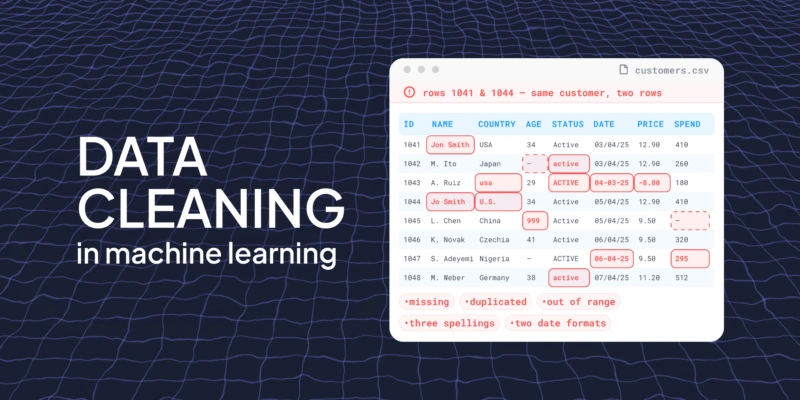
An electronic health record (EHR) — the digital version of a patient's chart, covering diagnoses, medications, lab results, and visit notes — is the most common source, and by 2024 nearly all non-federal acute care hospitals in the US had adopted one [1]. That near-universal adoption is also why EHR data is messier than it looks on paper: formats, code sets, and documentation habits vary by hospital system, so "pull the EHR data" rarely means a clean export.
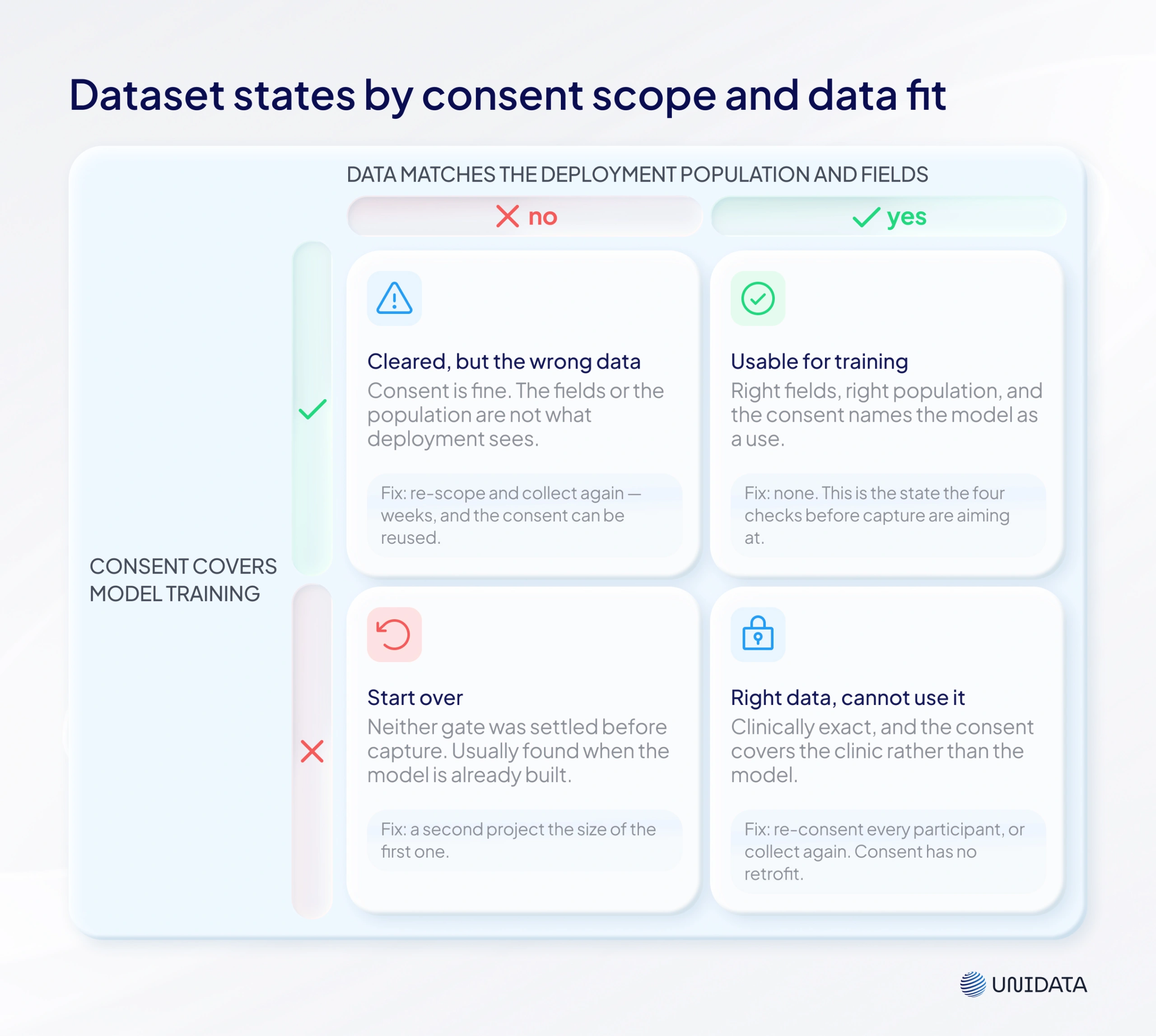
What collected medical data becomes depends on the destination. Packaged and labeled for model development, it's healthcare training data — the form machine learning systems consume to learn diagnostic, predictive, or monitoring tasks. The distinction matters early: a dataset built for a dashboard and a dataset built for model training need different fields, different consent scope, and different annotation depth, even when they're pulled from the same EHR.
Types of medical data and collection sources
The first confusion on most projects isn't technical — it's that "medical data" means at least four different things depending on who wrote the project brief. An electronic health record (EHR) contributes structured fields (lab values, billing codes, vital signs) and unstructured text (clinician notes, discharge summaries) in the same system. Medical imaging and wearable device streams sit outside the EHR entirely, with their own formats and collection paths. Knowing which type a project actually needs — before sourcing starts — avoids weeks of rework later.
Increasingly, none of these sources stand alone. Multimodal data — imaging paired with structured EHR fields, or device telemetry paired with clinical notes — is becoming the standard input for models that need more context than a single source provides, particularly in diagnostic and monitoring applications.
Structured EHR data and unstructured clinical notes
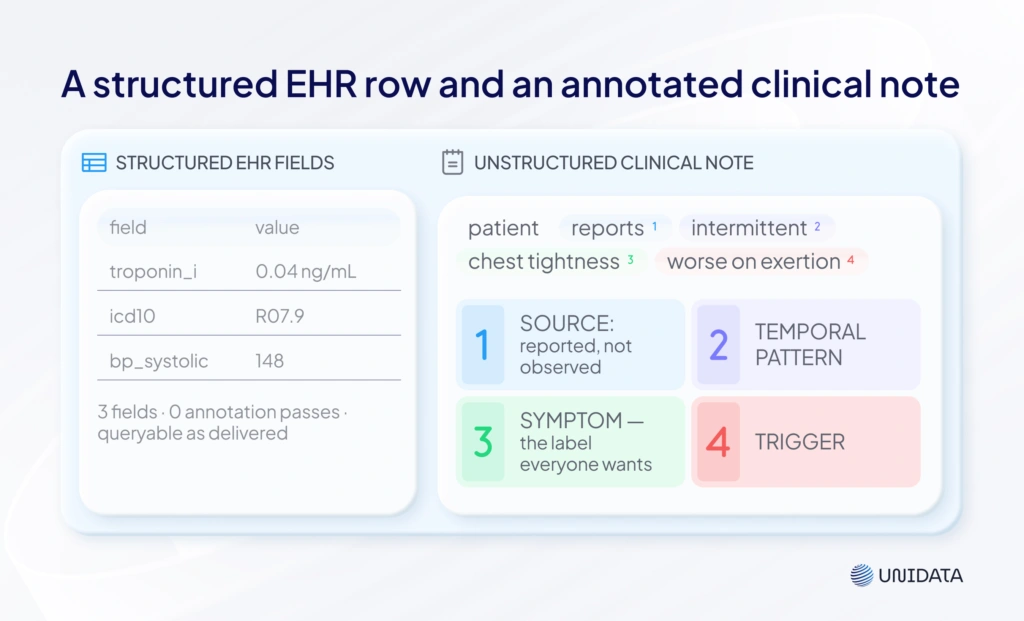
Structured EHR fields — lab results, diagnosis codes, vitals — are the easy half of the record: tabular, queryable, ready for analysis with minimal preprocessing. The harder half is unstructured: physician notes, discharge summaries, and free-text observations that carry clinical detail no structured field captures, like a symptom description or a clinician's reasoning.
That unstructured share only becomes usable healthcare training data after data annotation — a human or model-assisted pass that extracts entities (symptoms, medications, diagnoses) from free text and converts them into structured labels a model can train on. A note that says "patient reports intermittent chest tightness, worse on exertion" has to be annotated before a model can use it; the raw sentence isn't a feature.
Medical imaging, wearable and sensor data
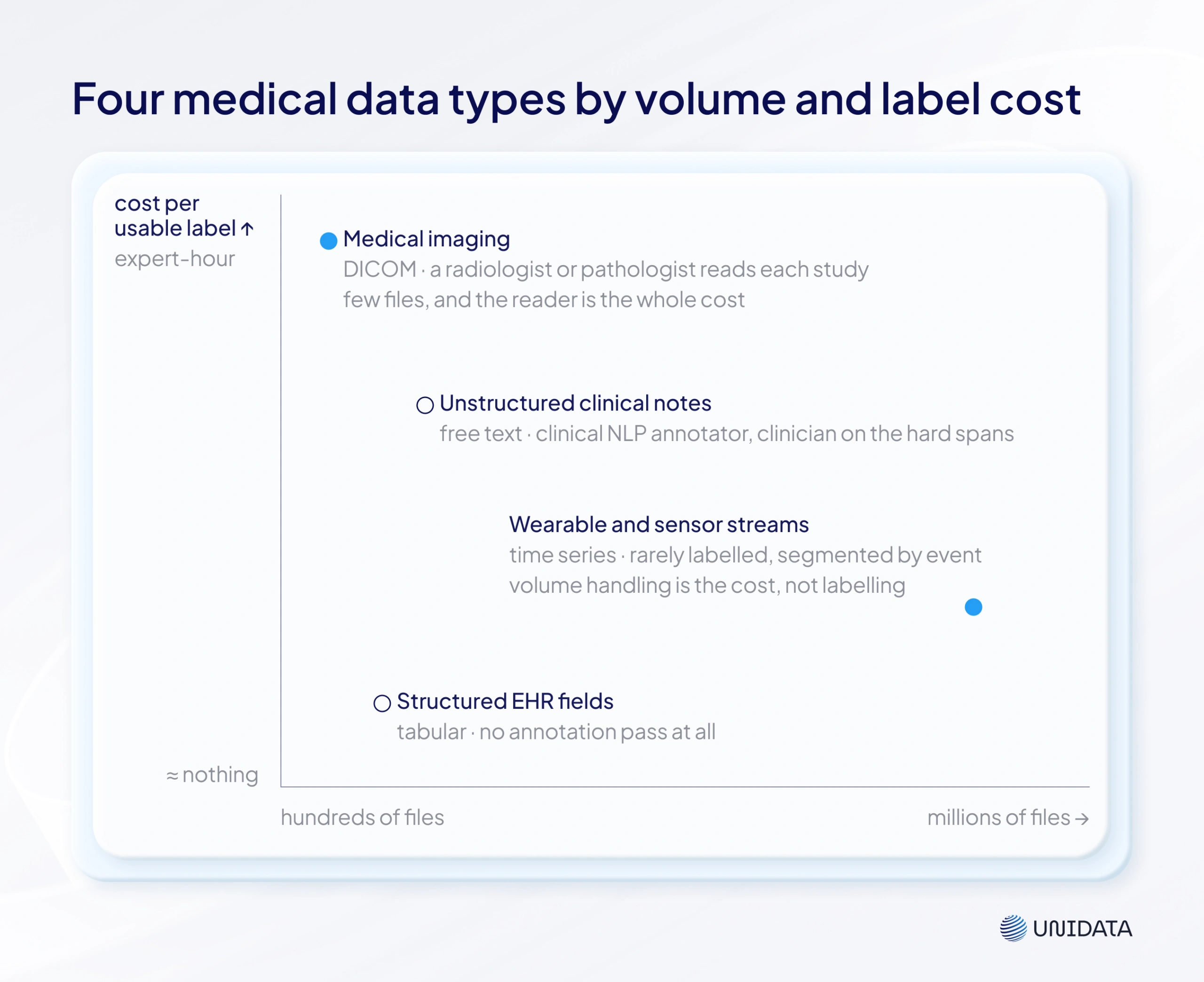
Medical imaging — X-ray, CT, MRI, pathology slides — is the data type behind most computer-vision healthcare models, and it comes with a cost structure unlike tabular data: large file sizes, specialized formats like DICOM, and annotation that often needs a radiologist or pathologist rather than a general-purpose labeler.
Wearable device data — continuous glucose monitors, ECG patches, pulse oximeters — works on the opposite cost curve: cheap to generate, high in volume, and continuous rather than point-in-time. The FDA's 2024 clearance of an over-the-counter continuous glucose biosensor signals where this is headed — wearable streams moving from research tool to consumer-grade clinical data source [2]. Both source types ultimately feed the same machine learning systems, just at different ends of the volume-versus-annotation-cost spectrum: imaging needs expensive expert labels on fewer files; wearables need volume-handling pipelines for continuous streams.
Methods for collecting medical data
Every project hits the same fork early: collect new data directly, or repurpose data that already exists. Primary data collection means gathering new data designed around the project's exact requirements — through surveys, device telemetry, or observation. Secondary data means using records, registries, or public datasets gathered for some other original purpose. Defaulting to one path without checking cost, consent burden, and timeline against the other is the most common planning mistake on medical AI projects. A clinical trial is the clearest example of primary collection done at scale — every data point is gathered for that study, under that study's consent terms, on that study's schedule.
Primary data collection methods
Primary data collection covers surveys, structured interviews, direct clinical observation, and device telemetry gathered specifically for the project at hand. It is slower and costlier than reusing existing records, but it produces data matched exactly to the study's population, format, and clinical question — no retrofitting a dataset that was built for something else.
Informed consent governs nearly every primary method: participants must understand and agree to what's collected and how it will be used before collection starts, and that consent scope has to cover the eventual AI training use, not just the clinical purpose.
Secondary data and public medical datasets
Secondary data is faster and cheaper because someone already did the collection work. Public medical dataset repositories make this concrete: MIMIC-III, the critical-care database from MIT's Laboratory for Computational Physiology, covers over 53,000 ICU admissions with vitals, medications, and clinical notes, available after researchers complete a HIPAA-focused training course and sign a data use agreement [3]. The Cancer Imaging Archive (TCIA), funded by the National Cancer Institute, hosts more than 30 million radiology images across roughly 37,500 subjects, and most collections are downloadable without an account [4].
The catch is data governance: access tiers, use agreements, and citation requirements that practitioners tend to underestimate when budgeting timelines. A use agreement that takes three weeks to clear can erase the speed advantage secondary data was supposed to provide. For teams deciding whether to build a custom dataset or license an existing one, the public-dataset route works well for early prototyping; production systems usually still need data scoped to the deployment population.
Medical data collection for AI and robotics
Garbage in, garbage out applies with unusual force in clinical AI: a model trained on narrow or biased data doesn't just underperform, it can misdiagnose. Healthcare training data is the AI-specific packaging of collected medical data — cleaned, labeled, and sampled with the downstream machine learning task in mind, not just stored. The same underlying pipelines are now also feeding medical robotics, a newer consumer of medical data collection with its own requirements.
Regulators are starting to treat that data quality question as a review criterion rather than an afterthought: FDA guidance for AI-enabled medical devices now covers lifecycle data management and bias mitigation as part of marketing submissions [10], building on broader Good Machine Learning Practice principles for how training data should be governed across a device's life [11].
Building training data for healthcare AI models
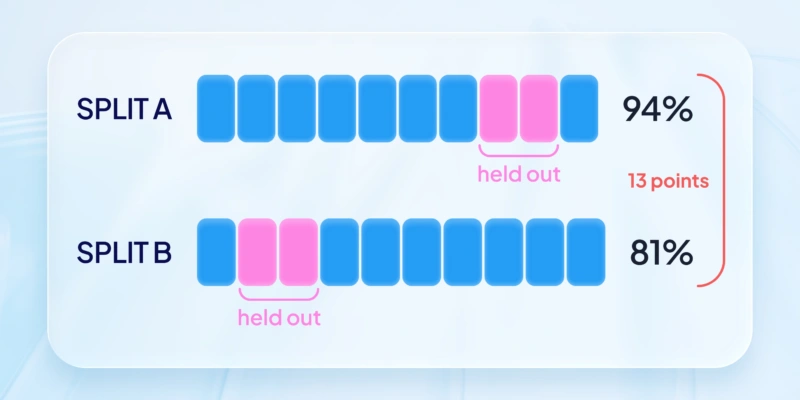
Raw collected data becomes healthcare training data through data annotation, expert review, and deliberate sampling across demographics — not just volume. Skipping the demographic step doesn't show up until deployment: models that look accurate in aggregate testing can fail badly on subgroups that were thin in the training set.
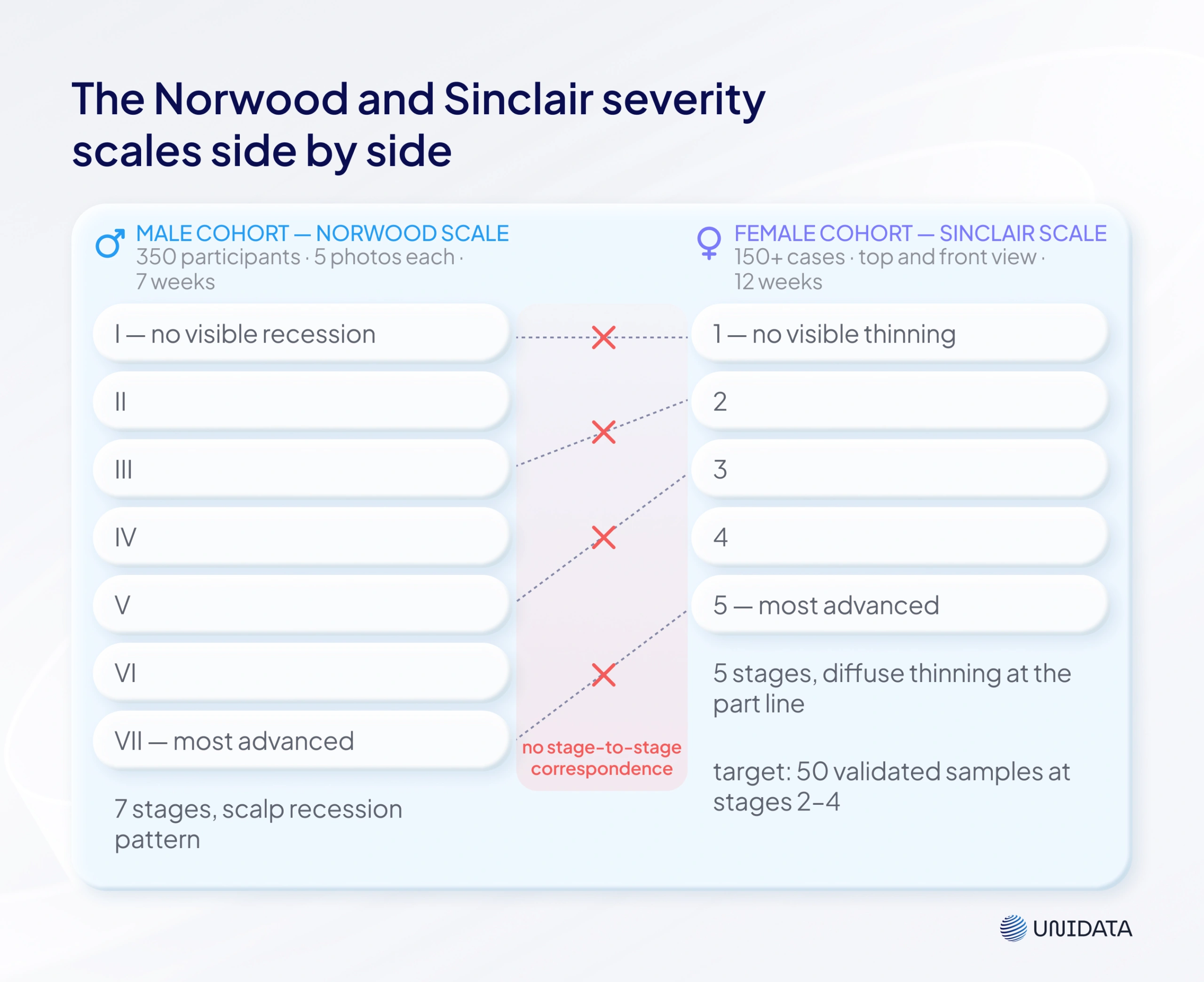
Unidata's clinician-labeled alopecia datasets were built as separate male and female cohorts — 350 male and over 150 female participants — specifically so a severity-grading model wouldn't be trained mostly on one population and asked to generalize to the other. How much training data a healthcare model actually needs depends more on how evenly that data covers the relevant subgroups than on raw row count.
Data collection for medical robotics and physical AI
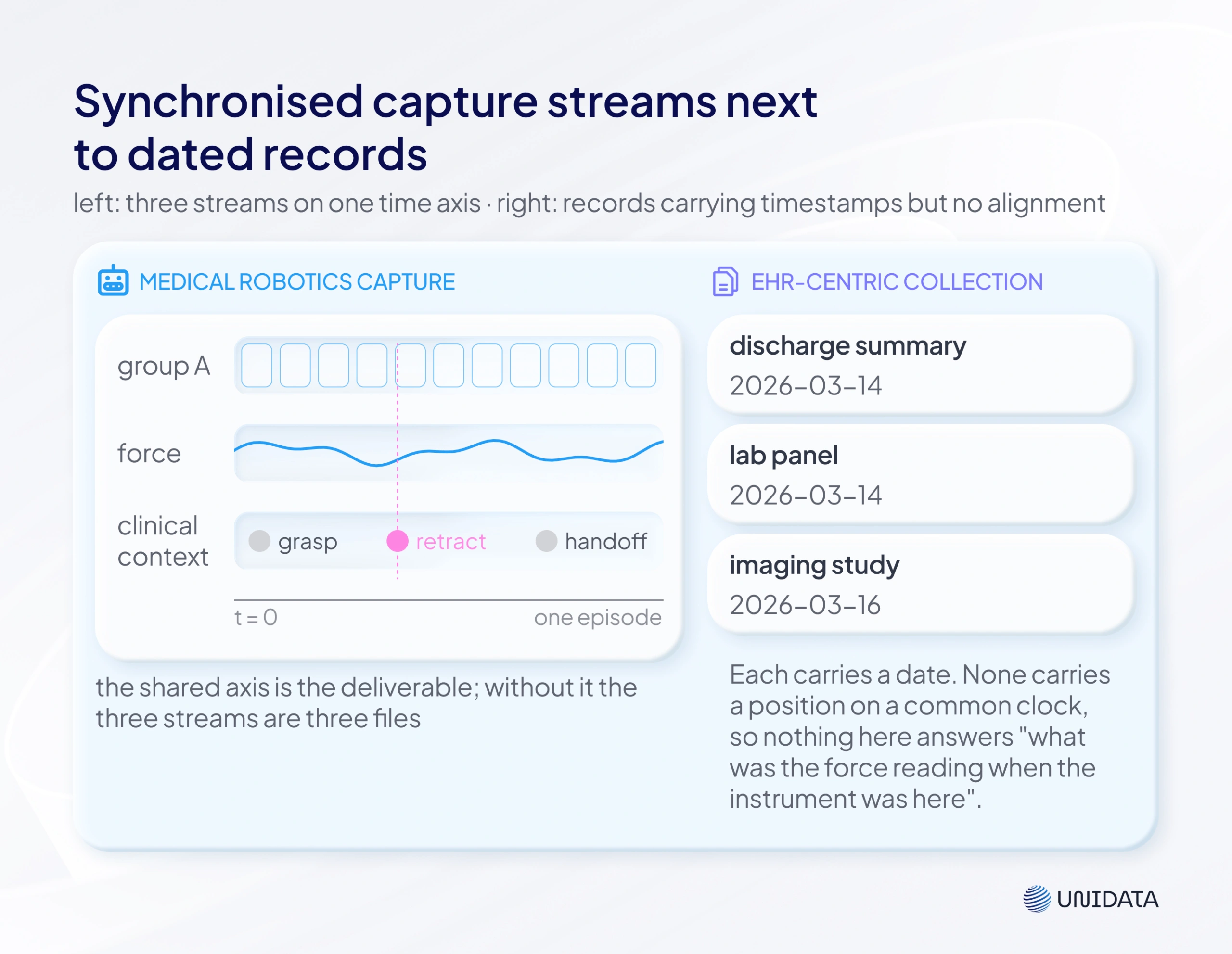
Surgical robots, autonomous diagnostic devices, and assistive robotics need a different kind of input than EHR-centric collection: multimodal data that synchronizes vision, force or sensor readings, and clinical context in real time, rather than static records reviewed after the fact. A model trained mostly on simulated motion still tends to misjudge real tissue resistance, real lighting, and real instrument drift once it leaves the simulator — the sim-to-real gap that robotics research consistently documents as the main obstacle to deploying policies trained primarily in simulation [5].
Privacy, compliance and ethical requirements
A dataset that can't legally be collected or shared is unusable, no matter how clean it is — which makes compliance a collection-stage decision, not a legal review bolted on afterward. For US-based projects, the Health Insurance Portability and Accountability Act (HIPAA) sets the baseline: its Safe Harbor method requires stripping 18 specific identifier categories — names, precise dates, contact details, device IDs, and more — before health information counts as de-identified [6].
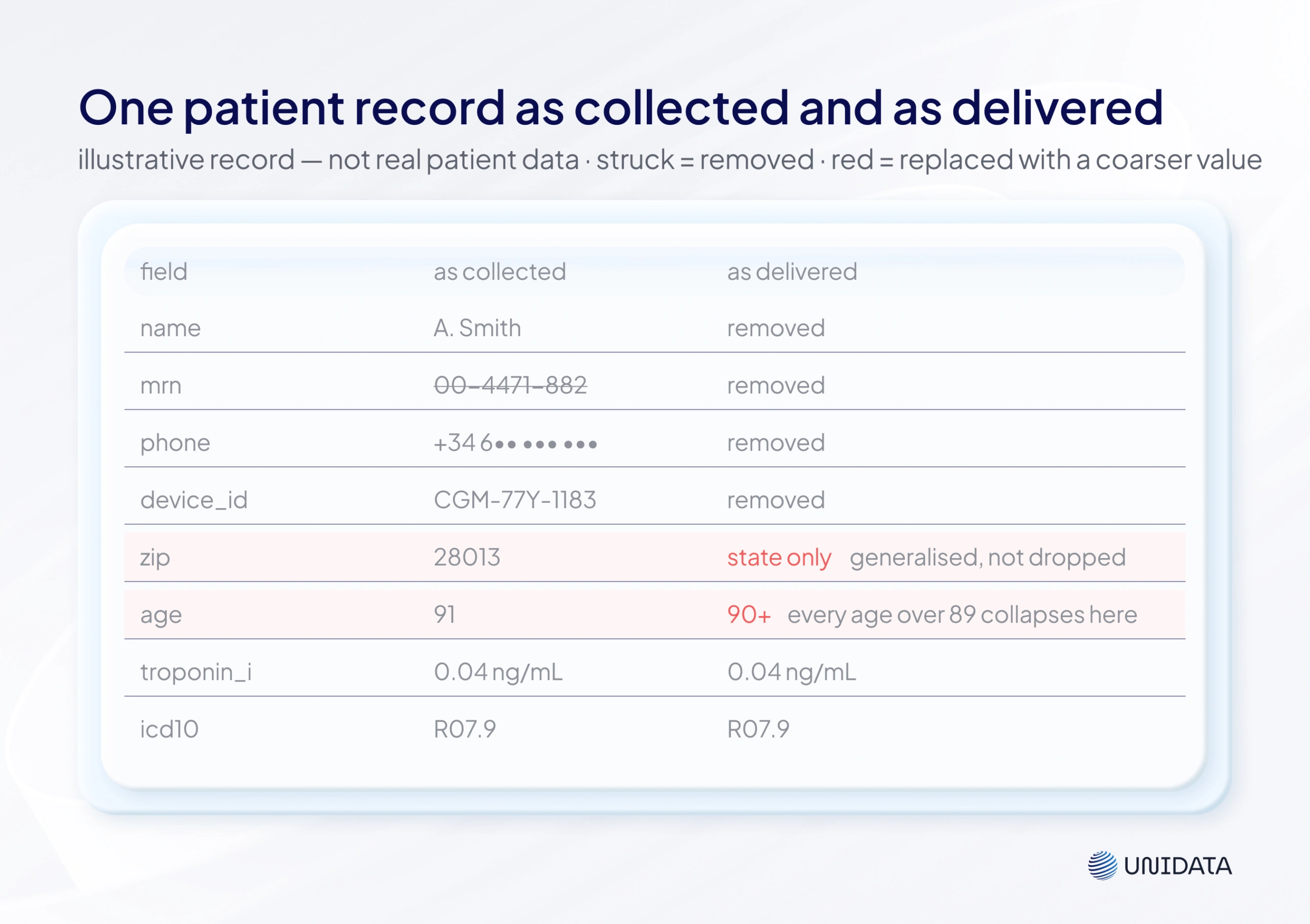
Data anonymization is the technical step that satisfies that requirement: removing or generalizing the listed identifiers so what remains can't reasonably be traced back to a patient. For projects touching EU subjects, the General Data Protection Regulation (GDPR) adds a second layer — Article 9 classifies health data as a special category, processable only under one of ten specific legal grounds, on top of the general lawful-basis requirement that applies to all personal data [7]. Underneath both frameworks sits informed consent: what participants agreed to at collection time sets the ceiling for what the data can be used for later, including AI training that wasn't necessarily part of the original clinical purpose.
Ensuring data quality and reducing bias
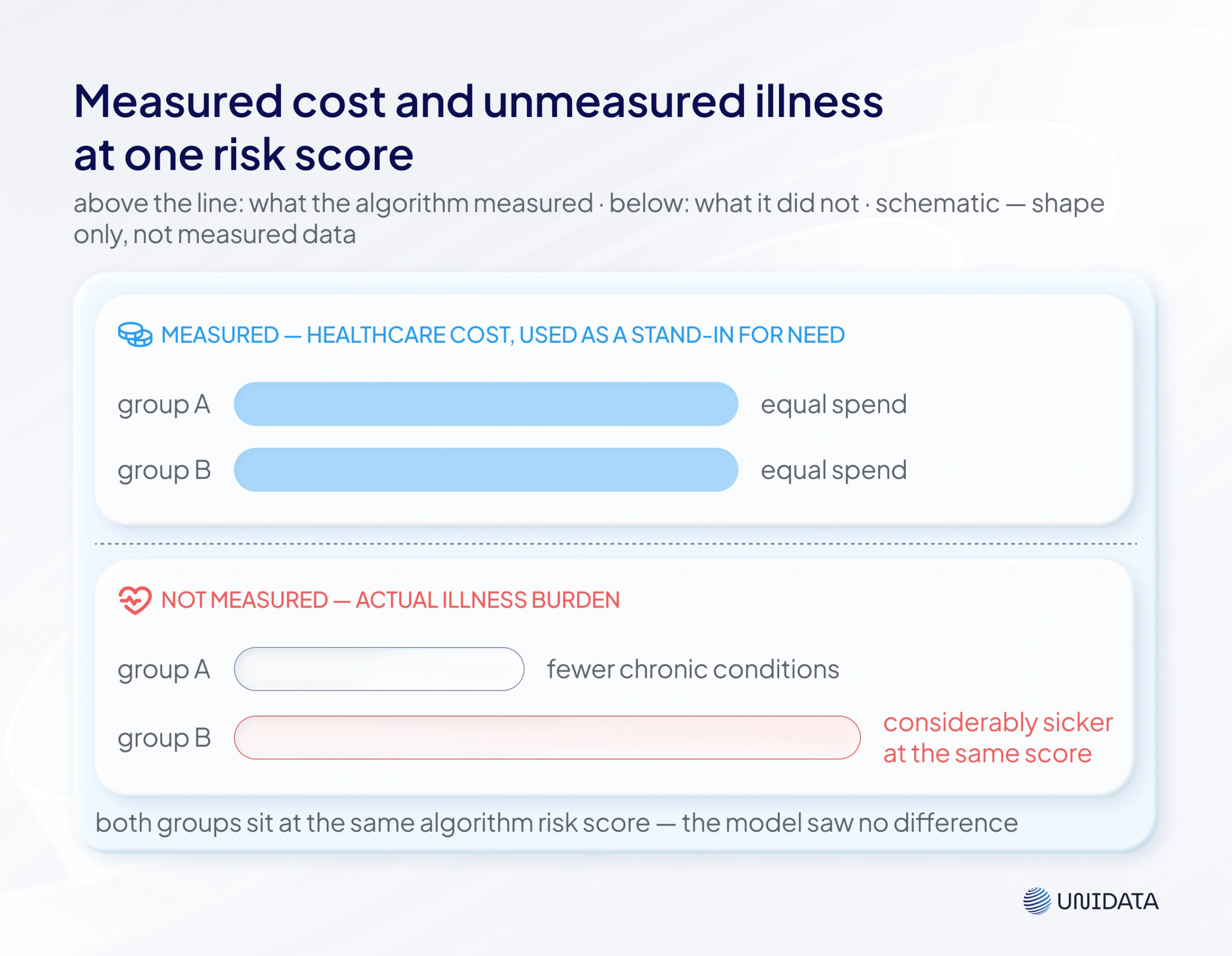
A 2019 study in Science found that a healthcare algorithm used to manage care for millions of patients systematically underestimated how sick Black patients were, because it used healthcare cost as a stand-in for healthcare need — and cost reflects unequal access, not actual illness [8].
The bias didn't originate in the model; it originated in what the training data was allowed to measure. That is the core argument for treating demographic and clinical-subgroup coverage as a collection-stage decision rather than a fairness metric checked after the fact.
Synthetic data — algorithmically generated records that mimic real patient data — can supplement collection for rare conditions or thin subgroups, but it has a well-documented failure mode: generative models trained on biased or narrow source data tend to reproduce or amplify that same bias in the synthetic output, and recent research treats synthetic data as an option of last resort rather than a substitute for representative collection [9]. Used honestly, it fills gaps; used as a shortcut around real collection, it just launders the same bias into a larger dataset.
Common challenges and best practices
Three obstacles show up across nearly every medical data collection project, and each has a fix already covered above rather than a new piece of advice. Interoperability gaps between EHR systems — different code sets, different documentation habits — are why a multi-site project needs standardized schemas agreed before collection starts, not after the first data dump arrives unusable. Inconsistent labeling standards across sites or annotators are why expert-reviewed, multi-tier annotation matters more than annotator headcount; a structured review pass (labeler, then reviewer, then a final QA check) catches the disagreements a single annotation pass misses. Slow data governance approval for public medical dataset access is why teams budget weeks, not days, for use-agreement review when planning around secondary data.
None of these are solved by working faster — they're solved by sequencing compliance and quality decisions before collection starts, which is the throughline of every section above.
Conclusion and next steps
Reliable medical data collection — the right type, the right method, cleared compliance, checked for bias — is the prerequisite for healthcare training data that a machine learning system can actually be trusted on. Skip any one of those four and the gap shows up later, usually in production, where it's far more expensive to fix.
The practical next step is rarely "start collecting." It's auditing an existing dataset against the compliance and bias checklist covered above, or piloting on a public dataset like MIMIC-III or TCIA before committing budget to primary collection. If that audit turns up a gap that needs clinician-graded imaging or consent-based participant recruitment, start here.
Frequently Asked Questions (FAQ)
Medical data collection is the systematic gathering of patient and clinical information — from electronic health records, medical devices, imaging systems, and direct observation — into a dataset structured for analysis or AI model training. It covers everything from a single clinical trial’s survey data to large-scale EHR extraction for population health research. The format and method depend on whether the end use is reporting, research, or training a machine learning model.
The main types are structured EHR data (lab values, codes, vitals), unstructured clinical text (notes, discharge summaries), medical imaging (X-ray, CT, MRI, pathology), wearable and sensor data (continuous glucose monitors, ECG patches), and increasingly multimodal combinations of these. Each type has different formats, volumes, and annotation requirements, so most healthcare AI projects need more than one.
Primary data collection gathers new data designed specifically for a project — through surveys, interviews, or device telemetry — under that project’s own consent terms. Secondary data reuses existing records, registries, or public datasets originally collected for another purpose. Primary collection costs more and takes longer but matches the project exactly; secondary data is faster but comes with access and licensing constraints.
Yes, for any project involving identifiable US patient data. HIPAA’s Privacy Rule governs how protected health information can be used and disclosed, and its Safe Harbor method specifies 18 identifier categories that must be removed before data counts as de-identified and exempt from those restrictions. Projects involving EU patients also need to satisfy GDPR’s separate special-category rules for health data.
The most common approach is HIPAA’s Safe Harbor method: removing or generalizing all 18 listed identifier categories, including names, exact dates, contact details, and device or account numbers, so the remaining data can’t reasonably identify a patient. Geographic detail is reduced to state level in most cases, and ages over 89 are grouped into a single “90+” category rather than reported exactly.
Widely used public datasets include MIMIC-III (ICU admissions with vitals, notes, and outcomes from a Boston teaching hospital) and The Cancer Imaging Archive (over 30 million cancer radiology images). Both require a formal access process — MIMIC-III requires completing a human-subjects research course and signing a data use agreement, while most TCIA collections are downloadable without an account.
There’s no fixed number — it depends far more on how well the data covers the relevant clinical subgroups than on row count. A dataset with even, balanced coverage of the populations and conditions a model will see in deployment can outperform a much larger dataset that’s concentrated in one demographic or one disease severity level.
Data annotation converts raw clinical material — free-text notes, images, sensor readings — into structured labels a model can train on. For text, that means extracting symptoms, diagnoses, and medications from notes; for imaging, it often means expert grading by a clinician rather than a general-purpose labeler. Without annotation, most collected medical data isn’t usable for supervised model training.
Medical robotics needs multimodal, time-synchronized data — vision, force or sensor readings, and clinical context captured together in real time — rather than static records reviewed afterward. This supports perception and control tasks like tissue manipulation or instrument tracking, where a model trained mostly in simulation tends to underperform once deployed on real hardware, a gap known as the sim-to-real problem.
The recurring challenges are interoperability gaps between EHR systems, inconsistent labeling standards across sites, and slow approval cycles for accessing public or institutional datasets. Each is best addressed before collection starts: agreeing on a standardized schema across sites, using multi-tier annotation review, and budgeting realistic time for data governance and use-agreement approval.
Bias reduction works best as a collection-stage decision: deliberately sampling across demographic and clinical subgroups rather than checking for imbalance after the model is trained. Stratified collection, expert-reviewed annotation, and treating synthetic data as a supplement rather than a substitute for underrepresented groups all reduce the risk of a model that performs well in aggregate but fails on populations it rarely saw in training.
Further Reading & References:
- [1] ASTP/ONC Health IT — "Non-federal Acute Care Hospital Electronic Health Record Adoption" — healthit.gov — 2024
- [2] U.S. Food and Drug Administration — "FDA Approves First Continuous Glucose Monitoring System with a Fully Implantable Glucose Sensor" — Press Announcement — 2024
- [3] Johnson, A.E.W., Pollard, T.J., Shen, L., et al. — "MIMIC-III, a freely accessible critical care database" — Scientific Data / PMC — 2016
- [4] The Cancer Imaging Archive — "About The Cancer Imaging Archive (TCIA)" — National Cancer Institute — 2026
- [5] "The Reality Gap in Robotics: Challenges, Solutions, and Best Practices" — arXiv — 2026
- [6] U.S. Department of Health and Human Services — "Guidance Regarding Methods for De-identification of Protected Health Information in Accordance with the HIPAA Privacy Rule" — HHS.gov
- [7] "Art. 9 GDPR – Processing of special categories of personal data" — gdpr-info.eu
- [8] Obermeyer, Z., Powers, B., Vogeli, C., Mullainathan, S. — "Dissecting racial bias in an algorithm used to manage the health of populations" — Science — 2019
- [9] United Nations University — "Algorithm Bias — Synthetic Data Should Be Option of Last Resort When Training AI Systems" — unu.edu — 2026
- [10] U.S. Food and Drug Administration — "Artificial Intelligence in Software as a Medical Device" — FDA.gov
- [11] U.S. Food and Drug Administration — "Good Machine Learning Practice for Medical Device Development: Guiding Principles" — FDA.gov