The Problem
A person who falls in a public space does not always receive help, because passers-by often cannot tell what happened. A city camera that recognizes the fall and triggers an ambulance call could save lives, and fall detection is one of the first tasks proposed for CCTV analytics. The limiting factor is data. A recent systematic review of vision-based fall detection found that all reviewed datasets were recorded in controlled settings, with every fall simulated by young volunteers. Footage of real falls, where it exists, is confidential, limited in variability and ethically problematic to collect. A scoping review adds that simulations do not cover the wide range of real-world scenarios, and detectors tested on real data perform poorly.
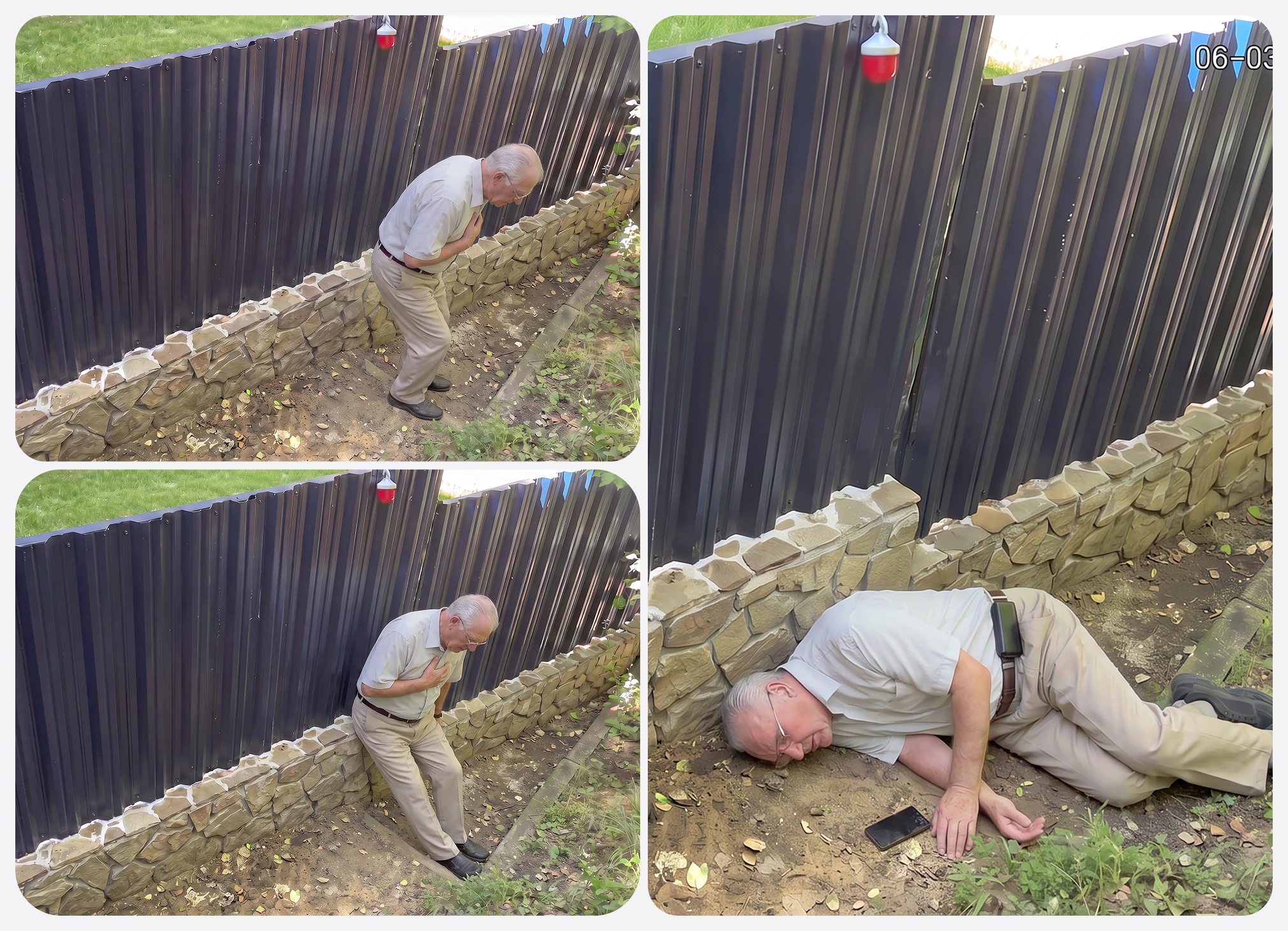
Unidata is closing this gap with data built for public safety and emergency response. Because real falls are out of reach, we staged them in volume to match what a city camera sees: mounted high, at a distance, in different places, lighting and clothing, under one specification across the whole collection.
Solution
The work split into two parallel streams:
Fall scenarios. Falls with and without support, including trips, each ending with a person lying or sitting in the frame.
Capture conditions. A fixed camera at 3 meters, a controlled subject distance, and quotas for locations, lighting and clothing.
Scenario Design
Every recording follows a scenario agreed in advance: from which side the performer enters, how the fall happens and what the person wears. The final state, a person lying or sitting, is part of every clip, so the model sees both the transition and its outcome. Clips run about 20 to 30 seconds. Fall types (with support, without support, trips) are recorded in the metadata so that classes can be evaluated separately.
Capture Setup
Footage is recorded on an iPhone 14 in landscape orientation at 1920x1080 and 30 frames per second, with the camera kept as level as possible. It is mounted at 3 meters, the height of a typical city camera, and the fall happens 3 to 5 meters from it. A camera at that height cannot be started by hand, so the operator fixes it, starts recording from a second device and then gives the cue to the performers.
Variety Control
A model trained on falls from a few places and a few outfits learns those places and outfits, so variety is planned through quotas rather than left to chance:
- 1,047 videos recorded at about 40 to 50 locations: 30% parking areas, 40% rooms, 30% corridors
- lighting split 60% daylight and 40% evening, dusk or streetlight, which adds the lower-light conditions that real cameras face
- performers change clothes every 10 videos
Locations and scenarios are selected before each trip, and a dedicated team under a team lead travels with the equipment to each site.
Annotation and Metadata
Delivery includes metadata with fall types, timestamps of the target action and blurred faces of bystanders, since footage cannot be shared without blurring.
Link to Detection Logic
For a detector, a fall is a bounding box that changes from vertical to horizontal. The start of that transition is the anchor point, and the time a person stays down can serve as an escalation trigger. The dataset is built around both, which gives the client capabilities that a generic action dataset does not offer:
- train and test detection of the vertical-to-horizontal transition across locations and lighting
- evaluate falls with support, without support and trips as separate classes
- set escalation thresholds based on how long a person stays down
- check that a model does not depend on one background, outfit or location
| Phase | Input | Scope of Work | Quality Control |
|---|---|---|---|
| Preparation & Scenario Design | Client requirements, fall types, target mix of locations | Scenario scripts, entry sides, clothing plan, equipment checklist | Coverage of fall types, quota plan for locations, lighting and clothing |
| Pilot Recording | Test locations, performers | Trial clips at each location type (parking, room, corridor), check of camera height and distance | Fall visible in frame, final position lying or sitting, image sharpness |
| Main Collection | iPhone 14 at 3 m, second device for remote start | Recording per scenario at 3 to 5 m, 60% daylight and 40% evening or dusk | Quota tracking, clothing change every 10 videos |
| Annotation | Raw clips | Fall type metadata, action timestamps, face blurring | Label consistency, all bystander faces blurred |
| Delivery | Validated videos and metadata | Packaging with format documentation | Spec compliance (1920x1080, 30 FPS), counts match quotas |
The Results
- 1,047 videos of falls with and without support, including trips, ending with a lying or sitting person
- 40 to 50 locations across parking areas, rooms and corridors
- one consistent specification: iPhone 14, 1920×1080, 30 FPS, camera at 3 m
- daytime and evening footage in a 60/40 split, with clothing changes every 10 videos
- metadata with fall types and action timestamps
- a repeatable collection process that follows one scenario template
When someone falls on a street, passers-by often hesitate because they cannot tell what happened. A camera that recognizes the fall and calls an ambulance does not hesitate. That is the practical reason behind this dataset: we wanted to give models enough varied examples to recognize the moment someone needs help.

- Elizabeth Karnaukhova
- Datamarket Project Manager