The Problem
Fire detection on video has to work on scenes that public datasets barely represent. A survey of AI smoke and fire systems puts false alarm rates between 3.4% and 29.49% across systems and lists dataset scarcity and environmental variability among the key challenges. A review of 153 papers and 17 public datasets finds that most datasets are not demanding enough to test real-world performance, and that most videos start with a fully developed fire, so early detection and detection delay cannot be verified.
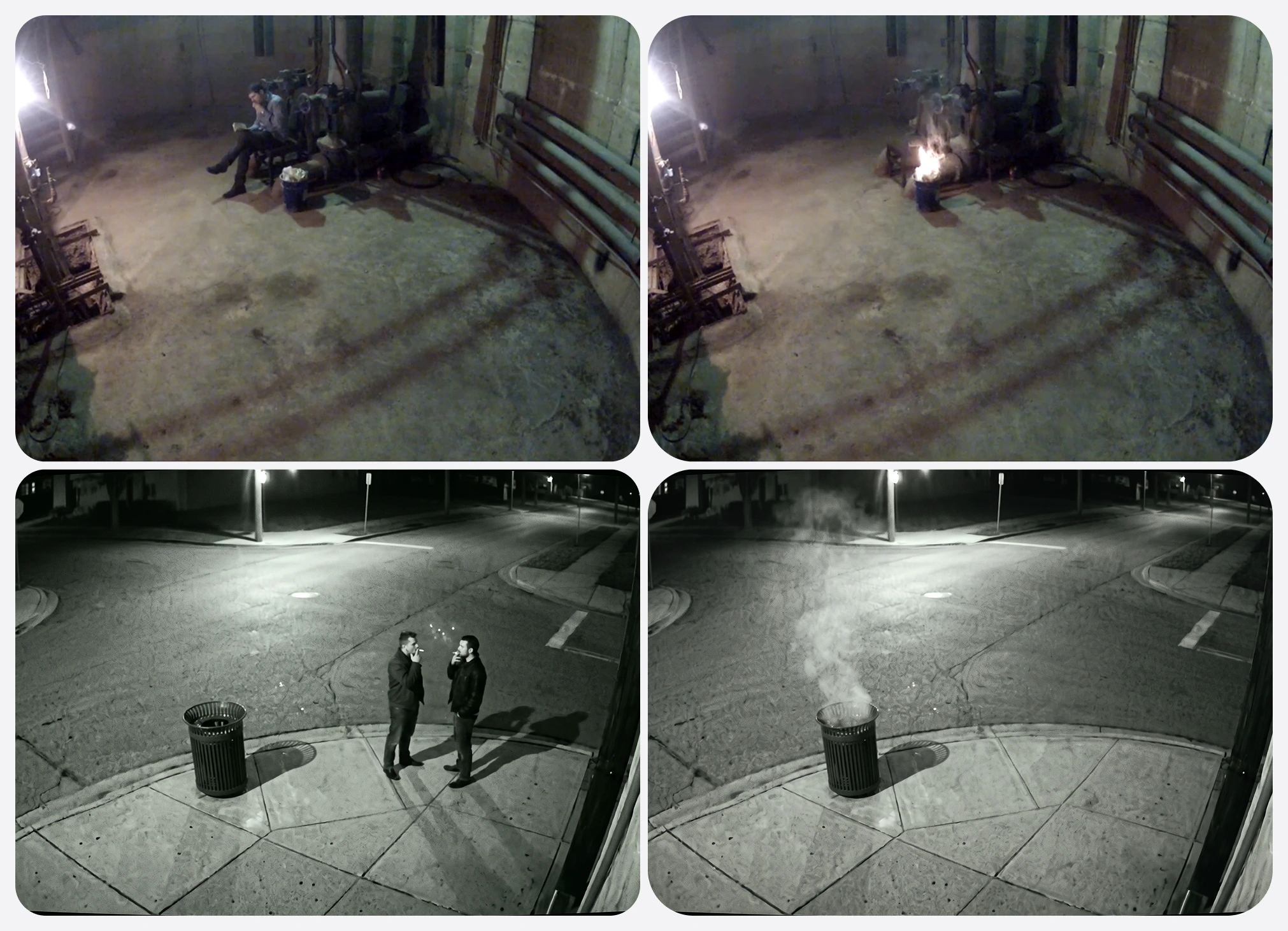
Unidata is closing this gap with data built for public safety systems, where every minute of a fire counts and distance changes what a camera sees first: nearby flames are visible from ignition, while from far away a smoke column often appears before the flame. We recorded footage that matches what an outdoor camera sees, mounted high, near and far, at different times of day and in many places, under one specification.
Solution
Scene Design
Each clip centers on one event a camera must catch: open flame or smoke at an outdoor site. Flame and smoke are filmed as separate subjects, since their appearance and the way they trigger detection differ. Night clips carry flame only.
Capture Setup
The iPhone 14 records in landscape at 1920x1080 and 25 to 30 FPS, held as level as possible on a 3 meter mount, close to typical CCTV height. Every scene is shot from two positions. At close range (3 to 5 meters) flame is visible from its earliest stage, and at far range (10 to 15 meters) the model learns to rely on smoke when flame is not yet visible.
Variety Control
A model trained on a handful of sites learns those sites, so variety is set by quotas rather than left to chance:
- 292 videos across 37 outdoor locations
- 52% daylight, 32% evening or dusk, 16% night (flame only)
- open-air recording, where smoke drifts and spreads with wind and weather in a way indoor sets cannot reproduce
- sites chosen ahead of each trip by a dedicated team that brings and installs the equipment
Annotation and Metadata
Every delivery carries timestamps of the target event and blurred faces of any bystanders, since footage cannot be shared without blurring. In the planned extension to individual objects, the metadata will name each object so its material can be identified.
Link to Detection Logic
For a CCTV system, flame and smoke are two separate triggers for sending a response service. The collection is organized around both, which lets a client:
- train and evaluate flame and smoke as separate classes at near and far range
- test whether a model holds from day to evening to night
- measure false alarm behavior against 37 different backgrounds
- expand training to individual objects, since each material burns with its own flame shape and smoke
| Phase | Input | Scope of Work | Quality Control |
|---|---|---|---|
| Site scouting | Client requirements, target mix of locations and lighting | Location list, shooting windows by time of day | Quota plan for locations and lighting |
| Setup and test shots | Selected site, iPhone 14 on a 3 m mount | Framing at close and far positions, check of image sharpness | Flame or smoke clearly visible at both distances |
| Recording windows | Approved sites | Recording at 3 to 5 m and 10 to 15 m, day, evening and night | Quota tracking: 52% day, 32% evening, 16% night |
| Review and annotation | Raw clips | Event timestamps, face blurring, object metadata for the extension | Label consistency, all bystander faces blurred |
| Handoff | Validated videos and metadata | Packaging with format documentation | Spec compliance (1920x1080, 25 to 30 FPS), counts match quotas |
The Results
- 292 outdoor fire and smoke videos from 37 locations
- two camera positions, 3 to 5 meters and 10 to 15 meters, with the camera at 3 meters
- 52/32/16 split between day, evening and night, with flame only after dark
- one specification throughout: iPhone 14, 1920×1080, 25 to 30 FPS
- event timestamps and blurred bystander faces in every delivery
A fire in a warehouse can end a business, so the first minutes decide everything. A vision model can add an earlier visual signal, but only if it has seen fire in many conditions, at different distances and times of day. That is exactly what we built this dataset to provide.

- Kirill Meshyk
- Head of Data Collection