
Video Annotation for Ore Detection
We helped a mining company train a model to detect ore granularity and oversized fragments directly from conveyor belt video streams—reducing processing delays and removing the need for internal QA involvement.
The Task
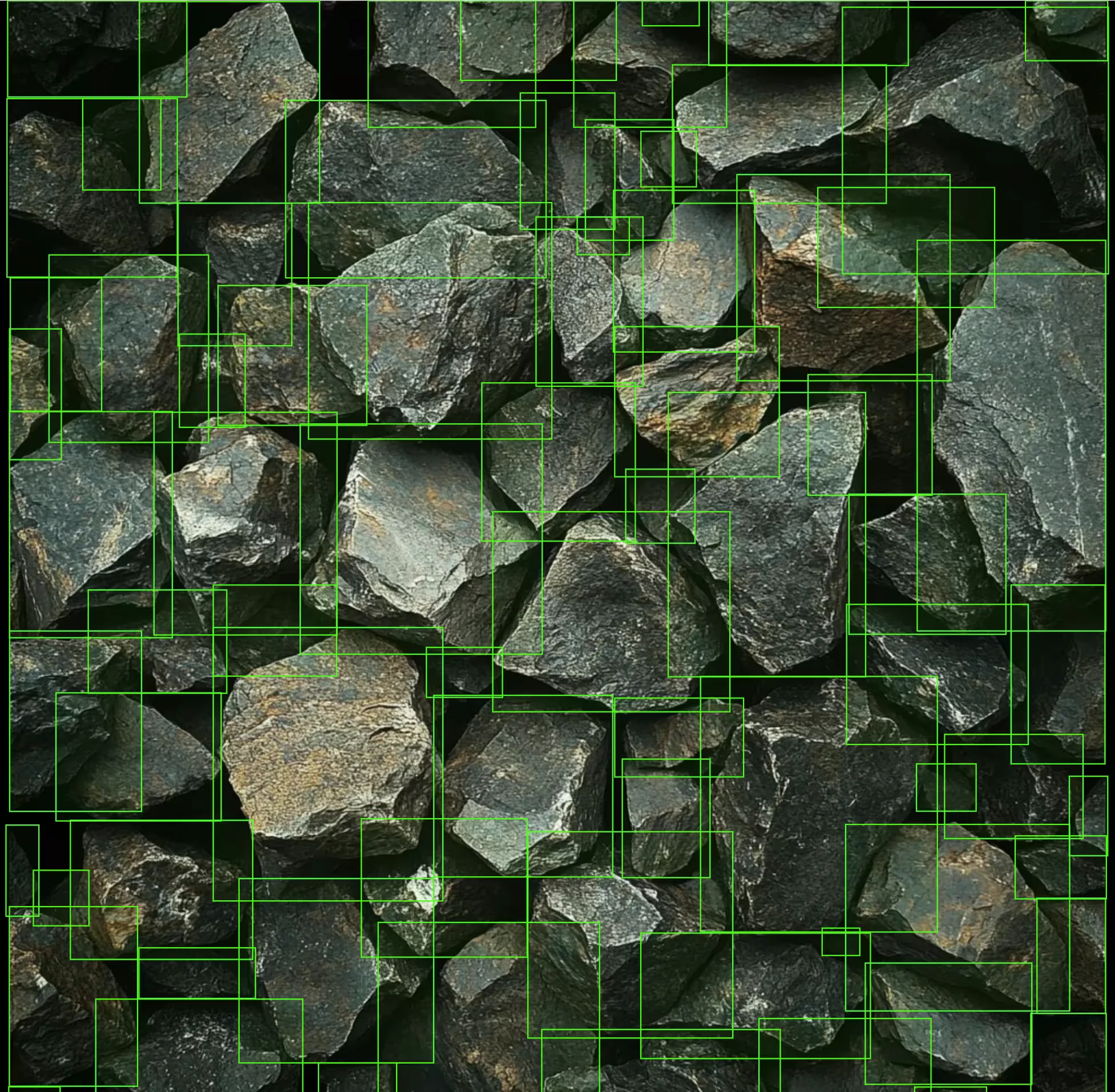
The client required annotated video data to train a model capable of detecting ore fragment sizes and identifying oversized pieces in real time on a conveyor belt.
The main challenge was handling dense scenes with multiple moving objects, where each frame required precise polygon-based annotation. Previous vendors failed to ensure consistent validation, forcing the client to rely on their internal team.
The deadline was strict: the full annotation and QA cycle had to be completed within 1.5 weeks.
The Solution
We designed a high-speed video annotation pipeline with strong QA control:
Rapid Team Setup & Workflow Optimization:
We assembled a team of 13 annotators within 24 hours. Due to heavy polygon load per frame, we split video frames into segments, annotated them separately, and merged them for final validation.
Frame-by-Frame Annotation:
Each frame was annotated with detailed polygons to capture ore fragments and identify oversized pieces, ensuring temporal consistency across sequences.
Multi-Level Validation:
Each batch passed through several QA layers. Feedback loops between annotators and validators were minimized through direct communication, while internal experts handled all edge cases.
| Stage | Input | Workflow Scope | Main Quality Checks |
|---|---|---|---|
| Requirements Alignment | Client goals, conveyor belt videos | Definition of object classes and size criteria | Clarity, edge cases, feasibility |
| Workflow Optimization | Raw video data | Frame splitting, workload distribution | Processing speed, system stability |
| Frame Annotation | Video frames | Polygon annotation of ore fragments | Boundary accuracy, temporal consistency |
| Validation | Annotated sequences | Multi-level QA, batch review | Frame-to-frame consistency, error rate |
| Final QA | Validated dataset | Merging segments, dataset delivery | Completeness, client acceptance |
The Results
- Full annotation and validation completed in 1.5 weeks
- No need for client-side QA or annotation involvement
- Production-grade dataset delivered with high consistency and accuracy
Video annotation for industrial environments demands consistency across frames and precise handling of moving objects. High-quality datasets depend on optimized workflows, frame-level accuracy, and tightly integrated quality control.

- Roman Lukoshin
- Speech and Generative Data Manager